Neanderthal Dentist: 59,000-Year-Old Molar Reveals Surgery
An international team of anthropologists has uncovered the oldest known evidence of invasive medical treatment — a Neanderthal who underwent a primitive root canal procedure approximately 59,000 years ago in what is now southwestern Siberia. The discovery, published in PLOS One, pushes back the timeline of deliberate dental surgery by more than 40,000 years and challenges long-held assumptions about Neanderthal cognitive capabilities.
The tooth, designated Chagyrskaya 64, was unearthed from Chagyrskaya Cave in the Altai Mountains of Russia. It is a lower second molar with a large, irregularly shaped concavity drilled into its chewing surface, extending all the way to the pulp chamber floor — effectively a prehistoric root canal. According to Science News, the procedure was performed using a small stone perforator made from local jasperoid raw material, rotated between thumb and forefinger.
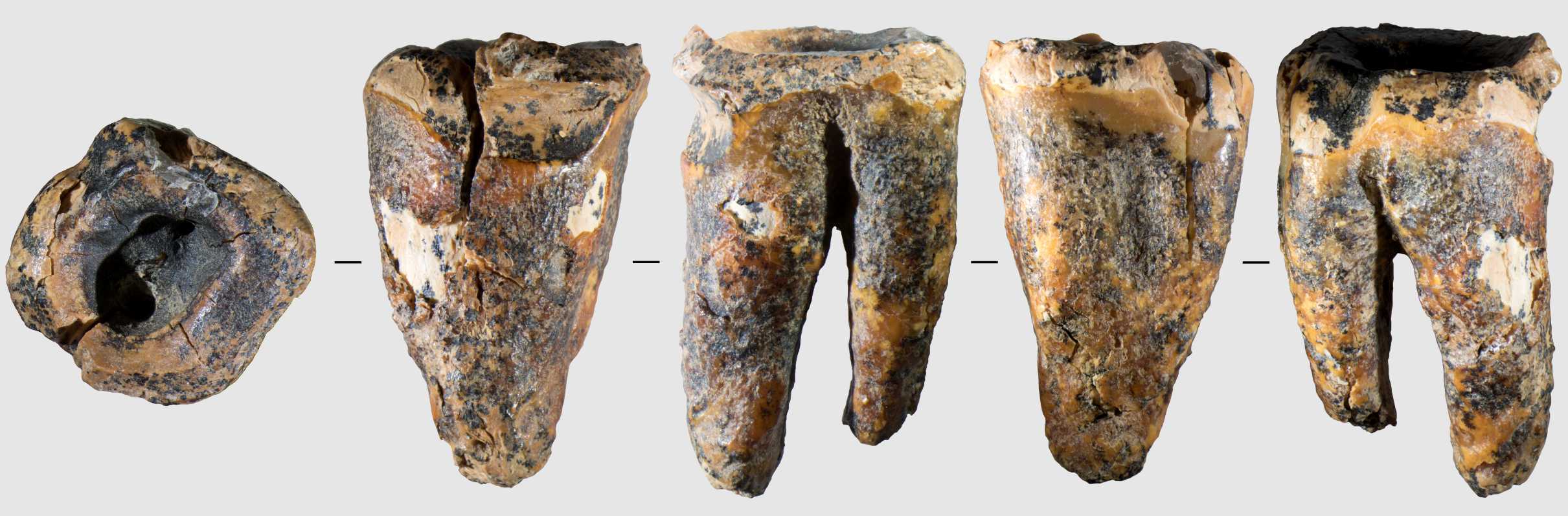
A Deliberate Medical Intervention
The research team, led by dental anthropologist Alisa V. Zubova of the Russian Academy of Sciences, employed a battery of advanced analytical techniques — including traceological analysis, scanning electron microscopy, micro-CT scanning, and Raman spectroscopy — to determine whether the hole was the result of intentional medical treatment rather than post-depositional damage.
They also conducted experimental replication, using replica stone tools on modern human teeth to recreate the drilling process. The results, reported in Ars Technica, closely matched the wear patterns observed on the Chagyrskaya 64 molar.
“We think this is an open and shut case,” said John Olsen, an archaeologist at the University of Arizona and co-author of the study, in an interview with OPB/NPR. He explained that the hole “was created by a stone tool handled by a Neanderthal between the thumb and the forefinger… to rotate that on the chewing surface of the tooth to expose the pulp and clean it out.”
Ksenia Kolobova, an archaeologist at the Institute of Archaeology and Ethnography SB RAS and co-author, emphasized the sophistication of the act. “Treating a carious tooth is not just feeding or guarding someone,” she told Ars Technica. “It requires diagnosing the source of pain, selecting an appropriate tool, performing a painful, invasive action, and persisting despite the patient’s discomfort. That is active, targeted medical intervention.”
Evidence of Survival and Multiple Interventions
Remarkably, the tooth shows signs of subsequent wear, indicating that the patient lived for years after the procedure. The same tooth also bears evidence of toothpick use — a groove on the distal interproximal surface — suggesting the Neanderthal received multiple forms of dental care.
Bruce Hardy, an anthropologist at Kenyon College who was not involved in the study, told Science News that “this new find at Chagyrskaya … is clearly evidence of a deliberate, planned intervention in an effort to relieve pain.”
Rewriting the History of Medicine
The Chagyrskaya 64 molar predates the previous record-holder — a 14,000-year-old tooth from Ripari Villabruna, Italy, which involved only scraping enamel — by more than 40,000 years. It is also the first evidence of dental surgery in any non-Homo sapiens hominin.
Lydia Zotkina, a paleoanthropologist at the Russian Academy of Sciences and co-author, reflected on the human dimension of the discovery. “What struck me, and continues to strike me, is what an incredibly strong-willed person this Neanderthal must have been,” she told Ars Technica. “Now, every time I go to the dentist, I think about that guy.”
Broader Implications
This discovery adds to a growing body of evidence that Neanderthals possessed sophisticated medical knowledge. Previous research has documented their use of medicinal plants such as chamomile and yarrow, the production of antiseptic birch tar, and community care for injured and elderly group members.
Not all experts are entirely convinced. Rachel Kalisher, a bioarchaeologist at UC San Diego not involved in the study, told NPR that while the evidence is strong, it may not be a “smoking gun.” However, she acknowledged that “I wouldn’t be surprised, because we have all this other evidence that they were very intelligent and able to respond and adapt to different types of situations.”
What’s Next
The study raises intriguing questions about the extent of Neanderthal medical knowledge. Was this an isolated innovation, or part of a broader medical tradition lost to the archaeological record? Kolobova suggested that researchers may have missed similar evidence in the past “because we weren’t looking for it” — hinting that future discoveries may further transform our understanding of prehistoric healthcare.
For now, the Chagyrskaya 64 molar stands as a testament to the resilience, intelligence, and compassion of our ancient cousins — and as the world’s oldest known dental patient.