China Space Station Prepares for 8th Crew Rendezvous
China’s Tiangong space station is gearing up for its eighth crew rendezvous as the Shenzhou-23 spacecraft enters its final launch preparation phase at the Jiuquan Satellite Launch Center. The mission, expected to launch in late May 2026, will mark several significant milestones for China’s human spaceflight program, including a year-long orbital residency experiment and the potential participation of astronauts from Hong Kong and Macau for the first time.
Launch Preparations Underway
The Shenzhou-23 crewed spaceship and its Long March-2F carrier rocket combination were transferred to the launch pad on May 16, 2026, according to People’s Daily. Pre-launch function checks and joint tests are currently underway, with the China Manned Space Agency (CMSA) confirming that all facilities and equipment at the launch site are in good condition. A full-system launch rehearsal was completed on May 21, and crew training has entered its final phase.
Upon arrival at the station, the Shenzhou-23 crew will meet the Shenzhou-21 astronauts — Commander Zhang Lu, Wu Fei, and Zhang Hongzhang — who have been in orbit for nearly 200 days. This handover will mark the eighth “space meetup” in Chinese spaceflight history.
Year-Long Residency Experiment
In a departure from the standard six-month rotation, one member of the Shenzhou-23 crew will conduct a one-year orbital residency experiment, as reported by People’s Daily. The extended mission will involve long-duration health monitoring, medical support, exercise regimens, psychological support, and logistics management — generating critical data for China’s future deep space ambitions, including planned crewed lunar missions by 2030.
Tianzhou-10 Delivers Supplies
The Shenzhou-23 mission follows the successful arrival of the Tianzhou-10 cargo spacecraft, which launched on May 11 from Wenchang Space Launch Site and docked with the Tianhe core module just five hours later. According to Wen Wei Po, Tianzhou-10 delivered nearly 6.2 tons of supplies — the highest payload count of any Tianzhou mission — including 220 items for living, maintenance, and experiments, plus 700 kilograms of propellant.
Among the cargo was a new “Feitian” extravehicular spacesuit (Model F) with an extended lifespan of four years or 20 uses, up from three years or 15 uses. The upgraded suit features improved joint bearings, modular design for in-orbit maintenance, and enhanced thermal comfort. Three new suits will replace all older models aboard the station.
The cargo spacecraft also delivered supplies for 41 scientific experiments across four domains: space life sciences and biotechnology, microgravity physical sciences, new space application technologies, and space astronomy and earth science. Notably, this includes a lightweight high-resolution greenhouse gas detection payload led by the Hong Kong University of Science and Technology — the first Hong Kong-led research project to enter the space station.
Hong Kong and Macau Astronauts on the Horizon
For the first time, astronauts from Hong Kong and Macau may execute space station missions in 2026, according to China News. The fourth batch of Chinese astronauts, selected in 2024, includes two payload specialists from these Special Administrative Regions. While it remains unclear whether they will fly on Shenzhou-23 or a later mission, their inclusion represents a significant political and symbolic milestone reflecting Beijing’s integration efforts.
International Cooperation: Pakistan Astronauts
China’s space station is also opening its doors to international partners. Two Pakistani astronaut candidates have been selected as China’s first foreign astronauts, as reported by People’s Daily. After completing training, one will join a future mission as a payload specialist, becoming the first foreign astronaut to enter the Tiangong space station. This cooperation strengthens China’s ties with a key strategic partner and positions Tiangong as an inclusive alternative to the U.S.-led International Space Station, from which China has been excluded by U.S. law since 2011.
Shenzhou-21 Crew: Record-Breaking Mission
The outgoing Shenzhou-21 crew has achieved remarkable milestones during their stay. Commander Zhang Lu has surpassed 500 cumulative days in orbit — the first Chinese astronaut to exceed one year in space cumulatively, according to Cislunar Space. The crew completed their third spacewalk on April 17, installing debris shielding and inspecting equipment, and are scheduled to return to Earth later this month.
What’s Next
China plans two crewed launches (Shenzhou-23 and Shenzhou-24) and one cargo mission in 2026. The Shenzhou-24 spacecraft and rocket are already at the launch site in a backup role, ensuring mission safety. With the Tiangong space station transitioning from construction to sustained operations, China’s human spaceflight program is entering a phase of expanding scientific output, international collaboration, and preparation for humanity’s next giant leap — the Moon.
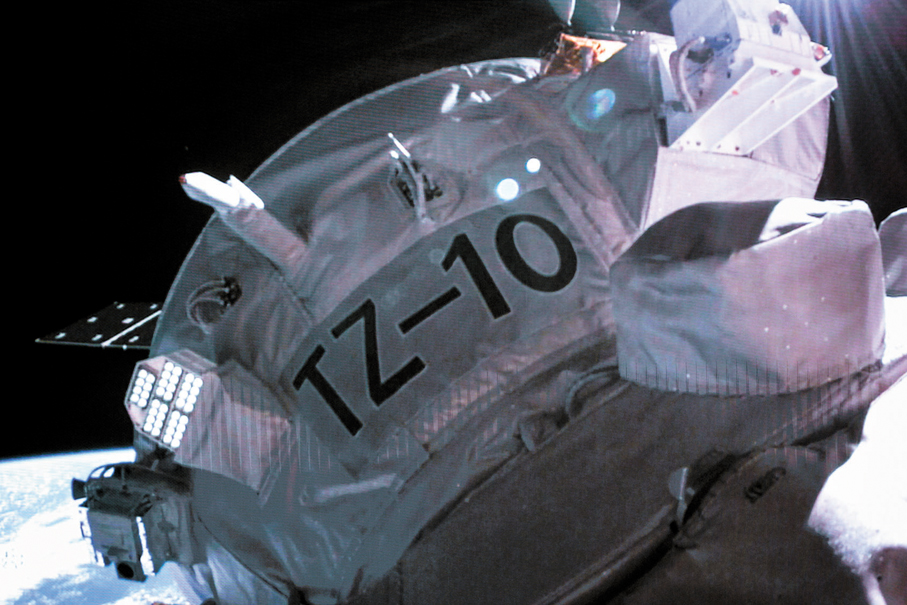 Tianzhou-10 cargo spacecraft docking with the Tiangong space station, captured at the Beijing Aerospace Flight Control Center on May 11, 2026. (Xinhua via Wen Wei Po)
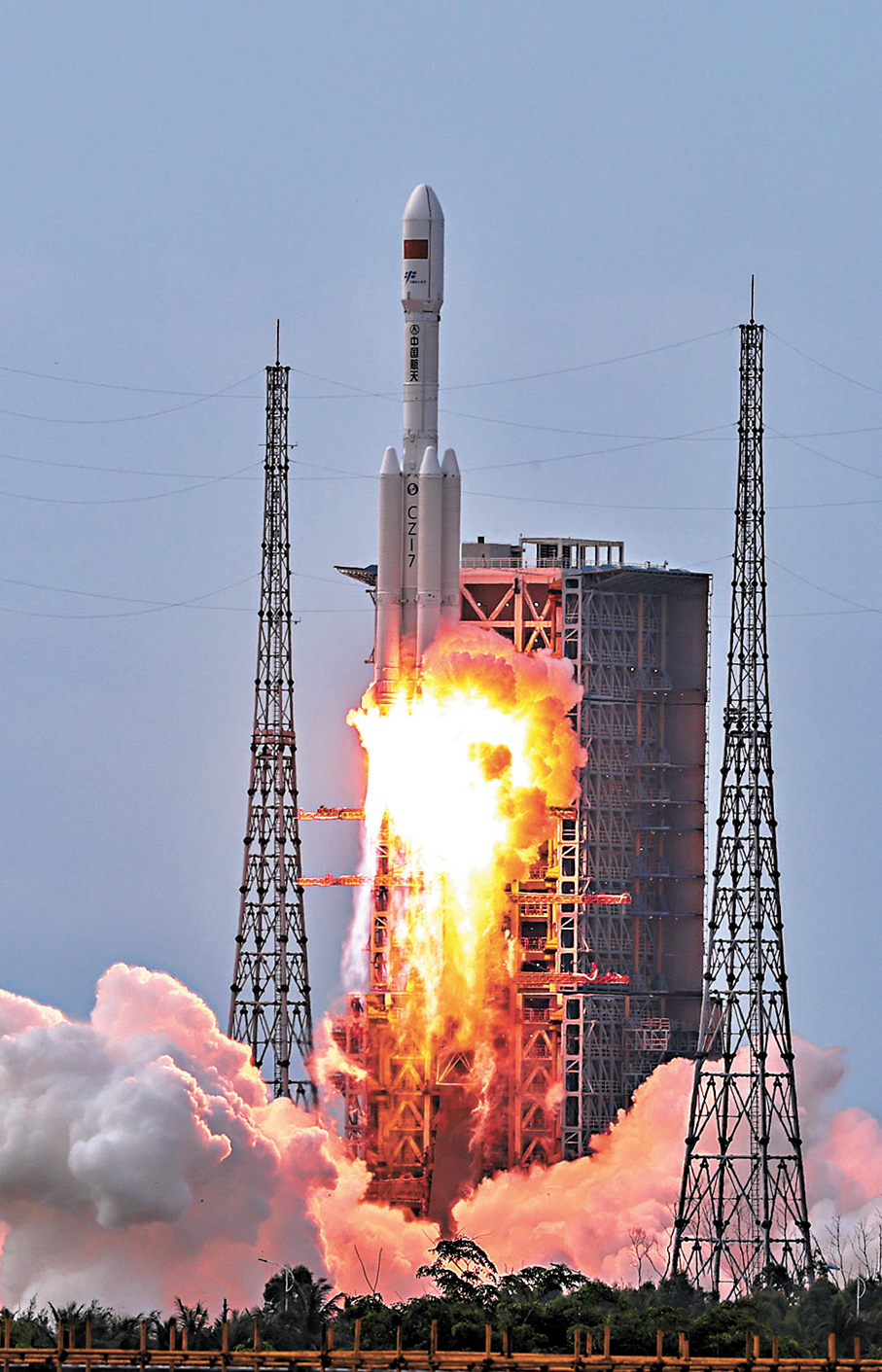 The Long March-7 Y11 rocket launching the Tianzhou-10 cargo spacecraft from Wenchang Space Launch Site on May 11, 2026. (Xinhua via Wen Wei Po)