WHO Raises Ebola Risk to ‘Very High’ in DRC Amid Protests
The World Health Organization has escalated the Ebola outbreak risk level in the Democratic Republic of the Congo to “very high” at the national level, as the rare and deadly Bundibugyo strain continues to spread through conflict-ravaged eastern provinces. The upgrade, announced on May 22 by WHO Director-General Tedros Adhanom Ghebreyesus, came just one day after protesters in the town of Rwampara set fire to an Ebola treatment center — a dramatic illustration of the community mistrust that now threatens to derail containment efforts.
A Growing Crisis
According to Al Jazeera, WHO has confirmed 82 cases and seven deaths from the Bundibugyo strain in DRC, but the true scale is believed to be far larger. Nearly 750 suspected cases and 177 suspected deaths have been reported, suggesting the outbreak may have been spreading undetected for weeks before it was formally recognized.
“The situation in the DRC is deeply worrisome,” Tedros wrote on X. “But we know the epidemic in the DRC is much larger.”
The outbreak is centered in Ituri province, a mining and commercial hub that borders Uganda and South Sudan. Two cases have already been confirmed in Uganda, including one death, raising fears of broader regional spread. WHO has assessed the risk as “high at the regional level” but “low at the global level.”
The Treatment Center Attack
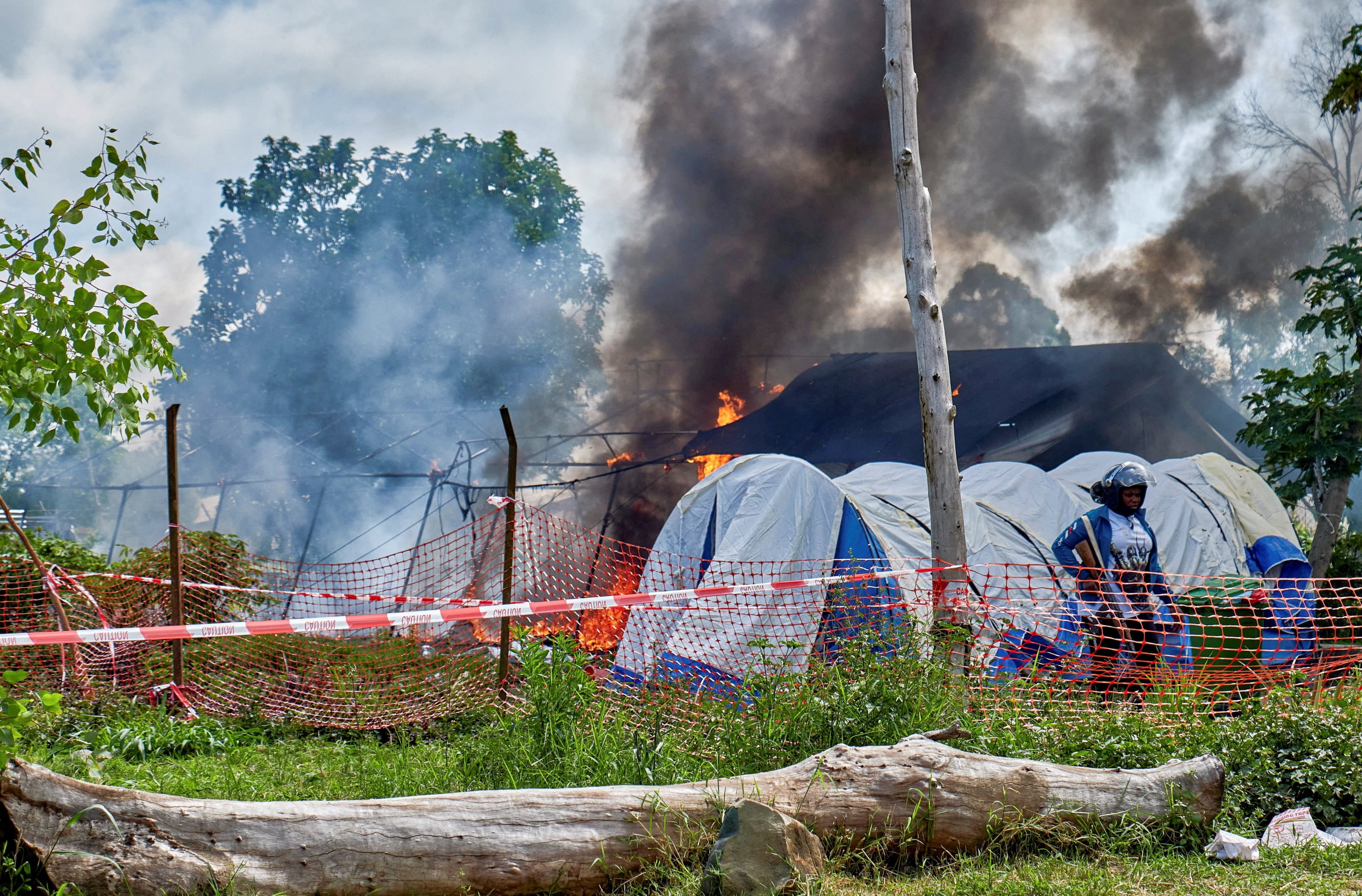
On May 21, tensions boiled over in Rwampara when protesters set fire to tents serving as an Ebola treatment center at a local hospital. According to Reuters, the unrest began after authorities refused to release the body of Eli Munongo Wangu, a popular local footballer suspected of dying from Ebola. His mother told Reuters she believed he died of typhoid, not Ebola.
Police fired tear gas and warning shots to disperse the crowd, but not before two tents fitted with eight beds were completely destroyed, along with a body scheduled for burial that day. Six patients who had been receiving care in the tents are now being treated at the hospital, according to the medical charity ALIMA.
Anne Ancia, the WHO Representative in DRC, said the attack would “seriously endanger” local epidemic control operations, though she expressed hope the center could resume operations within 24 hours.
A Rare and Dangerous Strain
This outbreak is caused by the Bundibugyo virus (Orthoebolavirus bundibugyo), a rare strain first identified in Uganda in 2007. Unlike the more common Zaire strain — for which effective vaccines exist — there is no licensed vaccine or specific treatment for Bundibugyo. As Gavi reports, two candidate vaccines are in development, but producing doses for clinical trials could take two to nine months.
“In plain terms, we do not currently have a proven, licensed, Bundibugyo-virus-specific vaccine available for outbreak control,” said Prof Emma Thompson, Director of the MRC–University of Glasgow Centre for Virus Research.
Mohamed Yakub Janabi, WHO Regional Director for Africa, warned against complacency. “It would be a big mistake to underestimate it, especially with a virus with this strain, Bundibugyo, [for] which we don’t have the vaccine,” he told Reuters.
Conflict and Mistrust Complicate Response
The outbreak is unfolding in Ituri and North Kivu provinces — regions scarred by decades of armed conflict. According to UN News, around four million people need urgent humanitarian assistance, two million are displaced, and ten million face acute hunger. Fighting has intensified in recent months, displacing more than 100,000 people and hampering health operations.
Deep community mistrust, fueled by misinformation and trauma from previous epidemics, poses an equally formidable challenge. Gabriela Arenas of the International Federation of Red Cross and Red Crescent Societies (IFRC) said many communities still carry trauma from the 2018-2020 outbreak, when hundreds of health facilities were attacked.
“They remember the fear. They remember the rumours spreading to villages,” Arenas told reporters. “They remember neighbours disappearing into treatment centres.”
Some residents believe “that Ebola is fabricated,” she added. The IFRC has deployed volunteers for door-to-door awareness campaigns to combat misinformation.
International Response Intensifies
On May 22, UN Emergency Relief Coordinator Tom Fletcher allocated up to $60 million from the Central Emergency Response Fund (CERF) to support the response in DRC and neighboring countries. WHO released an additional $3.9 million from its contingency fund and has deployed 22 international staff to the field.
The UN peacekeeping mission MONUSCO has airlifted nearly 30 tons of emergency supplies — including medicines, tents, and protective equipment — while WHO and Africa CDC have established a continental incident management support team.
WHO has also prioritized two monoclonal antibodies for clinical trials and is testing the antiviral drug obeldesivir for high-risk contacts, Tedros said.
Women at Greatest Risk
Social dynamics could leave women disproportionately affected, as they have in previous Ebola outbreaks. Sofia Calltorp, UN Women’s Chief of Humanitarian Action, noted that during the 2018-2019 outbreak in DRC, women and girls accounted for roughly two-thirds of reported cases.
“This is because Ebola transmission follows social realities,” Calltorp said. “The virus spreads along the lines of caregiving, domestic labour, frontline health work and burial practices.”
What’s Next
Ituri’s provincial government has banned public gatherings of more than 50 people, restricted funerals to specialized teams, prohibited transport of dead bodies by non-medical vehicles, and suspended the local football league. The national football team has been forced to cancel World Cup buildup events in Kinshasa and will instead prepare in Belgium.
Meanwhile, an American doctor who tested positive for Ebola in DRC has been transferred to Germany for treatment, and another American high-risk contact has been moved to the Czech Republic. A patient with low suspicion of Ebola was admitted to a hospital in the Netherlands.
Tedros emphasized that restoring trust is as critical as medical intervention. “Building trust in the affected communities is critical to a successful response, and is one of our highest priorities,” he said.
With no vaccine available, a conflict zone as the epicenter, and communities deeply skeptical of outside authorities, the coming weeks will determine whether the outbreak can be contained — or whether it becomes the next major global health emergency.