China’s F406 Turbofan Engine Completes First Flight
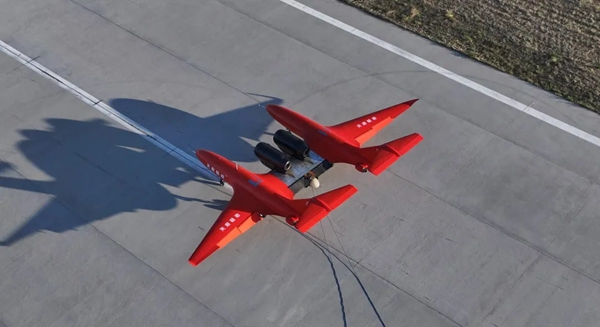
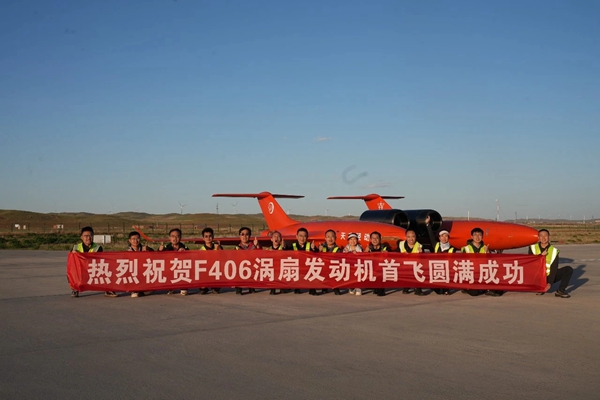
China has achieved a significant milestone in indigenous aerospace engine development with the successful maiden flight of its domestically-produced 600-kilogram thrust class F406 turbofan engine. The engine, mounted in a twin-engine configuration on an advanced meteorological unmanned aerial vehicle (UAV), completed its first flight on May 23 over Xilinhot, Inner Mongolia, according to Xinhua News.
A Rapid Development Journey
The F406 engine was developed by Sichuan Tianfu Lightweight Power Technology Co., Ltd. (天府轻动), a subsidiary of Aero Engine Corporation of China (AECC). The company, established on April 30, 2024, in Chengdu, Sichuan Province, represents a new collaborative model combining manufacturing expertise from AECC Chengdu Engine Co., research capabilities from the AECC Sichuan Gas Turbine Research Institute, and local government investment from the Chengdu Tianfu New Area.
Remarkably, the engine progressed from initial design to successful ignition in less than eight months. As IT之家 reported citing CCTV News, the F406 achieved its first ignition on December 27, 2024 — a milestone that AECC Vice President Xiang Qiao attended personally. Huang Ming, Chairman of Tianfu Lightweight Power, described the achievement at the time as having “landmark significance,” noting that the entire R&D team had employed advanced simulation technology to ensure every design met expected requirements.
Technical Capabilities and Performance
The F406 turbofan engine boasts complete independent intellectual property rights and is designed to operate at altitudes of up to 15 kilometers and speeds above Mach 0.8. According to CAAC News, the engine features long endurance, high reliability, low fuel consumption, and a long service life — characteristics that position it as a powerplant for 1.5-ton to 4-ton class UAV platforms.
Following the December 2024 ignition, the engine underwent a comprehensive testing regimen, completing all component and system tests by December 2025. The May 23 maiden flight validated the engine’s reliability and maturity under real flight conditions. An AECC official, quoted by IT之家, stated that this “marks the first time in China’s general aviation power field that independent control and domestic application of small-to-medium high-end turbofan engines has been achieved.”
Strategic Significance and Applications
The F406 engine fills multiple technical gaps in China’s small-to-medium thrust turbofan engine sector, reducing dependence on foreign suppliers for UAV propulsion. China Economic Net reported that AECC described the first flight as marking “a complete closed loop from core technology to product application to scenario building in the high-end UAV power field.”
Potential applications for the engine are broad and include long-endurance inspection drones, high-altitude meteorological detection, unmanned cargo transport, high-altitude high-speed UAVs, and high-end target drones. The engine is also explicitly positioned to support China’s strategic “low-altitude economy” (低空经济) initiative — an emerging sector encompassing general aviation and UAV operations that the Chinese government has identified as a new growth engine.
Broader Context: China’s Accelerating Aerospace Engine Development
The F406’s successful first flight is part of a broader pattern of rapid progress in China’s aerospace engine sector. In recent months, China has achieved several notable milestones: the ATP120A 1200kW turboprop engine successfully ignited in January 2026, the world’s first megawatt-class hydrogen aviation turboprop engine completed its first flight in April, and a 1000kgf-class aviation engine passed its acceptance review on May 18 — just five days before the F406’s maiden flight.
According to the AECC official website, the original development plan called for the F406’s first flight by June 2025 and final certification by 2026. While the first flight occurred slightly later than originally planned, the engine has now validated its airworthiness, and derivative products for business aircraft and other platforms are in development.
Looking Ahead
The successful first flight positions the F406 engine as a cornerstone of China’s indigenous UAV power capabilities. As the engine moves toward certification and eventual production, it will provide a domestically-controlled powerplant option for China’s rapidly expanding UAV industry. The milestone also demonstrates the effectiveness of Tianfu Lightweight Power’s collaborative development model, which could serve as a template for future Chinese aerospace engine programs.
While questions remain about production volumes, customer commitments, and export market penetration, the F406’s maiden flight represents a tangible step forward in China’s long-standing ambition to achieve self-sufficiency in aerospace propulsion technology — a strategic priority that has driven the establishment of AECC and the broader “China Heart” initiative.