NASA Awards Lunar Rover Contracts for Artemis Moon Base
NASA has taken a major step toward establishing a permanent human presence on the Moon, awarding contracts to two companies to build crewed lunar rovers and selecting three uncrewed lander missions for 2026. The announcements, made during a press conference at NASA Headquarters in Washington on May 26, represent the most detailed roadmap yet for the agency’s Moon Base initiative under the Artemis program.
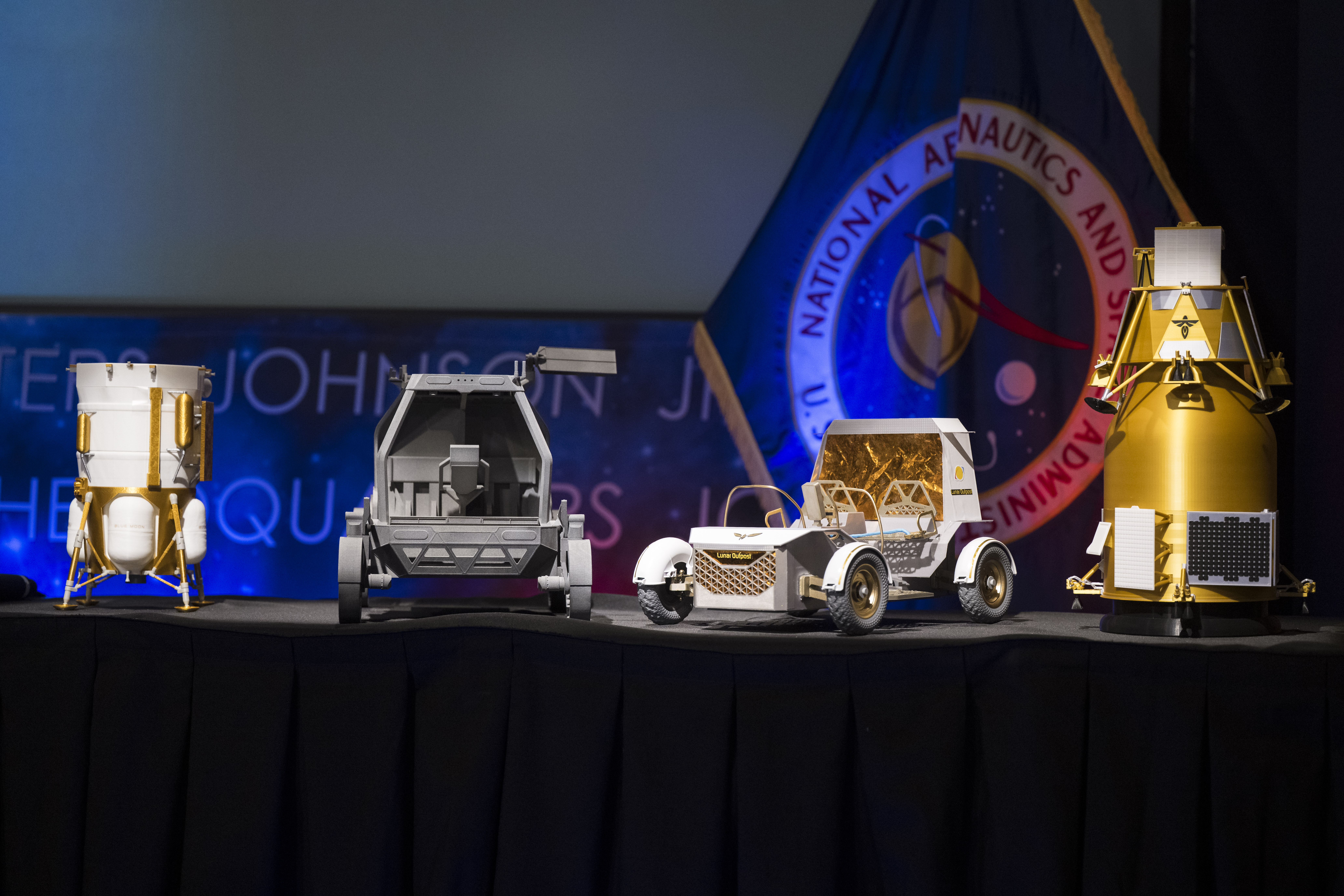
Lunar Rover Contracts
The centerpiece of the announcement is the selection of two companies to build crewed Lunar Terrain Vehicles (LTVs). NASA awarded Astrolab of Hawthorne, California, $219 million and Lunar Outpost of Golden, Colorado, $220 million to build and deliver the first phase of crewed rovers under firm-fixed-price, performance-based milestone contracts.
Astrolab’s Crewed Lunar Vehicle, or CLV-1, is adapted from the company’s FLEX architecture. It has a mass of approximately 2,000 pounds (950 kg), a top speed of about 6 mph (10 km/h) on level terrain, and can carry astronauts and supplies. When stowed for delivery, it measures roughly 2 meters by 2.3 meters by 2.2 meters, deploying to about 4 meters in length on the lunar surface.
Lunar Outpost’s Pegasus is a lighter, mission-ready evolution of its Eagle rover. Operational for up to a year, Pegasus can be driven manually, operate autonomously, or be teleoperated. It seats two astronauts, can reach speeds exceeding 9 mph, and supports livestreaming from the lunar surface — a feature that underscores NASA’s emphasis on public engagement.
“We’ve spent the better part of the past decade engineering advanced mobility solutions designed for the realities of operating and building on the lunar surface,” said Justin Cyrus, CEO and co-founder of Lunar Outpost, as reported by The Colorado Sun. “Pegasus gives astronauts the range, reliability, and flexibility needed to thrive in new terrain as we identify and prepare the sites that will become the first permanent lunar outpost.”
Delivery and Timeline
Blue Origin was awarded $188 million (with an option period worth $280.4 million for two task orders) to transport the two LTVs to the Moon’s South Pole region. Both rovers are expected to be on the Moon by 2028, ready for the Artemis IV crew. The companies have approximately 18 months to finalize designs, conduct crewed evaluations, and qualify flight units for operational readiness.
Three Moon Base Missions in 2026
NASA also outlined the first three uncrewed “Moon Base” missions scheduled for this year, each designed to generate operational data and reduce risk ahead of crewed Artemis surface activities.
Moon Base I is targeted for launch no earlier than fall 2026, using Blue Origin’s Blue Moon Mark 1 “Endurance” lander. NASA Administrator Jared Isaacman called it “the first privately funded lunar lander mission in history,” according to SpacePolicyOnline.com. The mission will land at Shackleton Connecting Ridge carrying NASA payloads including Stereo Cameras for Lunar Plume-Surface Studies and a Laser Retroreflective Array.
Moon Base II will use Astrobotic’s Griffin lander to deliver more than 1,100 pounds of cargo, including Astrolab’s FLIP rover, to mature mobility systems that inform future LTV operations. The launch has slipped to July 2026.
Moon Base III will fly Intuitive Machines’ Nova-C “Trinity” (IM-3) lander, carrying NASA’s Lunar Vertex experiment to study lunar swirls — light-colored surface features that could improve understanding of surface evolution under extreme conditions. The mission will also include payloads from the European Space Agency and the Korea Astronomy and Space Science Institute.
MoonFall Drones
NASA’s Jet Propulsion Laboratory selected Firefly Aerospace under a $75 million contract to build the spacecraft that will deliver three to four MoonFall drones to the Moon, targeted for 2028. The drones will make multiple short-hop flights during one lunar day (14 Earth days) to survey potential landing sites and establish a “perimeter.” After their final flights, the drones will continue to operate for several months, marking a sustained U.S. presence at the lunar South Pole.
Strategic Implications
The dual-award strategy for LTVs reflects a deliberate policy shift by NASA Administrator Jared Isaacman, who emphasized that building one “exquisite” vehicle does nothing to stimulate a lunar economy. NASA wants multiples of everything produced faster, and the selection of Lunar Outpost alongside Astrolab signals the agency’s intent to diversify its industrial base beyond traditional aerospace giants.
“The Moon Base will be America’s and humanity’s first outpost on another celestial world,” Isaacman said. “Every mission, crewed and uncrewed, will be a learning opportunity as we return to the lunar surface, build the infrastructure to stay, and master the skills required to live and operate in one of the most demanding and dangerous environments imaginable.”
What’s Next
NASA plans to announce the four Artemis III astronauts on June 9, 2026, at Johnson Space Center in Houston. The agency also released the final CLPS 2.0 request for proposals on May 15, with responses due June 30, opening the door for next-generation cargo landers. These missions are the first of more than a dozen that will be announced this year, each building toward the goal of crewed lunar landings by 2028 and the beginning of Moon Base construction in 2029.