Vucic Awarded China’s Highest Honor in Landmark Visit
Serbian President Aleksandar Vucic completed a five-day state visit to China from May 24 to May 28, 2026, at the invitation of Chinese President Xi Jinping — a trip he described as “undoubtedly the most important visit of my political career.” The visit marked a significant deepening of the China-Serbia strategic partnership, highlighted by Vucic receiving the Friendship Medal of the People’s Republic of China, the nation’s highest state honor for foreign recipients.
A Historic Welcome and Highest Honor
Upon arriving in Beijing on May 24, Vucic posted on social media expressing the gravity of the occasion, according to Xinhua News. The following day, Xi Jinping and Vucic held formal talks at the Great Hall of the People, discussing bilateral relations and international issues of mutual concern, reaching broad consensus.
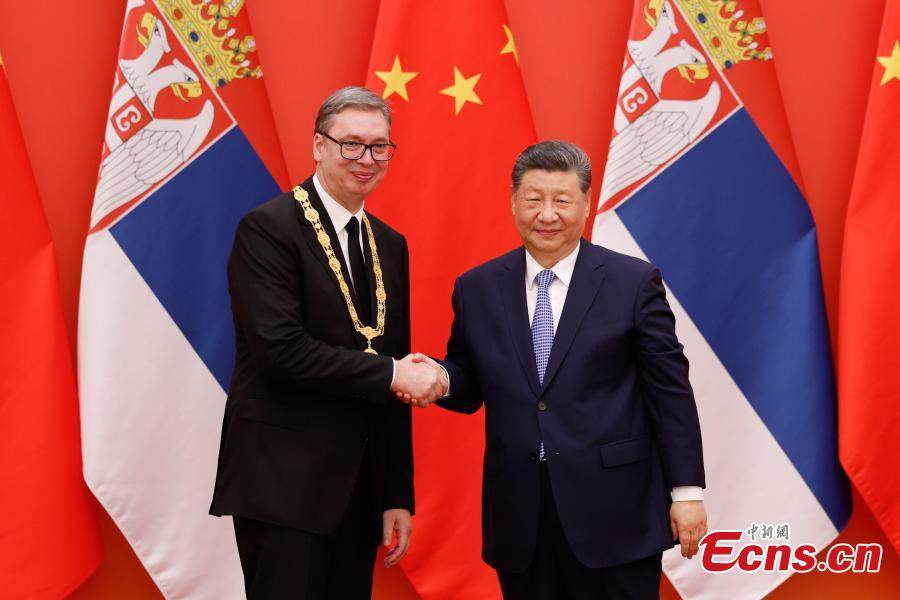
That evening, Xi awarded Vucic the Friendship Medal in a ceremony at the Great Hall of the People. Vucic became visibly emotional, stating the medal “reflects the resilience of our bilateral relations and the immense mutual respect and shared achievements between our two countries.” Filip Filipovic, a Serbian PhD student at Fudan University who attended the ceremony, described the moment in a first-person account published by Fudan University: “To witness this moment in person left a deep impression on me. It was not only an unforgettable honor, but also a vivid and profound lesson in international relations.”
Strategic Alignment and Joint Declarations
A key outcome of the visit was the issuance of two major joint cooperation documents. Serbia became the first country to issue a joint statement with China supporting all four of China’s major global initiatives: the Global Development Initiative, Global Security Initiative, Global Civilization Initiative, and Global AI Governance Initiative.
The two sides also agreed to align China’s “15th Five-Year Plan” with Serbia’s “Serbia 2030” development strategy. Ju Hao, Deputy Director at the Center for Transformation and Integration Theory of the Chinese Academy of Social Sciences, noted that this represents “an important highlight of this visit,” actively expanding new growth points for cooperation.
Zhao Chen, a researcher at the Institute of European Studies of the Chinese Academy of Social Sciences, told Xinhua that the two countries “have used a series of pragmatic cooperation documents to align their interests, laying solid foundational work in trade, politics, and people-to-people exchanges.”
Trade and Economic Foundations
Bilateral trade between China and Serbia reached $6.48 billion in 2025, a 13% year-on-year increase. The China-Serbia Free Trade Agreement — China’s first FTA with a Central and Eastern European country — took effect on July 1, 2024, covering approximately 20,000 product categories with tariffs on over 95% of products to be phased to zero.
A flagship project of bilateral economic cooperation is the HBIS Group Serbia steel mill in Smederevo. Acquired by China’s HBIS Group in 2016 when it was on the brink of bankruptcy, the century-old plant was turned around to profitability, saving thousands of jobs. During Xi’s 2024 visit to Serbia, he gifted Vucic steel crafts made from HBIS Serbia steel, quipping: “We are now ‘steel-clad friends,’ even deeper than ‘iron-clad.’”
Technology and Innovation Cooperation
Vucic’s itinerary included visits to cutting-edge Chinese technology facilities. In Beijing, he toured Xiaomi’s EV super-factory and Tsinghua University, and in Jiaxing, Zhejiang Province, he visited the Minth Group future factory to explore humanoid robotics and innovation sectors.
“World-class EV factories symbolize modernization, while historical museums trace the past,” Vucic said during his visit. “Without understanding China’s past, one cannot understand how China dares to dream big and achieve its current development.”
The two countries agreed to strengthen cooperation in space technology, artificial intelligence, embodied intelligence, digital economy, and new energy — jointly cultivating “new quality productive forces.”
Youth and People-to-People Exchanges
Addressing Serbian youth participating in the “Iron-Clad Youth, Smart Manufacturing Future” international youth exchange camp at the Minth Group factory, Vucic urged them to learn from China’s diligence. “You must work extremely hard and never stop striving. Learn from the Chinese people — see how hardworking they are. I hope you can become good friends!”
The Emotional Dimension: A Leader’s Genuine Affection
In an interview with China Central Television on May 26, Vucic shared a touching personal anecdote. He revealed that his father had noticed his excitement about the China visit and asked whether his enthusiasm was appropriate. His father reassured him: “Your demeanor was professional and appropriate, but because I know you, I could tell. You were truly very happy, and seeing you like that made us very happy too.” The story, reported by Guancha, offered a rare glimpse into the Serbian leader’s personal connection to China.
Historical Foundations of the ‘Iron-Clad Friendship’
The depth of China-Serbia relations is rooted in decades of mutual support through adversity. The 1999 NATO bombing of the Chinese Embassy in Belgrade, which killed three Chinese journalists, forged a deep bond between the two nations. During the COVID-19 pandemic, when European countries were unable to help, China sent medical experts and supplies to Serbia. Vucic personally greeted the Chinese medical team at the airport, kissing the Chinese flag, and famously stated: “European solidarity does not exist. Only China can help us.”
As CRI reported, these moments of shared hardship — from the 2008 Wenchuan earthquake to the pandemic — have cemented a friendship that both leaders describe as unbreakable.
Geopolitical Implications
Serbia’s deepening partnership with China creates a complex dynamic for its European Union accession process. Serbia is an EU candidate country, but Brussels expects candidate nations to align with EU foreign policy — a requirement that sits uneasily with Belgrade’s growing reliance on Beijing. China’s support for Serbia’s territorial integrity regarding Kosovo — a position of fundamental importance to Belgrade — further strengthens the bilateral relationship.
Vucic articulated Serbia’s strategic calculus in an interview with Xinhua: “The world today craves stability and peace, and China represents the force of stability and peace. Not only Serbia, but people across the Global South see China as the most important source of stability.”
What to Watch For
The agreements signed during this visit set the stage for accelerated Chinese investment in Serbian infrastructure, manufacturing, and technology sectors. Key questions remain: whether Serbia can translate political goodwill into expanded exports to China to address the trade imbalance, how the EU will respond to Serbia’s deepening China ties, and what specific projects will emerge from new areas of cooperation in AI and robotics. For now, the visit has reinforced Serbia’s position as China’s most significant European partner — a relationship Vucic has called “friendships forged in adversity [that] become indestructible in prosperity.”