Carney Meets Chinese FM Wang Yi in Historic Ottawa Visit
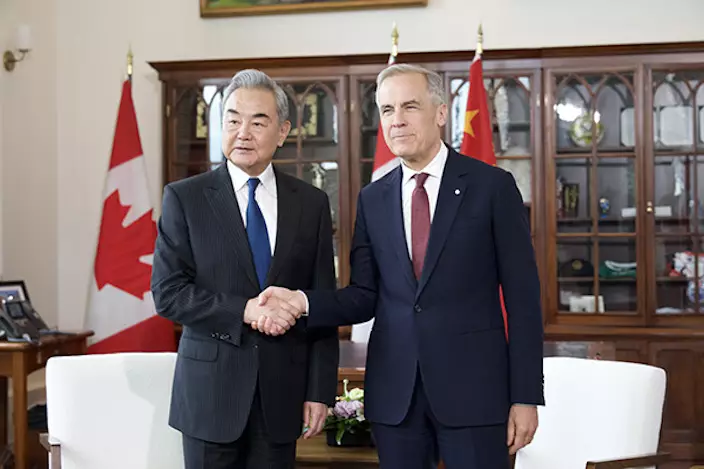
Canadian Prime Minister Mark Carney met with Chinese Foreign Minister Wang Yi in Ottawa on May 29, marking the first visit by a Chinese foreign minister to Canada in a decade. The high-level meeting, which followed Carney’s own trip to Beijing in January, represents the latest step in a rapid rapprochement between two countries whose relationship plunged to historic lows during the 2018-2021 diplomatic crisis over the Huawei executive Meng Wanzhou case.
A Decade-Long Hiatus Broken
Wang Yi’s three-day visit (May 28-30) was the first bilateral trip to Canada by a Chinese foreign minister since 2016, when Wang’s last visit was overshadowed by his now-infamous rebuke of a Canadian journalist who asked about China’s human rights record. This time, according to BNN Bloomberg, media access was highly restricted — only official photographers were initially permitted, though limited media access was later granted after pushback from the Parliamentary Press Gallery.
During the Ottawa meetings, Wang also sat down with Canadian Foreign Minister Anita Anand and former Prime Minister Jean Chrétien. The Prime Minister’s Office confirmed the meeting, noting that only official photographers were permitted for the session with Carney.
Trade at the Forefront
Trade and economic cooperation dominated the agenda. Canada is seeking to increase exports to China by 50 percent by 2030, a goal Anand described as achievable “while safeguarding Canada’s economic and national security interests and values,” as reported by the National Observer. Wang Yi suggested that figure could go even higher — potentially reaching 100 percent growth.
“The export volume can definitely exceed 50 percent, and it might even be possible to grow by 100 percent without any problem, because China will soon become the world’s largest market, and China’s market is willing to open to Canada,” Wang said, according to Radio-Canada.
Bilateral trade between Canada and China reached CAD $125.1 billion in 2025, a 5.2 percent increase over the previous year, according to Global Affairs Canada.
From Crisis to Reset
The meeting marks a remarkable turnaround from the nadir of Canada-China relations. In December 2018, Huawei CFO Meng Wanzhou was arrested in Vancouver at the request of the United States, prompting China to detain Canadians Michael Kovrig and Michael Spavor — the so-called “Two Michaels” — in apparent retaliation. The crisis lasted until September 2021, when all three were released.
Relations began to thaw in July 2024, when then-Foreign Minister Mélanie Joly made a surprise visit to Beijing. The breakthrough came in January 2026, when Carney visited China and met with President Xi Jinping, agreeing to establish a “China-Canada new-type strategic partnership.” A preliminary trade deal followed, with China lowering tariffs on Canadian agricultural products and Canada reducing tariffs on some Chinese electric vehicles.
As People’s Daily reported, Wang told Carney that “China-Canada relations have corrected course and returned to the right track.”
Strategic Implications
Carney has pursued a policy of trade diversification, arguing that Canada cannot rely excessively on the United States amid ongoing US-China trade tensions. Former Canadian Ambassador to China Guy Saint-Jacques told Radio-Canada that relations are “very close to returning to normal, that is, returning to the level before the Meng Wanzhou incident.”
Gordon Houlden, Director Emeritus of the China Institute at the University of Alberta, described Wang Yi as a “very senior trusted hand” who is “all business and a reliable transmitter” of Canada’s views to Chinese leadership, according to BNN Bloomberg. Houlden noted that “Xi Jinping is not spending every day, not even every week, thinking about Canada. These things need to be pushed forward.”
Points of Tension Remain
Despite the positive atmosphere, several contentious issues persist. Canada continues to raise human rights concerns, including the treatment of Uyghurs in Xinjiang. Just days before Wang’s visit, a Canadian Navy ship sailed through the Taiwan Strait, drawing a warning from Beijing. Conservative leader Pierre Poilievre criticized the Carney government for restricting media access to the meeting, accusing it of importing “Beijing’s rules” into Canada, as The Epoch Times reported.
What’s Next
Wang Yi has invited Carney to visit China again in November to attend the Asia-Pacific Economic Cooperation (APEC) summit. Meanwhile, the temporary tariff agreements reached in January are valid only until the end of 2026, meaning follow-up negotiations must continue to achieve more permanent arrangements. As Saint-Jacques noted, the two countries must “establish mechanisms to ensure that tariffs are not reinstated before the end of the year.”
The rapid pace of diplomatic engagement suggests both sides are eager to lock in the gains of the reset before political or geopolitical headwinds can slow the momentum.