Meteor Over Massachusetts Triggered Explosion Reports Across Northeast
A meteor approximately 3 feet (1 meter) wide streaked across the sky over Massachusetts on Saturday afternoon, generating a powerful double sonic boom that rattled buildings and prompted hundreds of reports from as far south as Delaware to as far north as Montreal, Canada. NASA officials confirmed the object was a natural meteor, not space debris or a satellite.
According to AP News, the meteor entered Earth’s atmosphere near the New Hampshire-Massachusetts border at approximately 2:06 p.m. EDT on May 30, traveling at an extraordinary 75,000 mph (120,700 km/h). NASA estimated that the energy released when the meteor broke apart was equivalent to about 300 tons of TNT.
A Daytime Fireball Caught by Surprise
The event unfolded in broad daylight, catching residents off guard. The American Meteor Society (AMS) reported receiving dozens of witness accounts from across the northeastern United States and parts of Canada. People described hearing what sounded like two distinct booms, feeling their homes shake, and spotting a fireball resembling a shooting star in the daytime sky.
“It was definitely bigger than a normal fireball, about a yard wide,” Robert Lunsford, program monitor for the American Meteor Society, told AP News. He added that the group received reports from Delaware to Montreal of people either hearing the double boom, feeling the ground shake, or seeing the fireball.
Social media quickly lit up with reactions. One Boston resident wrote, “I have never heard an explosion that loud,” as reported by the New York Post. Another user reported that their sister in Lexington heard the boom and felt her windows rattle from the force.
Scientific Confirmation and Analysis
NASA spokesperson Allard Beutel confirmed that the meteor was natural material and likely fragmented about 40 miles (60 kilometers) above the ground. The agency’s analysis ruled out the possibility that the object was a re-entering satellite or space debris.
The U.S. Geological Survey (USGS) also weighed in, confirming that despite numerous “Did you feel it?” reports from the public, no seismic event was recorded on the agency’s seismographs. “There was no event registered on the agency’s seismographs, meaning the shaking was not due to an earthquake,” USGS spokesperson Steve Sobie said, as reported by AP News.
Meteorologist Danielle Noyes of 1 Degree Outside provided additional confirmation through weather radar analysis. Speaking to WBUR, Noyes explained that a radar flash was detected in an area with no thunderstorm activity, consistent with a bolide — a meteor that explodes in the atmosphere. The National Oceanic and Atmospheric Administration’s (NOAA) GOES-19 satellite also detected the bright fireball.
Why the Boom Was So Powerful
When a meteor enters Earth’s atmosphere at hypersonic speeds — in this case, roughly 100 times the speed of sound — it compresses the air in front of it, creating a powerful shock wave. If the object is large enough, this shock wave can produce a sonic boom audible to people on the ground. The “double boom” phenomenon occurs when the shock wave from the meteor’s fragmentation reaches the ground at different times due to varying atmospheric conditions.
Experts said it was unlikely the meteor struck the ground. “We would need more information about the trajectory, the speed and other aspects to know for sure if it hit the ground, but if it didn’t burn up, then it would have landed in the ocean,” Lunsford explained. “Most of them do burn up before they hit the ground.”
Wider Significance and Public Response
While meteor events capable of producing audible booms are uncommon in New England, they occur periodically worldwide. Because much of Earth’s surface is covered by water or sparsely populated areas, many go unnoticed. When such events occur over densely populated regions like the Boston metro area, they generate widespread public attention and, initially, some alarm.
Local police departments across Massachusetts and Rhode Island fielded calls from concerned residents who feared an explosion or earthquake. The rapid coordination between NASA, the USGS, NOAA, and local authorities helped quickly identify the source and calm public fears.
As The Guardian noted, the event provided valuable data for meteor scientists studying fireball trajectories and atmospheric entry physics. NASA’s rapid confirmation also demonstrated improved capabilities for detecting and characterizing meteor events in real time.
What to Watch For
No injuries or property damage were reported from the event. Scientists continue to analyze trajectory data to determine the meteor’s origin in the solar system and whether it was part of a known meteor shower. The event serves as a reminder of the dynamic nature of Earth’s cosmic neighborhood — and the importance of public education about meteor phenomena to reduce panic during similar events in the future.
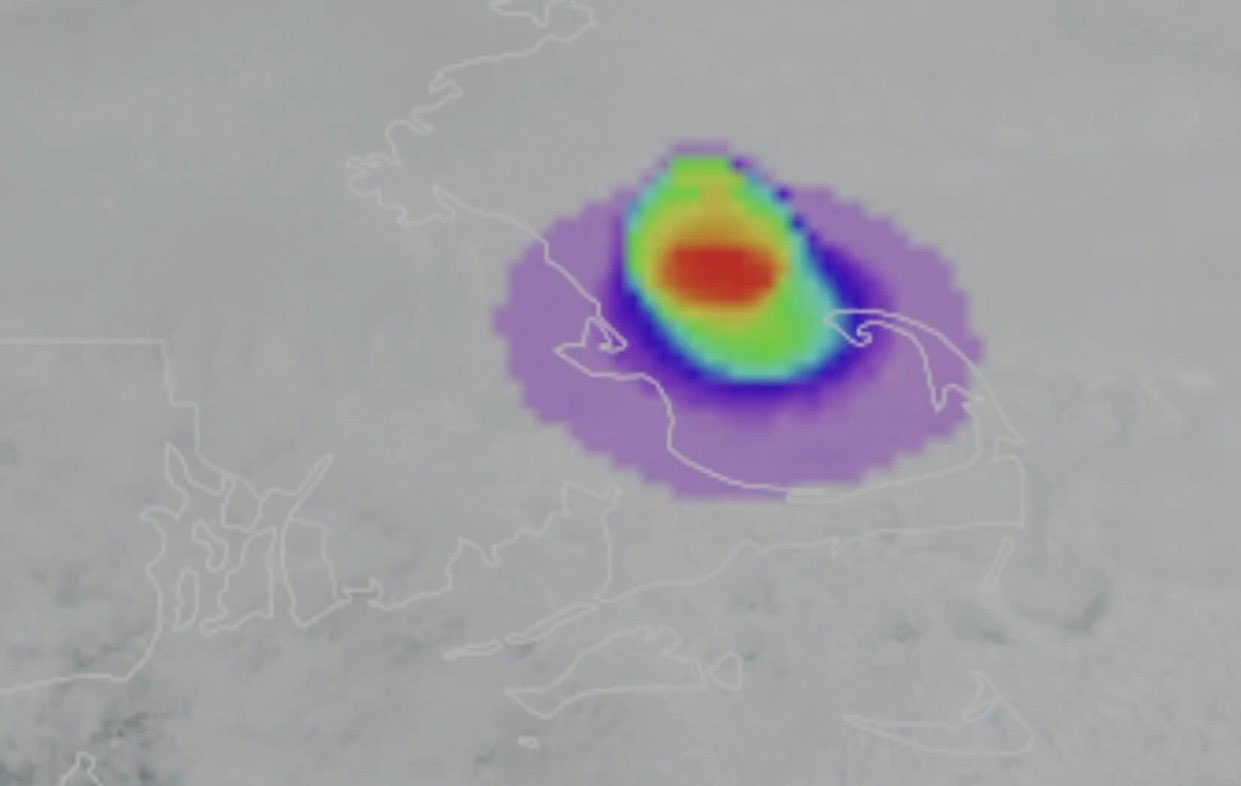 Satellite imagery captured the meteor’s explosive entry over the northeastern United States. (Source: The Maine Wire)