NASA Declares Mars MAVEN Spacecraft Dead After Six Months
NASA officially declared its Mars Atmosphere and Volatile Evolution (MAVEN) spacecraft dead on Wednesday, ending a more than decade-long mission that revolutionized scientists’ understanding of the Red Planet’s atmosphere. The spacecraft had been silent since December 6, 2025, when it passed behind Mars and emerged in an unrecoverable state.
According to AP News, telemetry data received after the spacecraft emerged from behind Mars showed it had entered safe mode and was spinning uncontrollably at an unusually high rate, causing its batteries to drain and communications systems to lose power. An anomaly review board convened by NASA in February 2026 concluded the spacecraft is not recoverable and no longer capable of performing its science and data relay mission.
A Mission That Exceeded All Expectations
Launched on November 18, 2013, from Cape Canaveral, Florida, aboard a United Launch Alliance Atlas V rocket, MAVEN arrived at Mars on September 21, 2014. Its primary one-year mission was to study the Martian upper atmosphere and determine how much of the planet’s atmosphere has been lost over time — a key to understanding why Mars transformed from a potentially habitable world into the cold, arid desert it is today.
The spacecraft operated for more than 11 years, far exceeding its original one-year primary mission. Over that time, its science team produced more than 800 publications, and MAVEN set a solar system record for the most data relayed from another planet in a single day, as noted in the NASA press release.
Key Scientific Discoveries
MAVEN’s contributions to planetary science were profound. The spacecraft revealed that the erosion of Mars’ atmosphere increases significantly during solar storms, with the solar wind continually stripping away the atmosphere. It discovered several types of auroras on Mars, including proton auroras that can occur across the entire planet — unlike on Earth, where they are confined to polar regions.
MAVEN also measured atmospheric sputtering for the first time at any planet, observing how ions crash into the Martian atmosphere and splash gas molecules out into space. During the 2018 global dust storm, the spacecraft showed that heating from the storm can loft water molecules far higher into the atmosphere than usual, leading to a sudden surge in water lost to space. In 2025, MAVEN captured images of the interstellar comet 3I/ATLAS at Mars, studying the object’s composition and history.
A Critical Communications Node Lost
Beyond its scientific mission, MAVEN served as a vital communications relay for NASA’s Curiosity and Perseverance rovers on the Martian surface. It was one of five spacecraft in the Mars Relay Network. NASA officials confirmed that four other orbiters — Odyssey, Mars Reconnaissance Orbiter, Mars Express, and Trace Gas Orbiter — will pick up the slack, with no rover science data expected to be lost.
However, MAVEN’s loss leaves a unique scientific gap. It was the only spacecraft capable of simultaneously measuring both the Sun’s activity and Mars’ atmospheric response, making it irreplaceable for studying solar-weather effects on the planet.
Human Reactions to the Loss
“The team really did experience the loss of a loved one with the end of the mission here,” said NASA project manager Mike Moreau.
Shannon Curry, MAVEN’s principal investigator at the University of Colorado Boulder, echoed that sentiment: “The team is certainly broken up about this, but at the same time we are incredibly proud of the science we’ve accomplished over the last decade.”
Louise Prockter, director of NASA’s Planetary Science Division, emphasized the mission’s enduring value: “The science MAVEN has given us is key to informing what kind of radiation protection and safety measures we must take before sending humans to Mars. The data collected from MAVEN will continue to provide valuable insight into Mars for decades to come.”
What Comes Next
MAVEN is expected to remain in orbit around Mars for another 50 to 100 years before crashing into the planet, posing no threat to other spacecraft. The root cause of the anomaly remains under investigation, with a final report from the anomaly review board expected later in 2026.
The loss of MAVEN highlights the aging state of NASA’s Mars orbital fleet. With MAVEN gone, only two NASA orbiters remain at Mars — Odyssey, launched in 2001, and Mars Reconnaissance Orbiter, launched in 2005 — both operating well beyond their original mission lifetimes. The gap in atmospheric monitoring capability underscores the need for future orbiters equipped with atmospheric science instruments as NASA prepares for eventual human missions to Mars.
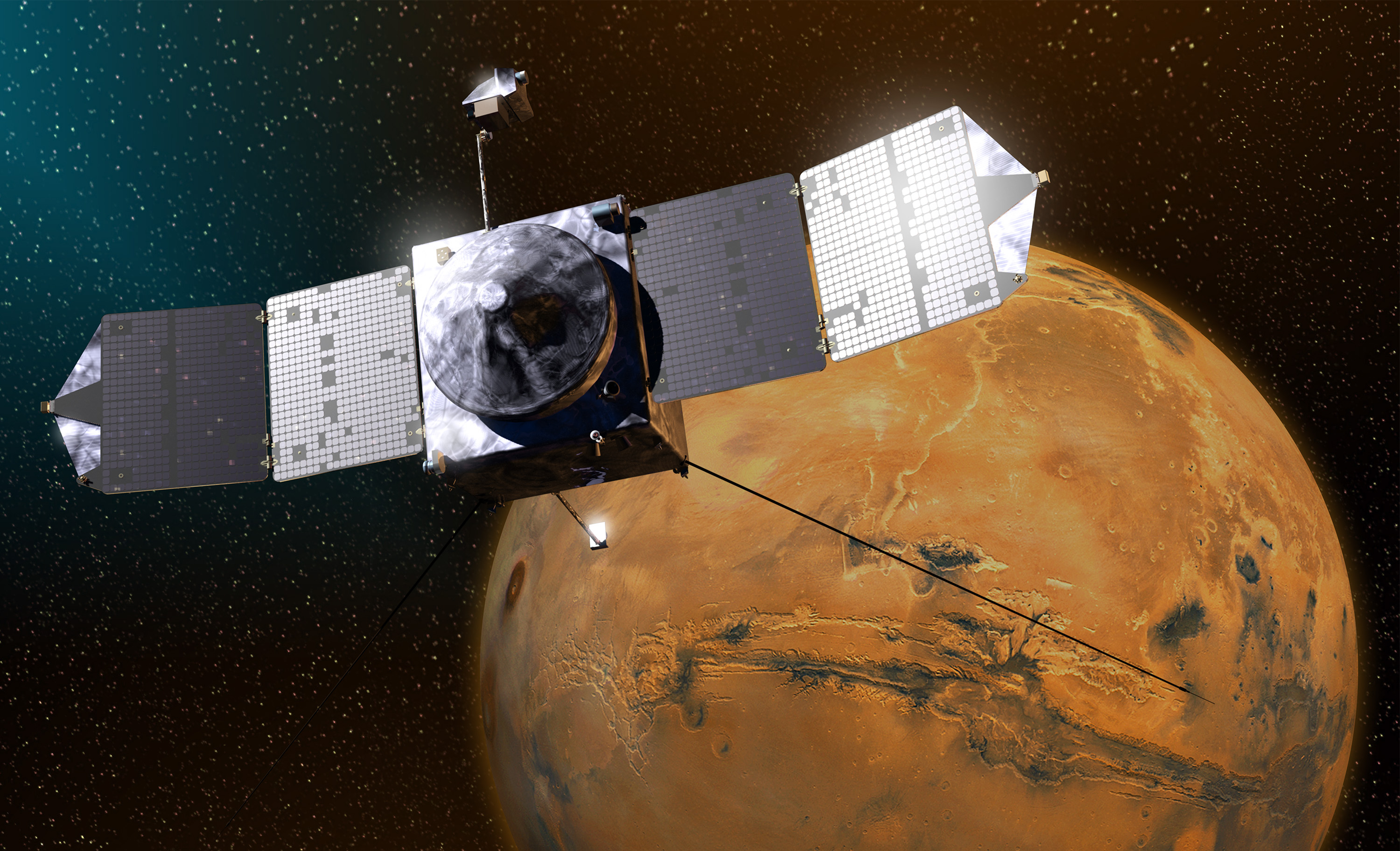
Artist’s rendering of the MAVEN spacecraft at Mars. Credit: NASA/Goddard/University of Colorado/Laboratory for Atmospheric and Space Physics