Wang Yi Visits Canada After Decade Hiatus, Signaling Thaw
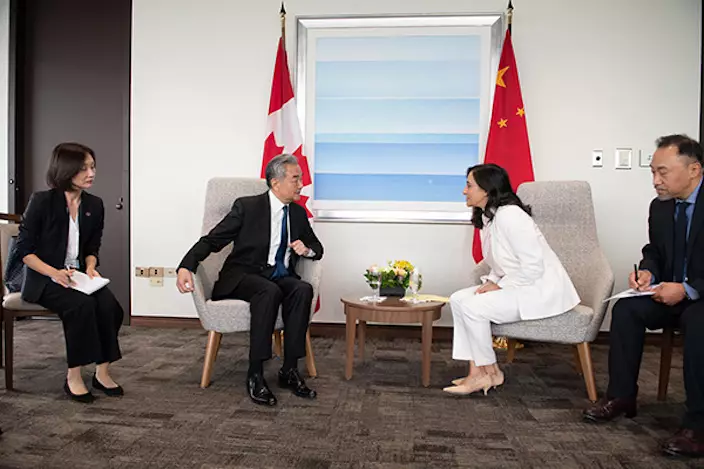
Chinese Foreign Minister Wang Yi visited Canada from May 28–30, 2026 — his first bilateral visit in a decade — marking a significant milestone in the warming of relations between the two countries. The visit builds on momentum generated by Canadian Prime Minister Mark Carney’s landmark trip to Beijing in January 2026, during which the two nations announced a “new strategic partnership.”
A Relationship Restored
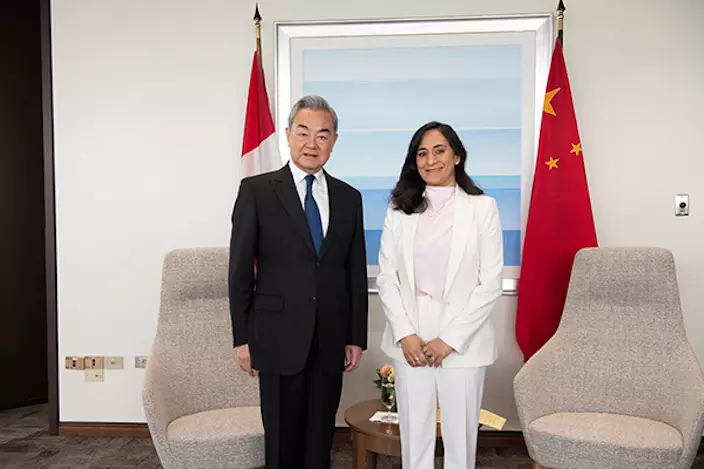
During his three-day visit, Wang Yi met with Prime Minister Mark Carney in Ottawa on May 29, held talks with Foreign Minister Anita Anand, and also met with former Prime Minister Jean Chrétien. According to the Chinese Foreign Ministry, Carney asked Wang to convey his sincere greetings to Chinese leaders, stating that exchanges and cooperation between the two countries had “accelerated their restart and made positive progress” since his January visit.
The visit yielded several concrete outcomes. Both sides agreed to establish a China-Canada Foreign Ministers’ Strategic Dialogue mechanism, restart political and security consultations between the two foreign ministries, and resume the high-level national security and rule of law dialogue. These institutional frameworks are designed to sustain the improved relationship beyond the current political cycle.
“Facts have proven that a better China-Canada relationship serves the interests of both countries, meets the expectations of all parties, and represents the right choice for Canada,” Wang Yi said during his meeting with Carney, as reported by the Chinese Foreign Ministry. “There are no clashes of fundamental interests between the two nations and there is enormous room for cooperation.”
The Carney Pivot
The diplomatic thaw traces its roots to September 2025, when President Xi Jinping met Carney on the sidelines of the APEC summit in Gyeongju, South Korea. That meeting set the stage for Carney’s January 2026 visit to Beijing — the first by a Canadian prime minister since 2017 — where the two countries signed the China-Canada Economic and Trade Cooperation Roadmap, encompassing 28 specific measures across eight areas.
According to the Prime Minister of Canada’s Office, Carney described the relationship at its best as having “created massive opportunities for both our peoples.” The new partnership rests on five pillars: energy cooperation, economic and trade cooperation, public security, multilateralism, and people-to-people exchanges.
Trade and Economic Dimensions
China is Canada’s second-largest trading partner, with $118.9 billion in two-way merchandise trade in 2024. Canada has set an ambitious goal to increase exports to China by 50% by 2030 — a cornerstone of Carney’s strategy to diversify Canada’s trade relationships away from over-reliance on the United States.
Tangible trade outcomes are already visible. Canada reduced tariffs on Chinese electric vehicles from 100% to 6.1%, allowing up to 49,000 Chinese EVs annually. China, in turn, lowered tariffs on Canadian canola seed from approximately 85% to roughly 15% as of March 1, 2026, and removed anti-discrimination tariffs on canola meal, lobsters, crabs, and peas. CGTN reported that Foreign Minister Anand reaffirmed Canada’s commitment to the One-China policy and the goal of increasing exports to China by 50% by 2030.
Strategic Context and the U.S. Factor
A critical dimension of the rapprochement is its timing relative to Canada’s relationship with the United States. Canada faces upcoming CUSMA (USMCA) renegotiations, and Trump’s “America First” policies have created significant uncertainty for Canadian trade. As the Institute for Peace & Diplomacy noted in a symposium published ahead of Wang Yi’s visit, the Carney government has “downplayed ‘values-oriented diplomacy’ while stressing pragmatic economic and trade cooperation grounded in shared interests.”
Zhao Xingshu, a Senior Fellow at the Chinese Academy of Social Sciences, wrote in the symposium that Carney’s approach — which he described as “principled pragmatism” — helps foster “a healthy, stable, and sustainable China-Canada relations.”
What’s Next
Wang Yi’s visit lays crucial groundwork for Prime Minister Carney’s expected attendance at the APEC Economic Leaders’ Meeting in China in November 2026. Canada has expressed support for China’s APEC presidency, and both countries have committed to deepening cooperation on energy, finance, and law enforcement.
Wang Yi also extended an invitation for Canada to participate in the China International Import Expo as the country of honor, according to CCTV English. China has additionally committed to introducing visa-free access for Canadians traveling to China.
However, analysts caution that the relationship remains vulnerable to several structural constraints. The U.S.-China dynamic, domestic political shifts in both countries, and unresolved differences on human rights, Taiwan, and foreign interference allegations all pose risks. As Bastille Post reported, Wang Yi himself acknowledged the need to “properly manage differences, persist in dialogue and communication, and continuously converge common ground while dissolving differences — not engaging in ‘megaphone diplomacy.’”
For now, the institutional mechanisms established during this visit — the strategic dialogue, security consultations, and trade frameworks — provide a foundation for sustained engagement. Whether they lead to a durable reset or remain largely symbolic will depend on how both sides navigate the geopolitical challenges ahead.