NASA Names Artemis III Crew for Critical Lunar Test Flight
NASA has selected the four-person crew for Artemis III, a highly complex demonstration mission in low Earth orbit that will test critical docking systems needed to return humans to the lunar surface. The crew includes NASA Commander Randy Bresnik, European Space Agency Pilot Luca Parmitano, and NASA Mission Specialists Frank Rubio and Andre Douglas, with Bob Hines serving as backup.
Announced on June 9 at NASA’s Johnson Space Center in Houston, the mission marks a significant shift from earlier plans. Originally conceived as the first crewed lunar landing since Apollo 17 in 1972, Artemis III was redesigned in February 2026 as an Earth-orbit risk-reduction flight, with the lunar landing goal pushed to Artemis IV in 2028. NASA Administrator Jared Isaacman described the mission as part of “humanity’s return to the Moon, building on the extraordinary foundation laid by the Artemis II astronauts,” according to a NASA press release.
The Crew
Commander Randy Bresnik, a retired U.S. Marine Corps Colonel, brings extensive experience to the mission. Having logged 149 days in space across two previous flights — including Space Shuttle Atlantis (STS-129) and a Soyuz mission to the International Space Station — Bresnik has served since 2018 as Assistant to the Chief of the Astronaut Office for exploration, overseeing Artemis spacecraft development.
Luca Parmitano of Italy becomes the first European Space Agency astronaut assigned to an Artemis mission. A colonel in the Italian Air Force and veteran of two spaceflights, Parmitano previously commanded Expedition 61 aboard the ISS, becoming the third European and first Italian to hold that position. His first spacewalk in 2013 was famously cut short when his helmet began filling with water in what NASA described as a near-drowning incident.
Frank Rubio, a U.S. Army veteran and board-certified physician, holds the record for the longest single spaceflight by an American astronaut at 371 days. His extended stay aboard the ISS resulted from a coolant leak in his Soyuz MS-22 spacecraft, which required a replacement vehicle before his return. NPR reported that Rubio’s experience will be invaluable for the mission’s complex operations.
Andre Douglas, a U.S. Coast Guard Reserve officer and systems engineer with a Ph.D. from George Washington University, will make his first spaceflight. Selected as a NASA astronaut in 2021, Douglas previously served as backup and closeout crew for Artemis II. “This mission is going to be fantastic. What an excellent crew. Got Artemis! Go NASA!” he said at the announcement.
A Mission of Unprecedented Complexity
Artemis III is described by NASA as “one of the most complex human spaceflight missions” ever attempted. The approximately two-week mission, planned for late 2027, involves three separate rocket launches and two docking operations with commercial lunar landers from competing companies.
The choreography begins with the uncrewed launch of Blue Origin’s Blue Moon lander, which can remain in orbit for up to 90 days. The four astronauts will then launch aboard NASA’s Space Launch System rocket and Orion spacecraft from Kennedy Space Center. After rendezvousing with Blue Moon, the crew will dock and spend about two days testing life support and control systems. Orion will then undock and await SpaceX’s Starship, docking for approximately one day of additional testing before returning for a Pacific Ocean splashdown off the coast of California.
This dual-provider approach pits SpaceX and Blue Origin in a direct operational comparison, reflecting NASA’s strategy of maintaining competition and redundancy in its Human Landing System program.
Challenges and Timeline Uncertainty
The aggressive timeline faces significant headwinds. On May 28, 2026, Blue Origin’s New Glenn rocket exploded during a pre-launch engine test at Cape Canaveral Space Force Station, causing catastrophic damage to the only launch pad capable of launching the Blue Moon lander. While NASA’s Jeremy Parsons expressed confidence that New Glenn would be ready, calling setbacks “a learning opportunity,” space industry experts have suggested repairs could take 12 to 18 months.
NASA Administrator Jared Isaacman has set an ambitious goal of launching Artemis III by the end of 2027, followed by the first crewed lunar landing on Artemis IV in early 2028. When asked whether the mission would launch if the landers weren’t ready, Isaacman stated the agency would not launch “until we feel like the objectives that are outlined are sufficient to bring down the risk for a follow-on landing to the Moon itself.”
Why This Mission Matters
Artemis III serves as a critical bridge between the successful Artemis II lunar flyby completed in April 2026 and the first crewed lunar landing planned for 2028. The mission will validate Orion’s new docking system for the first time and demonstrate the complex orbital operations required for future lunar landings.
As Artemis II Commander Reid Wiseman said while handing a ceremonial baton to the new crew: “We’ve been carrying these batons around for way too long. So with that, the Artemis II crew hands you the baton. You got the controls.”
Commander Randy Bresnik captured the mission’s significance simply: “The most important Artemis mission will always be the next Artemis mission.”
With a crew combining deep experience and fresh talent, and a mission design that pushes the boundaries of commercial partnership, Artemis III represents a pivotal moment in humanity’s return to the Moon — and a critical stepping stone toward the ultimate goal of crewed missions to Mars.
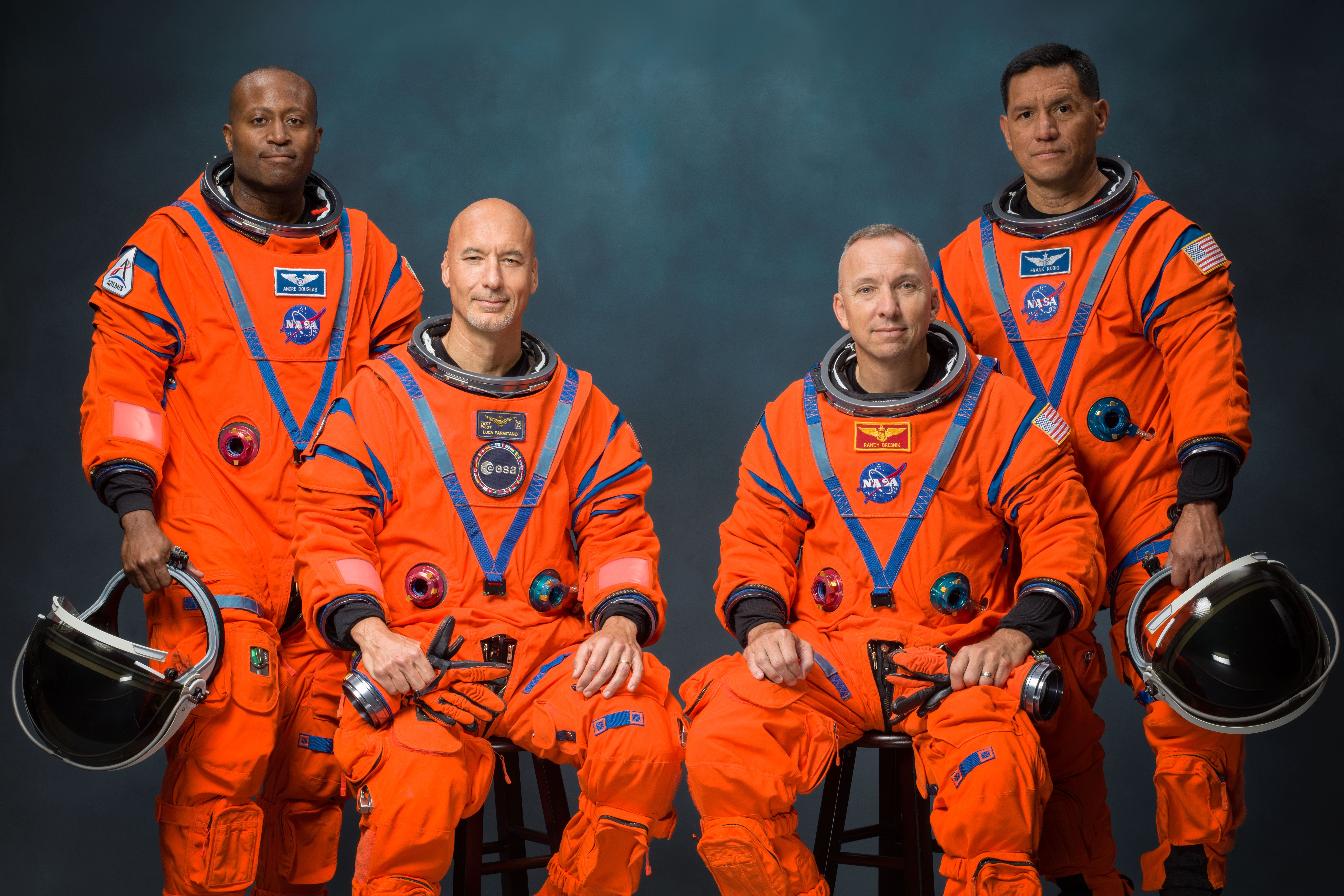
Image credit: NASA/Bill Stafford