Brussels Justice Palace Facade Emerges After Decades Hidden
For the first time in over 40 years, a significant portion of the iconic Brussels Justice Palace facade is visible without scaffolding. The middle section of the monumental building’s front facade has been fully restored and unveiled, marking a major milestone in one of Belgium’s most ambitious heritage restoration projects, as reported by VRT NWS.
A Landmark Emerges from Its Metal Cage
The Brussels Justice Palace, designed by architect Joseph Poelaert and inaugurated in 1883, is the largest courthouse in the world and the largest 19th-century building in Europe. Covering 26,000 square meters — larger than St. Peter’s Basilica — its copper dome has long defined the Brussels skyline. Yet for generations of Belgians, the building has been synonymous with scaffolding.
“A whole generation of Belgians has never really known the Justice Palace without scaffolding,” said Vanessa Matz, Minister of Modernization of the Government, responsible for State Building Management. “People aged 40 or younger have seen it hidden behind a metal cage almost their entire lives.”
The scaffolding first went up in 1984, and what was meant to be a temporary renovation spiraled into a four-decade saga marked by contractor bankruptcies, bureaucratic delays, and political tensions. The situation became a running joke and a symbol of Belgian administrative dysfunction, with former State Secretary Mathieu Michel calling the 40-year delay “totally unacceptable.”
Phased Restoration Nears Completion
The current Phase 1 of the facade restoration began in August 2023 and covers the front facade (22,750 m² — nearly five football fields), the forecourt, and the colonnade. The work is being carried out in three sections: the right section was completed in May 2025, the middle section was finished in June 2026, and work continues on the left section, as detailed by the Regie der Gebouwen.
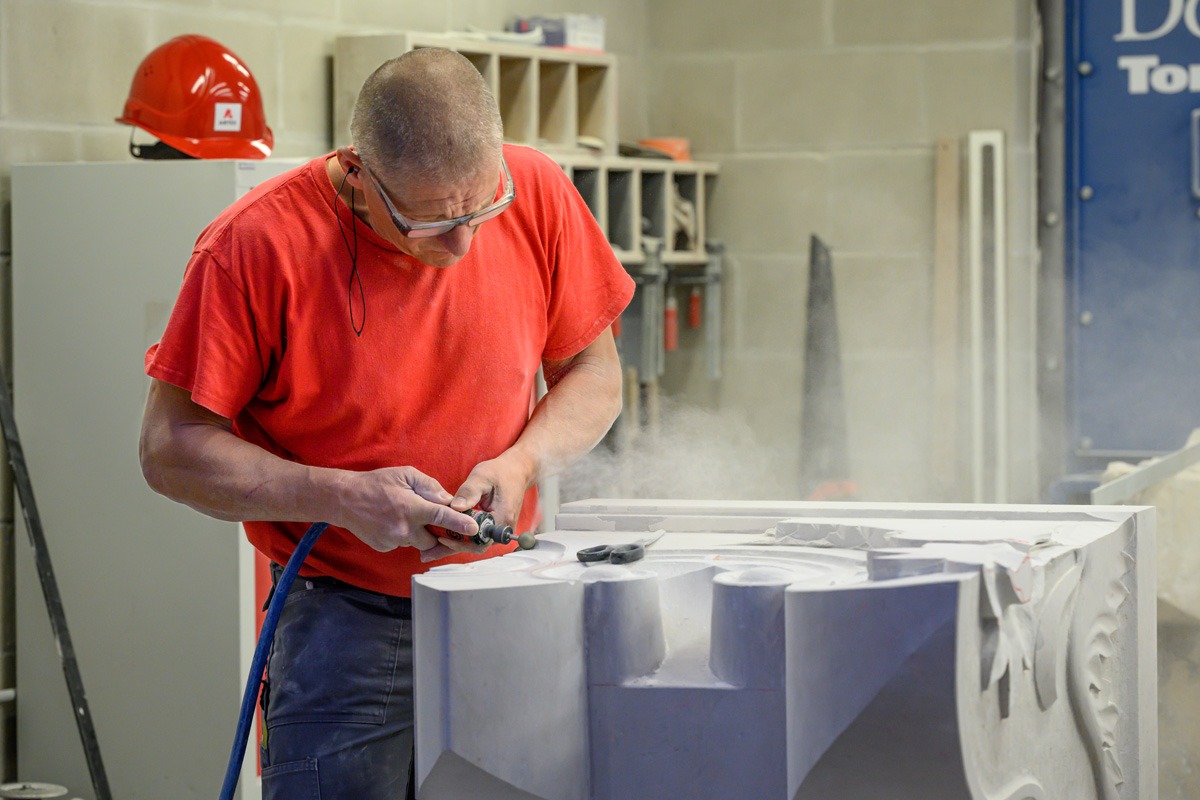
The restoration uses original materials sourced from the same quarries used in the 19th century: Comblanchien stone from Burgundy, France, and blue hard stone from Soignies, Belgium. Advanced Building Information Modeling (BIM) technology — unusual for heritage restoration — is being employed alongside traditional stonemasonry techniques. Robots assist with stone milling, but manual finishing is required for every piece. To date, 137 m³ of stone (approximately 370 tons, equivalent to 14 truckloads) has been replaced.
Some 70 to 80 workers are on site daily. A platform lift for persons with reduced mobility is also being installed on the left side of the facade. The main entrance will reopen upon completion of Phase 1, expected by summer 2026.
A €600 Million Undertaking
The cost of Phase 1 alone is €31.7 million (including VAT). But the full scope of the restoration is far larger. In response to a parliamentary question from MP Britt Huybrechts, Minister Matz revealed in March 2026 that the total estimated cost for the complete restoration — exterior and interior — exceeds €600 million, as reported by RTBF.
This breaks down into approximately €128.5 million for all exterior facades and an estimated €480 million for the interior renovation, based on a feasibility study. The interior work, however, has no confirmed timeline yet.
What Comes Next
Phase 2, focusing on the dome base (socle), is expected to begin in early 2027 and run through 2029. Phases 3 and 4 will address the remaining facades on the Rue de Wynants, Rue aux Laines, and Rue des Minimes. The target for completing all exterior facade restorations is 2035.
The interior renovation — potentially the most complex and costly phase — remains a longer-term prospect. As lawyer Jean-Pierre Buyle, founder of the Poelaert Foundation, told Business AM: “If a ceiling collapses here due to moisture problems, we look at it, close the door and wait two or three years. But if it happens in Parliament or the Royal Palace, workers are on site the next day.”
Justice Minister Annelies Verlinden called the progress “a promising step forward,” noting that the restored facade shows “not only the tour de force of this complex restoration project, but also the potential of what is yet to come.”
For now, Brussels residents and visitors can once again see Poelaert’s neo-classical masterpiece emerging from its steel cage — a view that, for many under 40, is entirely new. By summer 2026, the entire front facade should be fully visible, offering a glimpse of what the complete restoration will achieve by 2035.