Supreme Court Expands Trump Immigration Powers Amid Demographic Crisis
The Supreme Court has handed President Trump sweeping new authority over immigration policy in two landmark rulings, empowering the administration to deport hundreds of thousands of migrants living legally under Temporary Protected Status (TPS) and to turn away asylum seekers at the border. Experts warn the decisions could accelerate a historic population decline that is already reshaping the United States.
In a 6-3 decision on June 25, the high court ruled that federal law allows the government to stop asylum seekers from physically entering the country, effectively barring them from applying for asylum. Justice Samuel Alito wrote for the majority, while Justice Sonia Sotomayor authored the liberal dissent. Two days later, the Court confirmed that President Trump has broad authority to terminate TPS for Haitians, Syrians, and others — a program that currently protects approximately 650,000 people from deportation, as NPR reported.
A Demographic Tipping Point
The rulings come at a moment when the United States is confronting what demographers describe as a demographic crisis. U.S. birthrates have declined 23% since 2007, with just 3,606,400 newborns in 2025 — roughly 710,000 fewer than the 2007 peak, according to the CDC’s National Center for Health Statistics. Until recently, robust immigration largely offset this trend. Now, both pillars of population stability are collapsing simultaneously.
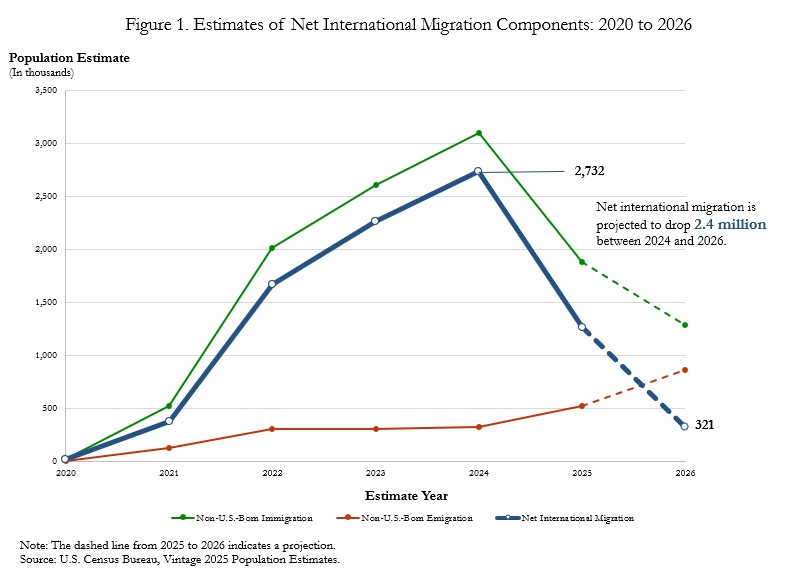
Net international migration peaked at 2.7 million in 2024, declined to 1.3 million in 2025, and is projected to fall to approximately 321,000 in 2026 — a decline of nearly 90% from peak levels, according to the U.S. Census Bureau. The foreign-born population, which reached a record 53.3 million in January 2025, has already fallen by 1.4 million to 51.9 million as of June 2025 — marking the first decline since the 1960s, the Pew Research Center reported.
“We’re destined to be there, in short order, there’s no question,” said David Bier, an immigration and population expert at the libertarian Cato Institute. “We’re already seeing a situation where most counties in the United States had more deaths than births.”
Broader Economic Consequences
The economic implications are far-reaching. Between January and June 2025, the immigrant share of the U.S. labor force dropped from 20% to 19%, representing a loss of over 750,000 immigrant workers, according to Pew. The Congressional Budget Office projects roughly 8 million fewer U.S. residents by 2055 than previously predicted, with the population aged 24 or younger projected to decline in each of the next 30 years.
Economists warn that without migrants, the number of young workers paying into Social Security will fall more rapidly; schools in many areas will close; and the number of young families having children will continue to decline. The Census Bureau estimates that without robust migration, total U.S. population loss by the end of this century could exceed 107 million people.
“Our higher birthrates of a century ago are not coming back,” Bier said. “There’s no way to have a sustainable fiscal and economic situation that doesn’t involve immigration.”
States on the Front Line
William Frey, a demographer at the Brookings Institution, described the Supreme Court rulings as “alarming.” He noted that the impact extends far beyond traditional immigrant destinations.
“Not just in big immigration states, but in places that have relatively small numbers of immigrants — Iowa, Kansas, Nebraska — those states require immigrants to get any population growth,” Frey said. “This is as clear as the nose on your face. You’ve got to have this growth in the younger population if you’re going to survive. Immigration is a key part of that going forward.”
Population growth in the U.S. fell by half in 2025 from the previous year, with five states already losing population. The total number of young Americans under age 25 is falling nationwide.
The Administration’s Next Target
The Trump administration views the rulings as a mandate for further restrictions. Stephen Miller, the White House deputy chief of staff for policy, announced that ending birthright citizenship for children of migrants born in the U.S. is the next step. Justices are expected to rule on this as early as next week.
“America’s doors are closed fully to asylum seekers,” Miller said on Thursday. “This country doesn’t have a future if we don’t end birthright citizenship.”
Last month, Trump issued an executive order making it harder for migrants without full legal status to use banking and financial services. The administration has also terminated the CHNV parole program, affecting approximately 500,000 immigrants from Cuba, Haiti, Nicaragua, and Venezuela.
A Clash of Worldviews
The policy direction reflects a fundamental disagreement about the role of immigration in American society. Christopher Hajec of the Federation for American Immigration Reform (FAIR) praised the rulings, stating that “our immigration laws are written to be pro-enforcement, not anti-enforcement.”
But Bier, who worked as a Republican congressional staffer on immigration policy, said that when he talks to conservatives about the economic and demographic risks of closing the country’s doors, many respond with a cultural argument: they “would rather have a declining population of ‘true Americans’ than have an economy kept afloat by people who don’t share their values.”
What Comes Next
The convergence of declining birthrates and plummeting immigration places the United States on a demographic trajectory similar to that of China, Italy, and South Korea — nations facing rapid aging and population decline. The U.S. has experienced net positive migration for over 50 years, a trend now at risk of reversing. The Census Bureau warns that if current trends continue, the U.S. could see net negative migration for the first time in more than half a century.
With the Supreme Court expected to rule on birthright citizenship within days, the stakes could not be higher. As Martha Bailey, an economist at UCLA, noted, the question is not whether Americans will have fewer children — that trend is already well established — but whether the nation will continue to welcome the immigrants needed to sustain its population and economy.
“People are having the number of children they want and that they can afford at a time that makes the most sense for them,” Bailey said. “What I don’t think anyone is in favor of is a Handmaid’s Tale type policy regime, where we’re trying to talk families into having children they don’t want.”
The coming weeks will determine not only the fate of birthright citizenship but also whether the United States chooses to embrace immigration as a solution to its demographic challenges — or accelerate a decline that experts say will reshape the nation for generations.