Rubin Observatory Begins Its Dazzling 10-Year Census of the Cosmos
On June 30, 2026, perched atop Cerro Pachón in the Chilean Andes, the NSF–DOE Vera C. Rubin Observatory officially switched on its 3,200-megapixel camera and began the most ambitious astronomical survey ever attempted. Over the next decade, the Legacy Survey of Space and Time (LSST) will create an ultra-wide, ultra-high-definition time-lapse record of the universe — capturing everything from nearby asteroids to the most distant galaxies in a single, sweeping cinematic narrative.
“Today, we begin filming the greatest cosmic movie ever made,” said Brian Stone, performing the duties of the NSF Director, as announced by NOIRLab.
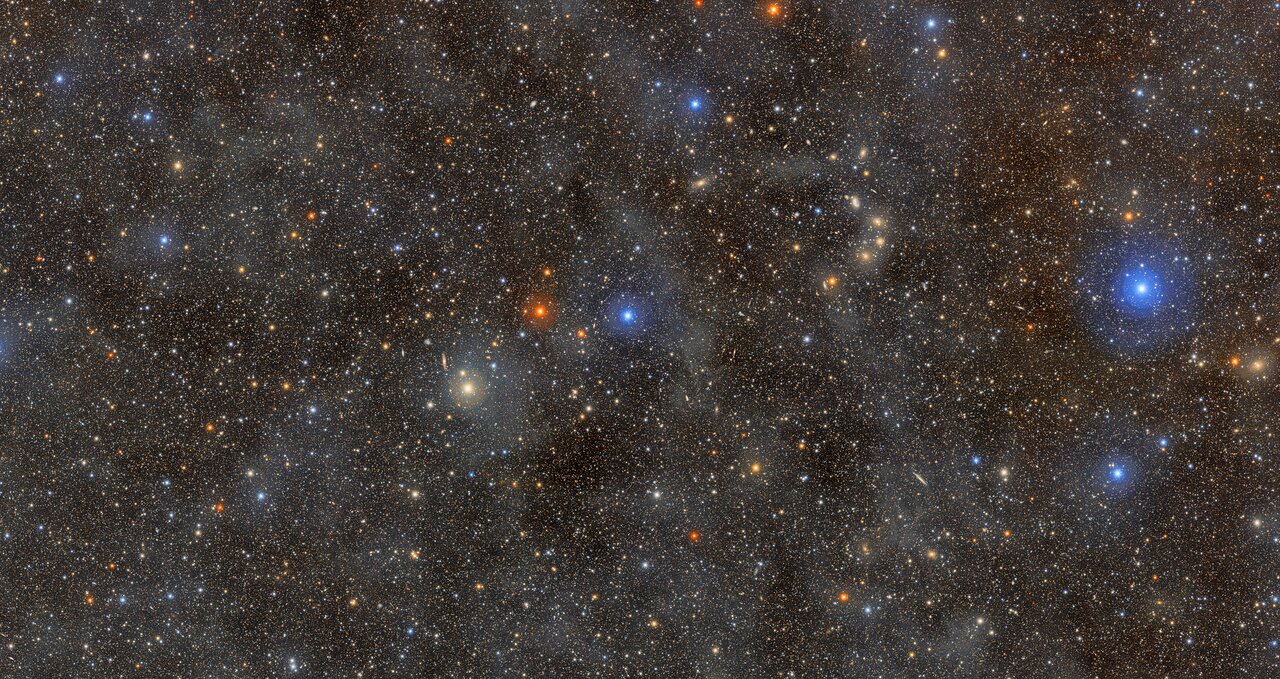 A 1.7-gigapixel image of a star field in the constellation Lupus, captured by the Simonyi Survey Telescope. The faint, glowing clouds are galactic cirrus — interstellar gas and dust in the foreground of the Milky Way. Credit: NSF–DOE Vera C. Rubin Observatory/NOIRLab/SLAC/AURA
What Makes Rubin Different
Unlike traditional telescopes that capture static snapshots of small patches of sky, Rubin is designed for speed and breadth. The 8.4-meter Simonyi Survey Telescope pairs enormous light-collecting power with an exceptionally wide field of view, while the LSST Camera — the largest digital camera ever built, weighing three tons — captures a new detailed image approximately every 40 seconds.
Over the next ten years, Rubin will observe the entire southern sky every few nights, returning to each point in the sky about 800 times. This repeated coverage is what makes the survey revolutionary: it transforms astronomy from a series of still images into a dynamic, time-resolved record of cosmic change.
A Discovery Machine Already in Motion
Rubin has already proven its capabilities. During early optimization surveys lasting just six weeks, the observatory discovered over 11,000 never-before-seen asteroids, including 33 near-Earth objects and 380 trans-Neptunian objects. One of these is the fastest-spinning asteroid larger than 500 meters ever found.
“It’s what I could only dream about 25 years ago,” said Mike Brown, a planetary scientist at Caltech. “If you talk to 50 different astronomers, you would get 50 different answers about what they are looking forward to.”
The Four Pillars of the Survey
The LSST is designed to address four fundamental science questions:
Dark Energy and Dark Matter: By observing the shapes and positions of billions of galaxies, Rubin will map the distribution of dark matter through weak gravitational lensing and help unravel the mystery of the universe’s accelerating expansion.
Solar System Inventory: Rubin will create a comprehensive census of millions of asteroids, comets, and trans-Neptunian objects — including the ongoing search for the hypothetical Planet Nine.
Transient Phenomena: The observatory will detect supernovae, tidal disruption events, and other cosmic explosions, issuing up to 7 million alerts per night to astronomers worldwide.
Milky Way Structure: Rubin’s deep, wide-field imaging will map the structure and evolutionary history of our own galaxy in unprecedented detail.
A Data Revolution for Everyone
Each night, Rubin generates approximately 10 terabytes of data. When the survey concludes in 2036, the final dataset will contain billions of objects with trillions of measurements — all made publicly accessible through regular data releases.
“Rubin Observatory is for everyone,” said Bob Blum, Director of Rubin Observatory at NSF NOIRLab. “The LSST will change how we do astronomy and astrophysics, allowing researchers anywhere to participate in cutting-edge science.”
This democratization of data represents a fundamental shift. For the first time, anyone with an internet connection will have access to a dataset that surpasses the combined output of every visible-light observatory in human history.
Challenges Ahead
The survey is not without obstacles. More than 15,000 satellites now orbit Earth, with thousands more planned by companies such as Starlink. These can leave bright streaks across Rubin’s images, potentially obscuring faint astronomical sources. Managing the “tsunami of information” — the 7 to 10 million nightly alerts — also requires sophisticated AI-powered filtering systems and alert brokers to identify the most scientifically valuable events.
What to Watch For
As the LSST gets underway, astronomers are most excited about the unexpected. “I think the most important questions LSST will help us answer are possibly the ones we haven’t even thought of yet,” said Kat Volk of the Planetary Science Institute.
With its first full night of science operations now complete, the Rubin Observatory is writing the opening chapter of what promises to be the greatest astronomical story ever told — a decade-long journey into the dynamic, ever-changing universe we call home.
For real-time updates on the survey’s progress, visit rubinobservatory.org.