PBOC, HKMA Unveil 11 Measures to Deepen HK Bond Market
The People’s Bank of China (PBOC) and the Hong Kong Monetary Authority (HKMA) have unveiled a sweeping package of 11 measures designed to deepen Hong Kong’s bond market, expand the offshore renminbi (RMB) ecosystem, and reinforce the city’s position as a premier global financial hub. Announced on July 7 at the Hong Kong Fixed Income and Currency (FIC) & Bond Connect Summit, the initiatives mark one of the most significant upgrades to cross-border financial connectivity between Mainland China and Hong Kong in recent years.
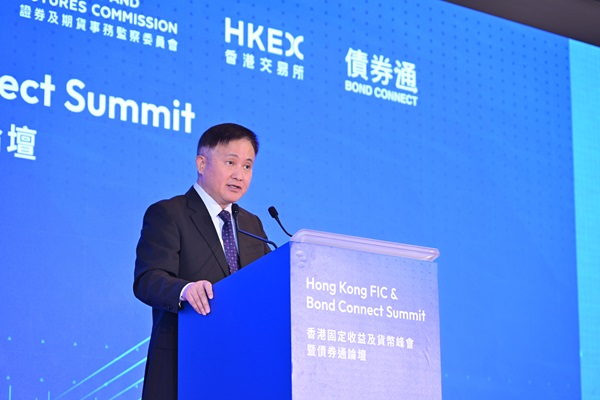
PBOC Governor Pan Gongsheng, who unveiled the package in a keynote address, said the yuan’s global use is “moving beyond trade settlement into investment, financing and reserve management,” signaling a strategic shift in China’s approach to currency internationalization. According to Caixin Global, the coordinated measures involve the PBOC, HKMA, and the Securities and Futures Commission (SFC), aimed at cementing Hong Kong’s role as the leading offshore yuan hub in an increasingly multipolar global monetary system.
Six Measures Targeting Fixed Income and Currency Markets
Six of the 11 measures focus on strengthening Hong Kong’s fixed-income and currency (FIC) infrastructure. The centerpiece is a significant expansion of the Southbound Bond Connect program, with its annual net investment quota raised from RMB 500 billion to RMB 800 billion (approximately $117.8 billion). The program will also include bond repurchase (repo) transactions, expand product scope to cover Hong Kong dollar- and yuan-denominated bonds, and extend its reach to Macao’s bond market.
In a parallel move, the China Foreign Exchange Trade System (CFETS) and Hong Kong Exchanges and Clearing Limited (HKEX) will jointly develop an electronic FIC trading platform, designed to complement existing channels and bring additional liquidity to the market. The HKMA confirmed that the Northbound Bond Connect settlement deadline will be extended by one hour to 4 p.m., improving operational efficiency for international investors.
Perhaps the most impactful measure for global investors is the planned launch of five-year offshore Chinese government bond futures on August 3, 2026. As HKEX announced, this will provide foreign investors with a critical hedging tool for their RMB bond holdings — a development long sought by international portfolio managers. By end-May 2026, overseas investors already held 3.2 trillion yuan of Chinese bonds, underscoring the growing demand for such risk management instruments.
Regulators also plan to expand the use of yuan bonds as eligible collateral, with onshore Chinese government and policy-bank bonds held through Northbound Bond Connect expected to be accepted by Hong Kong Futures Clearing Co. and SEHK Options Clearing House within 2026. Additionally, the 7-day depository institutions repo rate (FDR007) will be added as a reference rate for Swap Connect from Q4 2026, further enhancing risk management tools for international investors.
Five Measures to Boost Offshore RMB Market
The remaining five measures target the development of Hong Kong’s offshore RMB market. The RMB Business Facility (RBF), launched in October 2025, will see its quota more than double from RMB 200 billion to RMB 500 billion, effective July 10, 2026. New borrowing tenors of 9 months, 2 years, and 3 years will be introduced, better satisfying corporate clients’ funding demands for fund allocation and direct investment.
HKMA Chief Executive Eddie Yue welcomed the expansion, stating that the HKMA is also exploring a 7-day offshore RMB liquidity tender mechanism via repos to improve pricing signals, and studying the issuance of short-term offshore RMB debt instruments to fill gaps at the short end of the yield curve. As China Daily reported, Pan Gongsheng noted that Chinese bonds have become “increasingly attractive to global investors thanks to their relative stability and diversification benefits,” creating what he called a “rare development opportunity” for Hong Kong’s offshore RMB bond market.
In a significant step toward regional currency cooperation, the PBOC, HKMA, and Bank Indonesia signed a trilateral arrangement to promote local-currency settlement and reserves, with direct trading between offshore yuan and Indonesian rupiah targeted by end-2026. HKMA Deputy Chief Executive Chen Weimin indicated that similar arrangements with other Asian economies could follow if the Indonesia framework proves effective.
Infrastructure and Settlement Enhancements
Beyond the 11 measures, the summit also witnessed the signing of a Memorandum of Understanding between HKEX and CIPS Co. Ltd., operator of China’s Cross-border Interbank Payment System. As HKEX detailed, OTC Clearing Hong Kong Limited intends to apply to become a direct participant of CIPS, enabling more efficient cross-border RMB clearing and settlement. HKEX CEO Bonnie Y Chan said direct access to CIPS would “enhance OTC Clear’s settlement capabilities and lay the foundation for HKEX’s broader FIC product and infrastructure development.”
HKMA also became the first monetary authority to participate in PBOC’s FIMA RMB Repo facility for central banks, completing the first transaction — a milestone that Yue said would “facilitate RMB liquidity management for monetary authorities” and further increase demand for RMB fixed-income assets.
Gold Clearing System Launches in Parallel
Adding to the day’s announcements, Hong Kong’s central gold clearing system began trial operation, with Delivery Connect linking the Hong Kong and Shanghai gold markets. Hong Kong Chief Executive John Lee declared at the summit: “If gold is the world’s safe haven, then Hong Kong will be its safe harbour — with a clearing system that makes every trade shipshape, and every trust bankable.”
Implications and Outlook
The 11 measures represent a significant acceleration of China’s yuan internationalization strategy under the national 15th Five-Year Plan. By deepening Hong Kong’s FIC ecosystem and expanding offshore RMB liquidity, the initiatives aim to attract greater foreign investment into Chinese bond markets while reducing global reliance on the US dollar-dominated financial architecture.
For investors, the package offers tangible improvements: expanded access to China’s bond market through a larger Southbound quota, better hedging tools via new bond futures, enhanced settlement efficiency, and deeper RMB liquidity. The trilateral arrangement with Indonesia signals a broader strategy to promote bilateral currency settlement with Asian trading partners, potentially reshaping regional financial dynamics.
As these measures take effect through the remainder of 2026 and beyond, Hong Kong’s position as the world’s leading offshore RMB hub appears increasingly secure — though competition from Singapore and other financial centers will remain a factor to watch.