China Activates Level 4 Disaster Response for Jilin as Typhoon Bavi Floods Northeast
China’s National Disaster Prevention, Reduction and Relief Committee activated a Level 4 national disaster relief emergency response for Jilin Province on Wednesday, as Typhoon Bavi’s long-range moisture transport continues to unleash devastating floods across Northeast China. A working group has been dispatched to the disaster area to coordinate relief efforts, according to Xinhua News.
The activation marks the latest escalation in China’s response to what has become the most powerful storm to strike mainland China in 2026, with authorities warning that the crisis is far from over.
Typhoon Bavi’s Unprecedented Path
Typhoon Bavi, the ninth named storm of the 2026 Pacific typhoon season, formed in the western Pacific approximately two weeks ago and grew to cover an area the size of France. After making landfall in Zhejiang Province on July 11 — where authorities evacuated nearly 2 million people — the storm has maintained an unusually well-preserved warm core, making it the longest-lasting tropical cyclone in the Asia-Pacific region this year, as reported by the Straits Times.
Unlike typical typhoons that dissipate quickly after landfall, Bavi has retained much of its moisture as it tracks northward, drawing vast amounts of tropical humidity into northern China. The storm is now expected to transition into an extratropical cyclone while continuing to release moisture over the already-saturated Northeast.
Widespread Evacuations and Infrastructure Disruption
More than 260,000 people have been evacuated in Liaoning Province alone, according to CNBC. In Shenyang, the provincial capital, a floating lighthouse severed a high-voltage power line and drifted through floodwaters on main roads. All schools and training institutions have been ordered to suspend classes, and transport services have been largely disrupted across Shenyang and Jilin.
The Ministry of Water Resources upgraded its flood-control emergency response from Level IV to Level III for Liaoning and Jilin provinces on Monday, with 28 counties placed under red alert for flash flood meteorological risks and 8 counties under orange alert, ECNS reported.
Songhua River Flood No. 1 of 2026
A critical development occurred on Tuesday when the Songhua River’s Jilin section experienced its first numbered flood of 2026. The Fengman Reservoir recorded an inflow of 10,900 cubic meters per second at 2:00 PM, prompting the Ministry of Water Resources to scientifically dispatch both the Fengman and Baishan reservoirs for flood retention and peak reduction, according to China Water.
The Jilin Provincial Flood Control Bureau had already upgraded its emergency response from Level IV to Level III on July 10, forecasting weekly rainfall of 100 to 250 millimeters, with local accumulations potentially reaching 400 millimeters. Officials warned that multiple rivers — including the Songhua, Dongliao, Huifa, Yinma, Yitong, and Lalin — might exceed warning levels, as reported by the Economic Observer Network.
Central Flood Control Materials Deployed
At the request of the Liaoning Provincial Flood Control and Drought Relief Headquarters, the National Flood Control Office and National Grain and Strategic Reserves Bureau have allocated 500,000 woven bags, 100,000 square meters of filament geotextile, and 150 sets of levee inspection lights to support Liaoning’s flood control operations.
‘Train Effect’ and Extreme Rainfall
Central Meteorological Observatory Chief Forecaster Chen Tao warned that rainfall in central and northern Liaoning and central Jilin could break historical daily records, with cumulative rainfall of 40 to 100 millimeters — and locally up to 300 to 450 millimeters — driven by a phenomenon known as the “train effect” (列车效应), as reported by The Paper.
“Although Typhoon Bavi has weakened, its impact cannot be ignored, especially in Liaoning and Jilin, where rainfall has significant extremity,” Chen Tao said.
The “train effect” occurs when multiple convective cloud cells pass over the same area sequentially, like train cars on a track, causing sustained heavy downpours in a single location and significantly increasing the risk of flash flooding.
Climate Change Context
Chen Tao also linked the extreme weather to broader climate trends, noting that under global warming, weather extremity is intensifying and climate patterns are transforming. “With El Niño叠加 global warming, weather and climate anomalies no longer appear as single disasters in single regions, but present complex characteristics such as multiple disasters occurring simultaneously across multiple regions,” he said.
This year’s typhoon season is forecast to be unusually active, with the National Climate Center predicting 5 to 6 typhoons during the July-August peak period, with 2 to 3 making landfall. China is simultaneously dealing with flooding in multiple regions, including Guangxi in the south and Hebei in the north, reflecting the multi-hazard pattern described by meteorologists.
What to Watch For
As Bavi continues its northward track toward the Korean Peninsula, the immediate concern remains the sustained release of moisture over Jilin and Liaoning, where the ground is already saturated. The dispatched working group from the National Disaster Prevention Committee will assess damage and coordinate relief for affected communities. With the Songhua River already at flood stage and reservoir operations under strain, the coming days will be critical for determining the full extent of the disaster and the effectiveness of China’s multi-layered emergency response system.
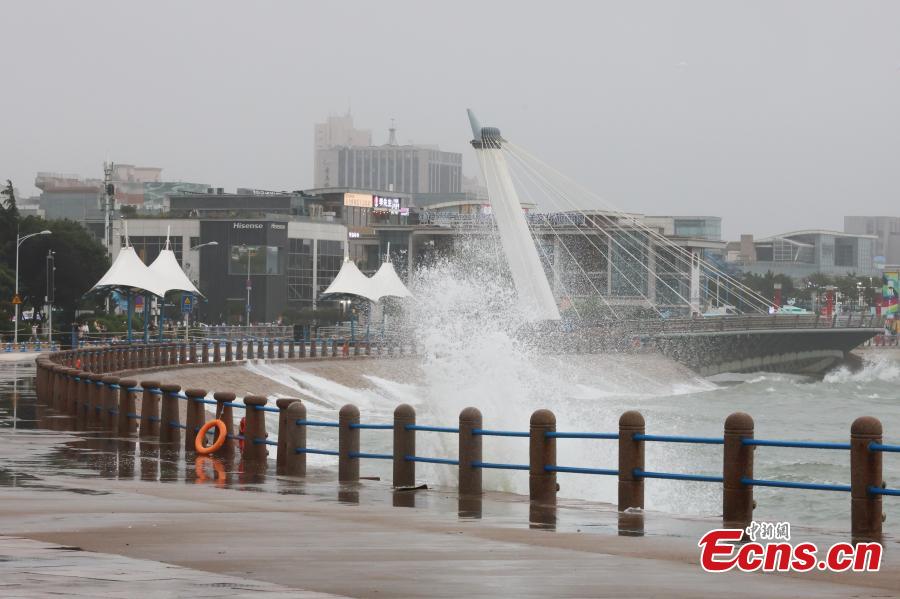 High waves crash along the Qingdao coast as Typhoon Bavi churns northward through the Yellow Sea on July 13, 2026. (China News Service / Zhang Xiaopeng via ECNS)