Faint New Planet Found Around Young Star After Decade-Long Hunt
Astronomers have discovered a faint, elusive third planet orbiting the young star Beta Pictoris, ending an 11-year cosmic game of hide-and-seek. The planet, designated Beta Pictoris d, is the faintest exoplanet ever directly imaged from Earth and was detected independently by two teams using different telescopes just days apart in late 2025. Their findings, published simultaneously on July 15, 2026, in The Astrophysical Journal Letters, make Beta Pictoris only the second planetary system known to contain at least three directly imaged planets.
A System Under Scrutiny
Beta Pictoris, located 63 light-years from Earth in the southern constellation Pictor, is one of the most intensely studied planetary systems in the galaxy. The star is nearly twice as massive as our Sun, nine times brighter, and remarkably young at roughly 20 to 23 million years old — a cosmic infant compared to our 4.5-billion-year-old Sun. The system is surrounded by a prominent debris disk extending five times farther out than Pluto’s orbit, acting like a cosmic fog that has long obscured its secrets.
Two giant planets were already known in the system: Beta Pictoris b, one of the first exoplanets ever directly imaged, and Beta Pictoris c, discovered through radial velocity measurements. Both are approximately ten times the mass of Jupiter. The newly discovered Beta Pictoris d, by contrast, is a far more modest 2.4 times Jupiter’s mass and 100 times fainter than its larger sibling.
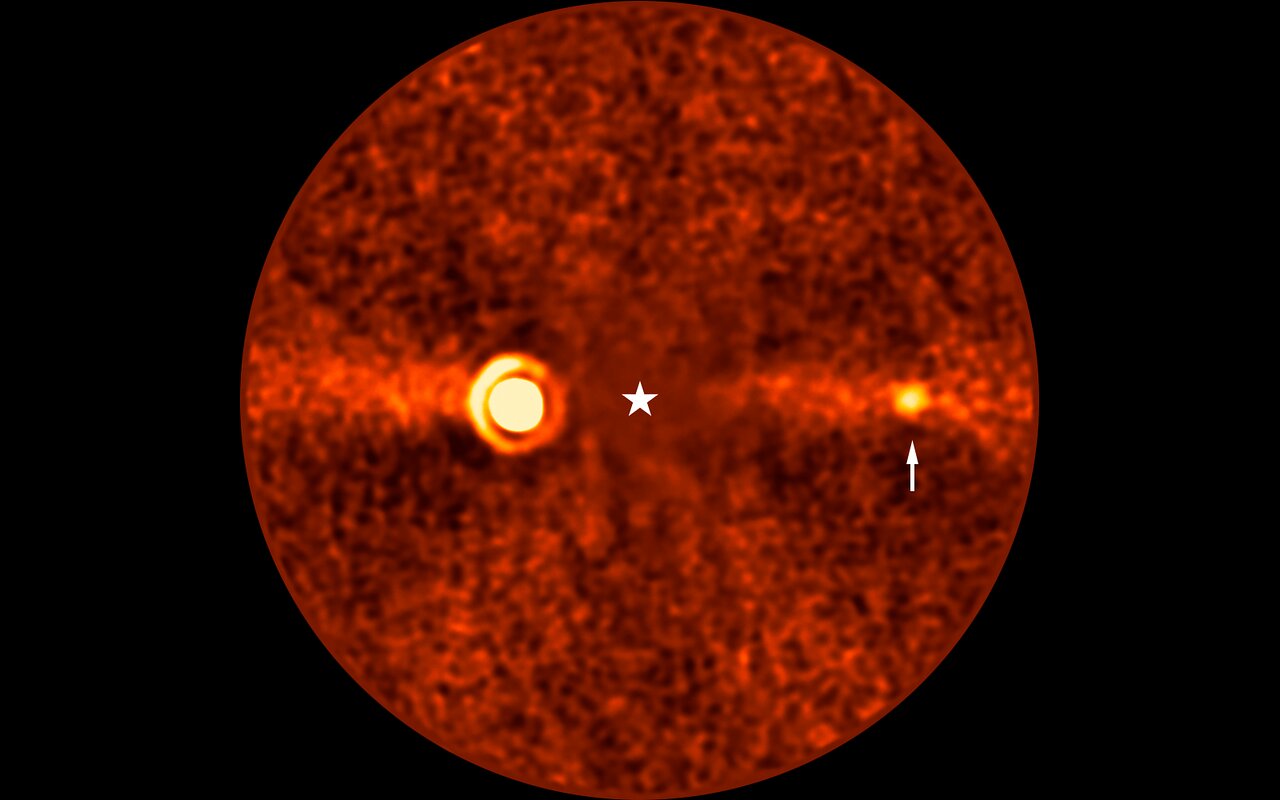 Beta Pictoris d (right) as imaged by the Very Large Telescope. Credit: ESO/B. Sutlieff, M. Bonse et al.
A Serendipitous Discovery
Remarkably, neither team was searching for a new planet. The European Southern Observatory (ESO) team, using the Very Large Telescope (VLT) in Chile, was studying variability in Beta Pictoris b’s light. The NASA-led team was using the James Webb Space Telescope’s NIRSpec instrument to analyze Beta Pictoris b’s atmosphere.
“We weren’t looking for a new planet,” said Aidan Gibbs of the University of California, San Diego, who led the Webb team, according to NASA Science. “We were trying to understand one we already knew existed. Then, this telltale signal appeared in the data where we didn’t expect it.”
The Webb team detected the planet not through direct imaging but by identifying carbon monoxide absorption lines — the chemical fingerprint of a planetary atmosphere. This marks the first time a directly imaged planet has been discovered primarily through moderate-resolution spectroscopy, a technique that could transform the search for exoplanets.
“A spectrum contains an incredible amount of information,” said Jean-Baptiste Ruffio, principal investigator of the Webb observations. “You don’t just learn that something is a planet; you immediately begin learning about its temperature, chemistry, and motion.”
Why It Stayed Hidden
Beta Pictoris d remained concealed for over a decade for several reasons. At 100 times fainter than Beta Pictoris b, it is extraordinarily dim. Its wide orbit — 26 to 30 astronomical units from its star, comparable to the region between Uranus and Neptune in our solar system — gives it a 91-year orbital period, meaning it moves slowly across the sky. The system’s debris disk further complicated detection by scattering starlight.
“It was very much playing hide-and-seek for 11 years,” said Markus Bonse of ESO, co-leader of the VLT team, as reported by the European Southern Observatory. Once the team knew where to look, they found the planet hiding in archival data spanning more than a decade, including observations from ESO’s SPHERE instrument and Webb’s NIRCam.
A Laboratory for Planet Formation
The discovery makes Beta Pictoris a unique laboratory for understanding how planetary systems form and evolve. With three directly imaged planets of different masses and orbits, astronomers can compare their atmospheres and properties within a single, well-characterized environment.
“Systems with multiple directly imaged exoplanets are the ‘holy grails’ of discoveries,” said Ben Sutlieff of the University of Edinburgh, co-lead of the VLT study, according to the Max Planck Institute for Astronomy. “They can teach us a lot about what different exoplanets are like in the same formation environment.”
Beta Pictoris d also solves a long-standing mystery: its mass and position precisely explain the unusual shape of the system’s debris disk, which astronomers had long predicted required an unseen planet.
What Comes Next
The discovery demonstrates the power of combining ground-based and space-based observatories, as well as the value of astronomical archives. Both ESO’s upcoming Extremely Large Telescope (ELT) and NASA’s Nancy Grace Roman Space Telescope, scheduled for launch in August 2026, are expected to find even more faint planets hiding in known systems.
“Planets seem to have friends,” said Beth Biller of the University of Edinburgh. “Many of the famous directly imaged exoplanet systems seem to have multiple giant planets in the same system, and likely there are even more lower mass planets hiding in these systems that might be revealed with instruments on the ELT.”
For now, Beta Pictoris d — a world that spent over a decade evading detection — stands as a testament to the persistence of astronomers and the power of modern telescopes to reveal the faintest secrets of the cosmos.