State Council issues 15th Five-Year IP protection plan
China’s State Council has issued its 15th Five-Year Plan for intellectual property protection and commercialization, setting out goals, quantitative indicators, key tasks and 12 special projects for the 2026–2030 period. The document, published as State Council Document No. 30 of 2026, was signed on 27 July and released on 31 July, according to Xinhua.
The plan anchors the long-standing goal of building a “China-unique, world-class intellectual property power” and calls for comprehensively raising the level of IP creation, commercialization, protection, management and services, the official notice published by the State Council’s website shows.
Context
The blueprint extends a strategy pursued over successive five-year cycles, reinforcing China’s drive to shift from a technology follower into an innovation leader. It aligns with the national 15th Five-Year Plan outline and follows the 13th and 14th five-year plans covering IP protection and commercialization. The plan arrives as China’s innovation standing rises: the World Intellectual Property Organization’s Global Innovation Index 2025 placed the country 10th — its first time in the global top 10 — with 24 of the world’s top 100 innovation clusters, according to a government interpretation of the plan.
Key targets and tasks
By 2030, the plan envisions “decisive progress” in building an IP power, with stronger protection, more prominent market value, higher-quality public services and deeper international cooperation. Looking further ahead, it expects China’s overall IP competitiveness to rank among the world’s leading nations and a China-unique, world-class IP power to be basically built by 2035.
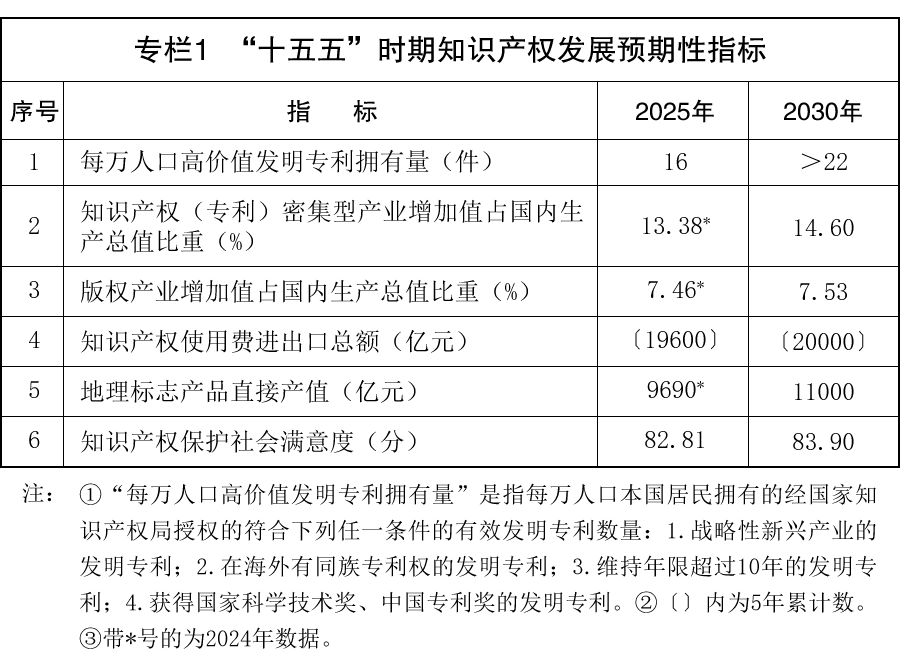
A headline indicator underscores the ambition: at least 22 high-value invention patents per 10,000 residents by 2030. As of the end of June 2026, China held 2.36 million high-value invention patents — 16.8 per 10,000 residents — with large patent pools already amassed in 5G, artificial intelligence and new-energy vehicles, Xinhua’s explainer noted.
The plan sets out four key tasks: optimizing the IP protection environment to support comprehensive innovation; improving IP commercialization to drive high-quality economic development; building a more efficient IP management system; and constructing a new architecture of international IP cooperation for high-level opening-up. It also establishes 12 special projects, including IP protection for strategic emerging industries, two-way empowerment between IP and artificial intelligence, IP services for regional development, and high-quality Belt and Road IP cooperation.
Other measures include refining punitive damages for infringement, cracking down on sham and malicious litigation and IP abuse, building a case database for foreign-related IP disputes, expanding patent open licensing, promoting “use first, pay later” and “transform first, then take equity” models, and developing IP finance through pledge financing, securitization, insurance and funds. The full text published by the National Intellectual Property Administration also sets out rules for algorithms, AI-generated content, the platform economy and data IP, and commits China to participating in international rule-making on AI, big data and green low-carbon technologies.
Analysis
The timing is deliberate. “The 15th Five-Year Plan period is a critical period for consolidating the foundation of basic socialist modernization and for basically building a China-unique, world-class intellectual property power,” said Cui Guobin, dean of Tsinghua University Law School, in the government interpretation. He added that a new round of technological revolution and industrial transformation, along with intensifying global innovation competition, poses new challenges for IP work.
The plan signals how Beijing intends to respond: strengthening legal protection at home while pushing to shape emerging international rules. It also puts greater weight on converting patents into revenue — a persistent weakness despite the country’s vast patent stock — through open licensing, equity reforms and financial instruments.
What’s next
Implementation now falls to the National Intellectual Property Administration, which will coordinate with other agencies, draw up annual action plans and conduct dynamic monitoring plus mid-term and final evaluations. Items to watch include follow-up amendments to patent, trademark and copyright laws, the rollout of data and AI-related IP rules, and progress on international fronts such as the Patent Prosecution Highway network and research tied to CPTPP and DEPA.