Chinese Robots Expand Global Reach Across Industries
Chinese robotics companies are rapidly expanding into diverse global application scenarios, from commercial cleaning floors in Europe and North America to high-risk inspection zones inside Swiss nuclear power plants. The expansion highlights the growing adaptability and competitiveness of China’s robotics industry in international markets, according to Xinhua News.
Production Lines Running at Full Capacity
At Pudu Robotics’ Jiangsu Jianhu factory, five production lines are running at full capacity for 10 hours daily, with the production schedule already booked through 2027. Workers are assembling new batches of LiDAR modules into robot chassis as the company races to meet surging demand.
Founded in 2016 and headquartered in Shenzhen, Pudu Robotics has become a global leader in commercial service robotics, with cumulative shipments exceeding 130,000 units serving more than 50,000 end customers across 85 countries and regions. The company’s export volume in 2026 has already surpassed its full-year 2025 level, with cleaning robot exports growing over 100% year-on-year for multiple consecutive years.
Quadruped Robots Deployed at Swiss Nuclear Plant
Deep Robotics, based in Hangzhou, has achieved a significant milestone with its four-legged robots now deployed at the Leibstadt Nuclear Power Plant (KKL) in Switzerland, one of the country’s largest and highest-output nuclear power stations. As reported by Yahoo Finance, the robots handle high-frequency, routine autonomous inspection of high-risk areas within the station.
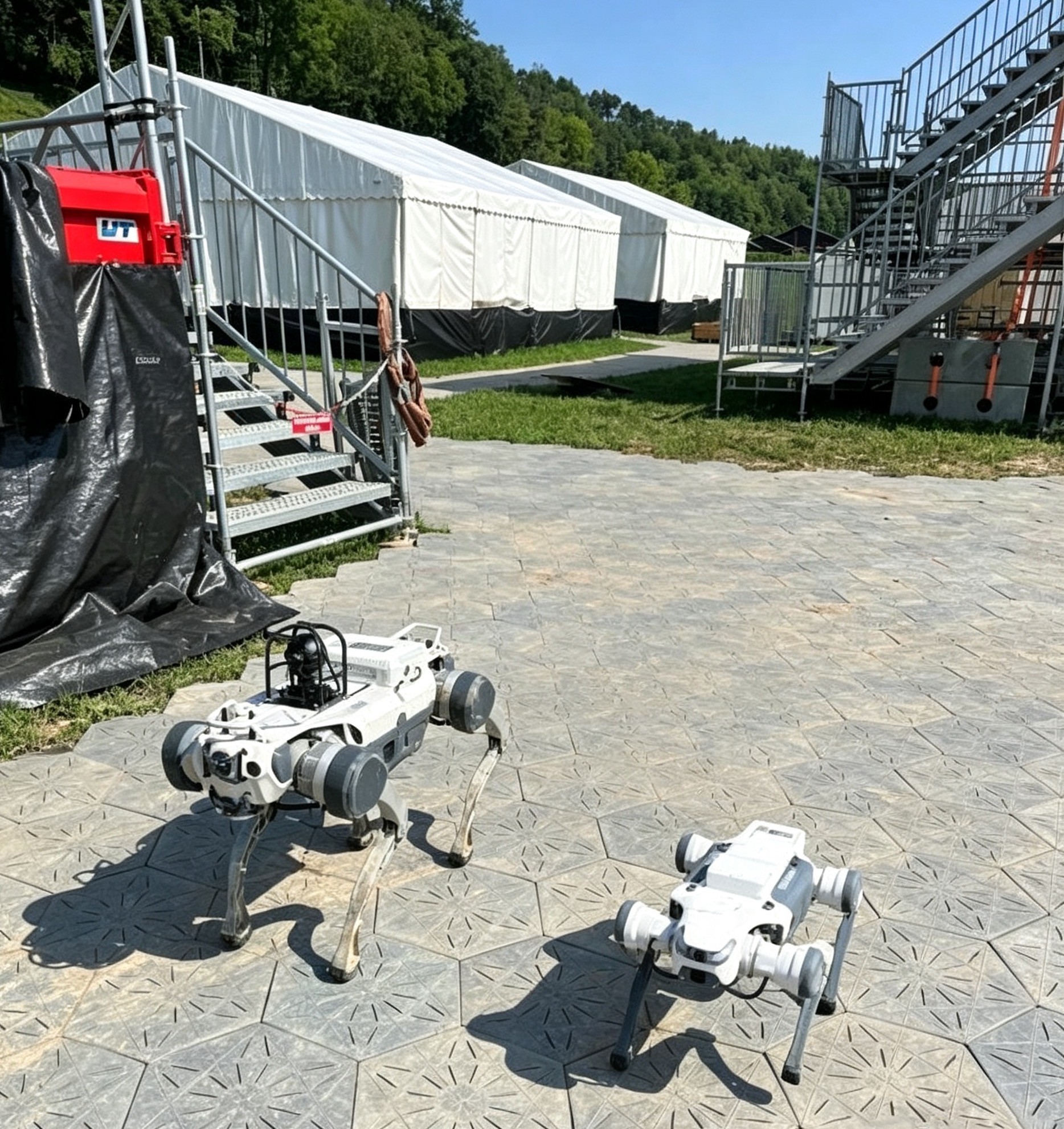
The quadruped robots can climb 45-degree slopes, navigate tight spaces, and use thermal imaging and acoustic sensors to detect leaks, temperature anomalies, and equipment abnormalities. Data is uploaded in real-time to digital management platforms, with automatic alerts triggered when anomalies are detected.
“Nuclear safety standards are extremely strict,” said Yao Hengyan, General Manager Assistant of Deep Robotics. “The successful deployment of our products at a Swiss nuclear power plant fully demonstrates the stability and reliability of domestically-produced robots. We have already reached an agreement for production expansion cooperation.”
Record Export Growth Across China
The expansion extends well beyond individual companies. According to Shenzhen Customs, in the first half of 2026, Shenzhen’s robot exports reached 6.94 billion yuan, a 10.4-fold year-on-year increase, with shipments to more than 110 countries and regions.
Zhejiang Province exported intelligent bionic robots worth over 400 million yuan in the same period, accounting for approximately 60% of the national total, according to Hangzhou Customs. Nationally, China’s industrial robot exports reached 6.29 billion yuan in the first half of 2026, up 18.6% year-on-year, shipped to 141 countries and regions.
China became a net exporter of industrial robots for the first time in 2025, when exports exceeded imports. This shift reflects the country’s transformation from a manufacturing base to a global innovation hub, as noted by Qiushi Journal.
Chinese Companies Dominate Global Rankings
According to Frost & Sullivan, the top five commercial service robotics companies worldwide in 2025 were all from China, collectively accounting for more than half of the global market. As PR Newswire reported, Pudu Robotics was ranked No.1 globally in commercial service robot revenue (~25% market share), shipment volume (~23% market share), overseas market share among Chinese companies (~44% of Chinese commercial service robotics exports), and commercial cleaning robotics revenue (~29% market share).
China’s commercial service robotics export market nearly tripled between 2021 and 2025, with overseas shipments expected to reach nearly 280,000 units by 2030.
From Product Export to Brand Localization
Chinese robotics companies are transitioning from “product export” to “brand localization,” building local offices, service warehouses, and dealer networks in overseas markets. Pudu Robotics has established a network of over 1,000 agents globally, with approximately 60% of its CC1 series cleaning robot shipments deployed in Europe and North America. Revenue in the Americas market increased by 285% year-over-year.
“Competition in China’s service robotics sector has shifted from price-performance comparison to comprehensive competition in quality, brand, and service,” said Zhang Tao, Founder and CEO of Pudu Robotics. “Customers need not just a machine, but a solution that can operate stably over the long term.”
Policy Support Facilitates Exports
Customs authorities have played a crucial role in facilitating robot exports. Hangzhou Customs has implemented electronic certificates for dangerous goods transport packaging inspection, allowing companies to submit materials online and download electronic dangerous goods packaging certificates themselves, achieving “zero running around” and significantly reducing processing time.
A Unified Intelligence Vision
Looking ahead, Pudu Robotics is advancing its “One Brain, Multiple Embodiments” architecture, a unified intelligence system supporting multiple robotic forms, including specialized robots, semi-humanoid robots, and humanoid robots. The company has filed more than 1,900 patent applications worldwide.
“Current robot penetration rates are still very low,” Zhang Tao noted. “In the future, robots will experience rapid growth, gradually penetrating thousands of industries. We hope robots can have a unified intelligent brain that can empower delivery, cleaning, industrial, and other robot products.”
As China’s robotics industry continues to mature, the global market is watching closely. Frost & Sullivan forecasts the global robotics industry could grow into a trillion-dollar market by 2030, with robots becoming essential infrastructure across enterprise operations, urban services, and industrial production. Chinese companies, with their manufacturing scale, engineering talent, and expanding global footprint, appear well-positioned to play a leading role in this transformation.