El Nino Poised to Amplify Warming, Scientists Warn
Wildfires are burning across North America and Europe. Deadly heat waves have parked over cities, and the world’s oceans are the hottest ever recorded for this time of year. Yet despite the apocalyptic scenes, this summer hasn’t quite broken global heat records — but scientists warn that could change soon as a strengthening El Nino threatens to amplify warming to unprecedented levels.
So far, 2026 ranks as only the third-hottest year on record, behind 2024 and 2025, according to climate statistics. But a one-two punch of accelerated human-caused global warming and a supersized El Nino is raising the odds that 2026 could eke out the crown for the hottest year on record by year’s end — or at least come close, scientists said.
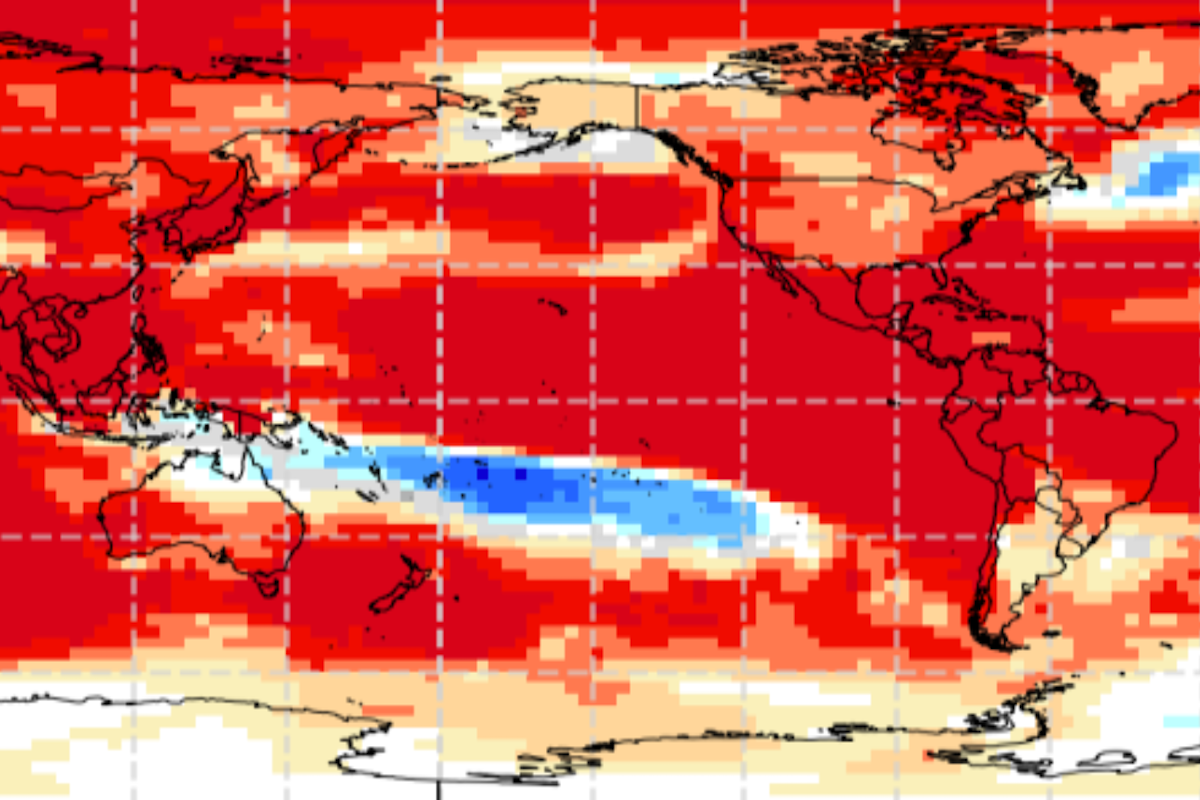
A Strengthening El Nino
The National Oceanic and Atmospheric Administration confirmed on August 3 that El Nino is present and strengthening across the central and eastern equatorial Pacific, with an 81% chance of becoming “very strong” during October-December 2026, according to NOAA data. The agency defines a “very strong” El Nino as a Relative Oceanic Nino Index of at least 2 degrees Celsius, and the event currently has a 97% chance of continuing through early Northern Hemisphere spring 2027.
The World Meteorological Organization’s multi-model forecast shows the Nino 3.4 anomaly rising from 2.7 degrees Celsius in August to 3.4 degrees Celsius in October, with the three-month mean forecast at 2.9 degrees Celsius. A positive Indian Ocean Dipole is also forecast to develop, which can amplify regional climate impacts including drought, floods and wildfire risk.
“El Nino is not just on our doorstep — it is inside the house and turning up the heat,” UN Secretary-General Antonio Guterres said in a WMO press release. “And this is only a warm-up act. El Nino is strengthening — adding fuel to a planet already on fire with scorching heat domes, apocalyptic wildfires and record hot seas.”
Rising Odds of a Record Year
Climate scientist Zeke Hausfather of Berkeley Earth calculated there’s a 35% chance that 2026 will pass 2024 as the hottest year on record — up from only 7% in March. Former top NASA climate scientist James Hansen, often called the godfather of climate science, has predicted that 2026 will edge out 2024 at the end of the year.
The world’s daily sea surface temperature tied 2024 starting in May, and since June it’s been record hot nearly every day. About 82% of the world’s ocean surface is overheated with marine heat waves this year, according to Europe’s Copernicus climate service. With oceans covering more than 70% of the globe’s surface, there’s generally a month-and-a-half lag between heat showing up in oceans and being reflected in the global average temperature.
NOAA’s July forecast gave a 66% chance that 2026 would be the fourth hottest year and only a 0.1% chance it would be No. 1 for warmth by year’s end. But those odds are expected to rise when NOAA finishes its July analysis.
Human-Caused Warming, Not El Nino, Drives This Summer’s Heat
Climate scientists emphasize that what we’ve seen this summer can’t be blamed on El Nino, because its impacts really don’t kick in for a few more months. The fires, heat and extremes that have dominated the summer of 2026 are what scientists have long been warning about from the burning of coal, oil and gas.
“The driver of the record warmth is climate change in the background,” said Zachary Labe, a climate scientist at Climate Central, a science and communications nonprofit. “And it’s a much larger — much, much larger — contribution than El Nino, which is just a tenth to two-tenths of a degree on top of that long-term trend.”
That warming is accelerating, Hansen said, because traditional industrial pollution that creates soot and smog — which cool the planet and mask greenhouse gas-triggered warming — is decreasing. It also looks as if the climate might be reacting to greenhouse gases stronger than scientists anticipated.
Extreme Weather Already Devastating
This summer’s heat waves have hit hard in places where people aren’t used to triple-digit heat. South Korea saw its highest temperature on record at 108.5 degrees Fahrenheit (42.5 degrees Celsius) on August 2, while Salt Lake City recorded 109 degrees Fahrenheit (42.8 degrees Celsius), its highest on record, in July. Western Europe endured its hottest June on record, with France experiencing its hottest day ever, according to Yale Environment 360.
More than 200,000 people in France were forced to flee their homes due to wildfires, described by President Emmanuel Macron as the worst fire-related crisis since World War II. Across the western United States, the first six months of the year were the hottest ever measured for parts of eight states, and drought is affecting 45 states, according to The Guardian.
“European heat waves are not in isolation,” said Samantha Burgess, global strategic lead at Copernicus climate service. “So there’s also been shocking heat waves in North America. There’s been shockingly hot conditions in South America as well. There’s been devastating heat waves in India.”
Princeton University climate scientist Michael Oppenheimer said this is what scientists have long been warning about. “These are vivid pictures of not just the future, which is what we used to say, but on the whole of what climate change is doing,” he said. “There’s no question that climate change has increased the risk of wildfires. There’s no question that the climate change increased the probability of really hot, nasty, even unprecedented summers around the world.”
What to Expect When El Nino Kicks In
El Nino typically peaks between November and February and exerts its strongest influence on global temperatures during the year following its onset. A very strong El Nino increases the chances for most of the southern US to be rainier in the winter, and boosts the likelihood of warmer winter conditions for the northern United States and Canada. It usually dampens Atlantic hurricane season, and Colorado State University has dramatically reduced its storm prediction.
But the impacts will be global. The WMO warns of a strong chance of drought and wildfires in Indonesia, India and other parts of Asia, south and east Australia, chunks of South America and southern regions in Africa. Other areas, including much of the United States and fire-struck Southern Europe, will get above-average rain.
“This El Nino, developing against the backdrop of unprecedented ocean heat and rising temperatures, provides governments and communities with a window of opportunity to anticipate risks and act before impacts unfold,” said WMO Secretary-General Celeste Saulo. “The decisions we make today will shape the impacts we experience tomorrow.”
A Near Lock for 2027
Even if 2026 sets the record, it won’t last long. Although scientists disagree on whether 2026 will be the hottest year on record, they agree it’s a near lock that 2027 will beat out any modern year for heat — possibly by a great deal. The last El Nino contributed to making 2023 the second-hottest year on record and 2024 the all-time high, at about 1.55 degrees Celsius above the 1850-1900 pre-industrial average, as Al Jazeera reported.
“We’re seeing something that is the warmest July ever recorded for that specific region,” said Columbia University climate scientist Jeffrey Shaman. “A year from now, it’s going to be very hot in the Northern Hemisphere. And we’re going to possibly have a summer like we’ve never experienced globally.”
Guterres called for more early warning systems and cooling systems to handle extreme heat, and urged governments to take the climate crisis seriously. “We hear much about record heat, drought and wildfires — but not enough about the real change that is driving these events: the accelerating climate crisis powered by fossil fuels,” he said. “The warm-up act is over. We cannot afford to wait for the main event.”