Belgian ‘Hero Rats’ Save Lives Worldwide: From Landmines to Tuberculosis
They sniff out landmines in war-torn fields, detect tuberculosis in crowded clinics, intercept illegal wildlife trafficking at ports, and may one day locate survivors trapped beneath earthquake rubble. These are the ‘hero rats’ trained by APOPO, a Belgian NGO that has spent nearly three decades turning African giant pouched rats into lifesaving humanitarian workers deployed across the globe.
The organization, founded in Belgium in 1997 by Bart Weetjens and Christophe Cox, operates its training headquarters at Sokoine University of Agriculture in Morogoro, Tanzania. From this base, APOPO has trained hundreds of rats to use their extraordinary sense of smell to tackle some of the world’s most persistent humanitarian challenges, as VRT NWS reported.

Why Rats?
The choice of the African giant pouched rat (Cricetomys ansorgei) is no accident. These animals possess one of the most sensitive noses in the animal kingdom, are intelligent enough for complex training, and are light enough to walk over pressure-activated landmines without triggering them. According to APOPO’s profile on Wikipedia, a single rat can search 200 square meters in about 20 minutes — a task that would take a human with a metal detector days to complete.
Training begins with clicker-based operant conditioning. “First and foremost, we breed them ourselves,” APOPO CEO Christophe Cox explained in an interview with Radio 1’s ‘De Ochtend’ program. “Then we tame them and train them with ‘click training.’ When the animal hears a click during such training, it knows it will get a reward. We build on that gradually, by then adding scent.”
Each rat costs approximately 6,000 euros to train, and training takes about nine months before accreditation. The investment pays off in remarkable efficiency: rats can check 100 sputum samples for tuberculosis in as little as 20 minutes — a task that would take a lab technician up to four days using conventional microscopy, according to APOPO’s TB detection program.
Clearing the World’s Minefields
APOPO’s mine detection rats are currently deployed in Ukraine, Angola, Cambodia, and Azerbaijan, where they work alongside metal detectors and mechanical demining machines in integrated clearance operations. Since 2014, the organization has helped clear more than 50,000 landmines in Angola and Cambodia alone.
In June 2026, a Belgian government delegation visited APOPO’s operations in Angola, witnessing live HeroRAT training demonstrations and active demining operations in Cuanza Sul Province. “Removing mines is important, but the reason we do it is to allow people to live normal lives on the land,” said Simon Roemen, deputy head of mission at the Embassy of Belgium in Angola. APOPO aims to help make Angola landmine-free by 2030.
A Second Line of Defense Against Tuberculosis
Perhaps APOPO’s most impactful work happens not in minefields but in laboratories. Since 2007, the organization’s rats have been screening sputum samples for tuberculosis, detecting infections that conventional microscopy misses.
“We have already prevented half a million tuberculosis infections,” Cox told VRT NWS. “These are people who, without our rats, would be told they don’t have tuberculosis and sent home. They then become sick and can also infect family members.”
Working with more than 200 hospitals in Tanzania and Ethiopia, the rats detect 45 to 50 percent additional TB infections missed in initial screenings. They have identified more than 30,000 patients who had been incorrectly told they were disease-free. In sub-Saharan Africa, only about half of TB patients receive a diagnosis, making this second-line screening potentially life-saving.
However, the program faces a significant challenge: APOPO’s rats are not classified as primary diagnostic tools by the World Health Organization. “It’s a big challenge,” Cox acknowledged in an interview with The Associated Press. “Not being recognized by the WHO means that the mainstream funding for TB never reaches us.” Positive samples detected by rats must still be confirmed by human microscopy before treatment.
Fighting Wildlife Trafficking
Beyond landmines and disease, APOPO’s rats are being deployed in the fight against illegal wildlife trafficking. At ports and airports in Tanzania, the animals sniff packages for the scent of ivory, rhino horn, pangolin scales, and other trafficked wildlife products, as detailed on APOPO’s wildlife trafficking impact page.
“There is a lot of illegal export of those products from this region,” Cox said. “Our rats sniff the packages and can detect those goods.”
RescueRATs: Finding Survivors in Earthquake Rubble
APOPO’s most ambitious project is the development of RescueRATs — rats fitted with specially designed backpacks containing cameras, two-way microphones, and location trackers, trained to locate survivors trapped beneath collapsed buildings. Because rats are small, they can penetrate much deeper into rubble than search dogs.
“Because the rats are so small, they can penetrate much deeper into the rubble than, for example, dogs, which also carry out such rescue operations,” Cox explained.
The project reached a major milestone in June 2025 when six trained RescueRATs relocated from Tanzania to Antalya, Turkey, in partnership with Turkish search-and-rescue organization GEA Arama Kurtarma. In June 2026, representatives from Turkish search-and-rescue teams AKUT, ANDA, and IHH observed a live demonstration in which RescueRATs Daniel and Jo successfully located two mock victims hidden in simulated debris.
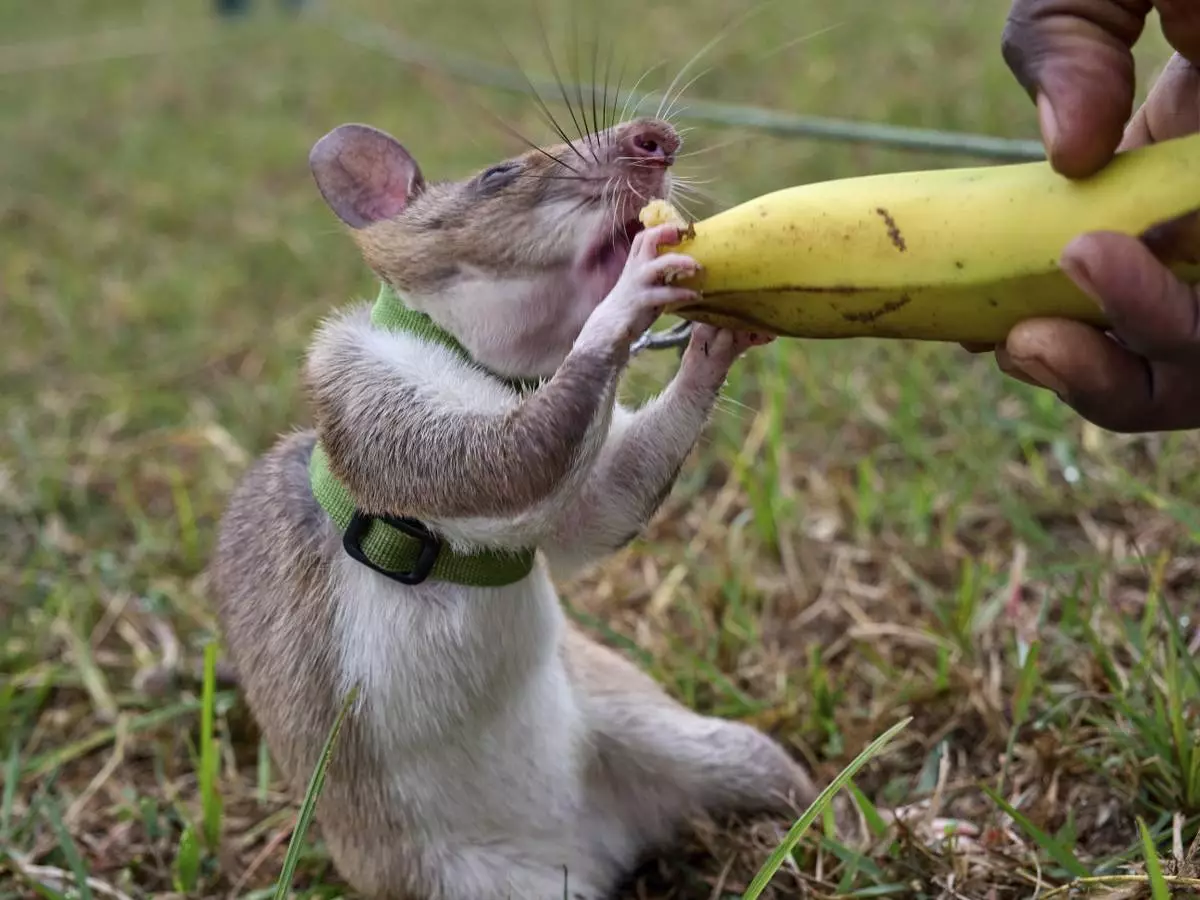
Magawa’s Legacy
The most famous of APOPO’s hero rats, Magawa, detected over 100 landmines and other explosives during his career in Cambodia. In 2020, he became the first rat to receive the PDSA Gold Medal for animal bravery, as VRT NWS reported at the time. Magawa retired in 2021 and died in early 2022 at age eight.
In April 2026, a statue was unveiled in Magawa’s honor in Siem Reap, Cambodia, on the International Day Against Landmines. His successor, Ronin, has since broken his record.
A Belgian Innovation with Global Impact
APOPO’s story is a remarkable example of Belgian innovation addressing global challenges. From its origins as a research project in Antwerp to its current operations spanning Africa, Asia, and Europe, the organization demonstrates how unconventional thinking can yield extraordinary results.
As APOPO continues to expand its RescueRATs program and refine its TB detection methods, the potential for these remarkable animals to save even more lives grows. The organization’s work in Turkey, in particular, could establish a model for integrating animal detection technology into formal disaster response systems worldwide.
For now, the hero rats of APOPO continue their quiet, life-saving work — one sniff at a time.