Pinglu Canal Completes First Full-Length Navigation Cruise, Paving Way for September Opening
China’s Pinglu Canal achieved a critical pre-opening milestone on August 8 when the “Haixun 1003” vessel dispatched by the Guangxi Maritime Safety Administration successfully traversed the entire 134.2-kilometer waterway, marking the first time a ship has completed the full route since the canal’s main engineering works finished. The vessel departed from Qinzhou Port on August 7 and arrived at Pingtang River Estuary the following day, passing through all three ship lock hubs — Qingnian, Qishi, and Madao — as reported by Xinhua News.
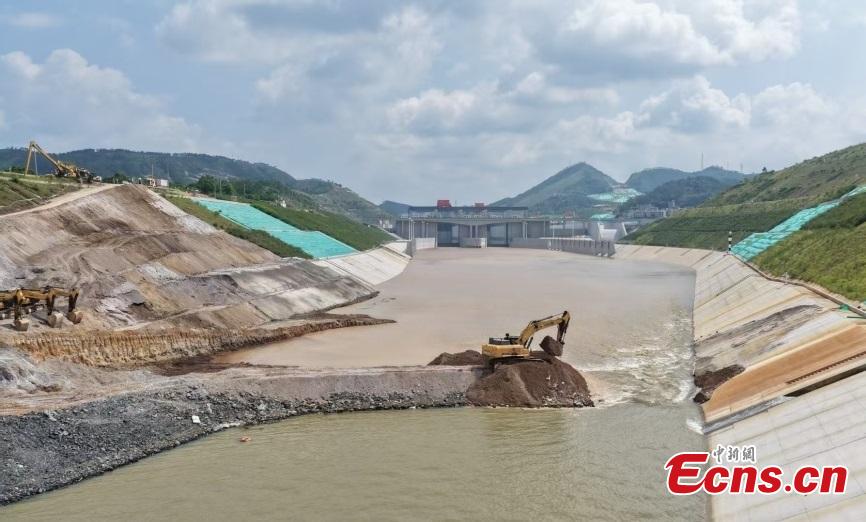
A Century-Old Vision Realized
The Pinglu Canal is the first canal built since the founding of the People’s Republic of China to connect a river system directly to the sea. It is a flagship project on the New International Land-Sea Trade Corridor, a key initiative enhancing global trade connectivity for China’s western inland regions. The 134.2-kilometer waterway stretches from the Pingtang River in Hengzhou, Nanning, Guangxi, through Lingshan County, and along the Qinjiang River into the Beibu Gulf.
The project traces its origins to 1919, when Sun Yat-sen first proposed connecting the Pearl River system to the Beibu Gulf in his “Plan for National Reconstruction.” Construction began in August 2022, and the canal is now scheduled for full navigation opening in September 2026, with the official ceremony planned to coincide with the China-ASEAN Expo, according to People’s Daily Online.
Engineering Feats and Navigation Verification
The cruise inspection focused on verifying navigation conditions at key waterways, including canal channel dimensions, bridge navigation clearances, ship lock approach channels, and tributary river mouths. The data gathered will inform final vessel navigation rules and safety measures ahead of the September opening, as CCTV News via China.com reported.
The canal is built to Class I inland waterway standards, capable of accommodating 5,000-tonne vessels. It features three ship lock hubs — Madao, Qishi, and Qingnian — that overcome a 65-meter water level difference between the canal’s endpoints. The project involved approximately 315 million cubic meters of earthwork, about three times that of the Three Gorges Project, and set multiple world records including the world’s largest inland water-saving ship lock and the world’s highest water head inland water-saving ship lock, as detailed by Beijing Daily.
Strategic Significance for Regional Trade
The canal’s completion will fundamentally reshape trade geography in southern China. Cargo from southwest China routed through the canal will save over 560 kilometers of inland waterway distance compared to the traditional route through Guangzhou Port, with estimated annual logistics savings of approximately 5.2 billion RMB (US$730 million) at projected cargo volumes of 89 million tonnes per year.
“The Pinglu Canal has set numerous impressive records, injecting powerful momentum into the China-ASEAN trade,” Hu Qimu, a professor at the Maritime Silk Road Institute of Huaqiao University, told the Global Times. “As rail, road, and waterway converge into a multimodal transport hub in the Beibu Gulf, the resilience and redundancy of supply chains connecting Southwest China to ASEAN will be markedly enhanced.”
The canal’s strategic importance extends far beyond Guangxi. As 21 Economic noted, the waterway directly connects the Xijiang River system with the Beibu Gulf, enabling cargo from Guangxi and the broader southwest region to reach ASEAN markets and the wider world without the costly detour through the Pearl River Delta. For Guangxi, the canal represents a decisive step toward its maritime ambitions — a province that has long possessed deep-water ports but lacked the riverine connectivity to feed them. For the broader southwest, it activates regional economic potential by shortening inland navigation distances by more than 560 kilometers and generating annual freight savings exceeding 5.2 billion RMB.
The waterway provides the shortest, most economical, and most convenient route from southwest China to ASEAN markets. For the first time, inland provinces like Yunnan and Guizhou — major producers of phosphate fertiliser, aluminium, and agricultural goods — will have direct sea access to Southeast Asia, redirecting cargo flows away from the established Guangdong corridor, according to Value Chain Asia.
What’s Next
With the successful navigation verification complete, the Pinglu Canal is on track for its official opening ceremony at the China-ASEAN Expo in September. Trial voyages are expected to continue through the summer as final navigation rules and safety protocols are refined. The canal’s full impact on regional logistics costs, port competition across the Beibu Gulf, and China-ASEAN supply chain dynamics will unfold over the coming years as cargo volumes build toward the projected 89 million tonnes per year target.
As 21 Economic noted, the canal represents more than a transportation project — it is a strategic investment that will help complete China’s inland waterway network and support the country’s broader economic integration with Southeast Asia. The question now is how quickly shippers, ports, and industries along the corridor will adapt to the new trade route that the Pinglu Canal has opened.