Scientists Find Baryon Number Carried by Gluon Junction
Chinese and international scientists have collaboratively observed a unique structure inside nucleons—the protons and neutrons that form the building blocks of all matter—marking a significant advancement in fundamental physics research. The findings, published in the journal Science on August 13, challenge a long-held view about how the most basic properties of matter are carried.
The research was led by the STAR Collaboration at the Relativistic Heavy Ion Collider (RHIC) at Brookhaven National Laboratory in New York, in partnership with the University of Science and Technology of China (USTC), Kent State University, and numerous other institutions worldwide. The study found that baryon number—a fundamental quantum property that distinguishes matter from antimatter—is carried by a Y-shaped “baryon junction” of gluons rather than solely by the three valence quarks as traditionally believed, according to Xinhua News.
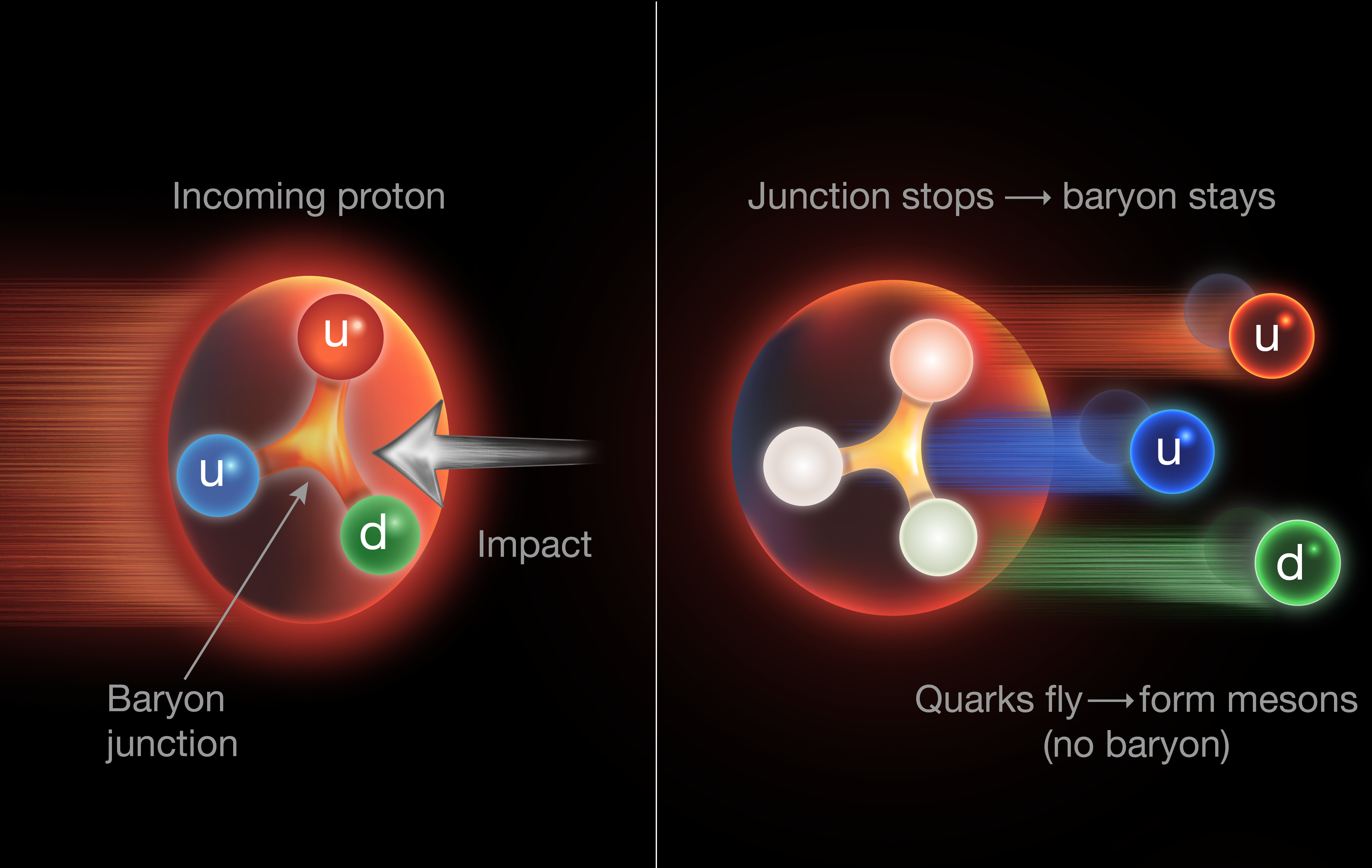 Upon impact in a collision, a proton’s three valence quarks continue to fly down the beampipe while the Y-shaped baryon junction is more easily stopped, pulling new quarks from the vacuum to become a new baryon. (Valerie A. Lentz/Brookhaven National Laboratory)
The Naive Quark Model and Its Limits
For decades, physicists described protons as being composed of three “valence” quarks—two up quarks and one down quark for a proton. In this conventional picture, the proton’s baryon number of +1 is divided equally among its three valence quarks, with each quark carrying +1/3 of the baryon number, similar to how electric charge is distributed.
“Traditionally, scientists have assumed that each of the three main ‘valence’ quarks inside a proton or neutron carries one-third of the baryon number,” said Zhangbu Xu, a professor at Kent State University with a joint appointment at Brookhaven Lab, as reported by Brookhaven National Laboratory.
However, the new experimental results suggest this picture is incomplete. “Using data collected from different types of particle collisions at RHIC, our results suggest that the baryon number is not simply carried by individual quarks,” Xu added. “Our findings strongly support the idea that baryon number is more favorably carried and transported by gluons, the particles that hold quarks together, when arranged in this special configuration.”
The baryon junction concept was first proposed by physicists in the 1970s to explain how gluons hold valence quarks together within protons. In 1996, Dmitri Kharzeev, a theoretical physicist at Stony Brook University and Brookhaven Lab, proposed that the baryon junction could be the true carrier of baryon number instead of the valence quarks.
The Experimental Approach
The STAR Collaboration used several complementary collision environments at RHIC to test these competing theories. The experiments measured net baryon number and net electric charge in high-energy nucleus-nucleus collisions, finding that baryon number is transported differently than electric charge.
“In the naïve quark model, there are three quarks inside a proton, but nothing else,” said Tommy Tsang, formerly a postdoc at Kent State University, now at Argonne National Laboratory. “But if we look at details inside, there are not only three quarks but also a lot of gluons interacting, connecting between those quarks, and there are also quarks and antiquarks that pop up from the vacuum, so it’s actually a really complex object.”
The key experimental finding was that the measured electric charge was only half of what would be expected from the naive quark model, indicating that a structure carrying baryon number but no electric charge or color charge must exist inside nucleons. “Measuring the electric charge coming out perpendicular to the collision gives you a definitive way of measuring how many quarks are stopped and transformed into new particles,” said Zebo Tang, a professor at the University of Science and Technology of China who led a group of students performing data analyses and model simulations.
According to ScienceAlert, the baryons travel farther through the dense, energetic collision zone than the electric charge does, suggesting that the baryon number is carried by the junction, which isn’t slowed as much as the electrically charged valence quarks. The results align with predictions of Regge theory, which incorporates a baryon junction.
Why Baryon Number Conservation Matters
Identifying the carrier of baryon number has profound implications. At the level of RHIC collisions, baryon number conservation ensures that the total number of baryons remains the same before and after a collision. But the concept extends to the entire universe.
“Since the Big Bang, the number of protons and neutrons all together never changes as a function of time,” said Nicole Lewis, a STAR physicist at Rice University who started this project as a postdoc at Brookhaven Lab in 2020. “The reasons for this conservation are not well understood. It’s one of the mysteries of the universe, related to why we have more matter than antimatter.”
On a practical level, baryon number conservation explains why protons are so stable and don’t decay. “It’s believed that the lifetime of a proton is longer than the lifespan of the universe,” Lewis said. “This allows atomic nuclei to form and be stable—which means matter, as we interact with it in the universe, can exist.”
Rongrong Ma, a Brookhaven Lab physicist, emphasized the broader significance: “Our research challenges the long-held idea that baryon number is simply divided among and carried by the three quarks. This new understanding reshapes how we think about the structure of matter and deepens our knowledge of the most fundamental element that is responsible for the universe in its current form.”
A Legacy of International Collaboration
The discovery represents a triumph of international scientific cooperation. The research involved the University of Science and Technology of China, Kent State University, Brookhaven National Laboratory, and many other institutions in the STAR Collaboration, as detailed by Kent State University.
Kent State has been part of the STAR Collaboration since its inception, through its High-Energy Nuclear Experiment Group, which for many years was led by now-retired Professor Declan Keane. Zhangbu Xu, who joined the Kent State faculty in 2024 after more than two decades at Brookhaven Lab, served as spokesperson for the STAR Collaboration from 2014-2017 and as co-spokesperson from 2017-2020.
“We conduct experiments and analyze scientific data as a team,” Xu said. “I lead the research project, but it is a collaborative effort. The detector we use, the operation, the data collection and various essential calibrations at the facility are all performed collectively by the collaboration.”
RHIC, which operated from 2000 to early 2026, ceased operations earlier this year, making this one of the final major discoveries from the facility. The findings have implications for future experiments at the Electron-Ion Collider (EIC), currently under development at Brookhaven National Laboratory, where scientists aim to map the 3D structure of protons and neutrons with unprecedented precision.
What’s Next
The STAR Collaboration’s results, supported by data previously reported from Au+Au collisions at a variety of beam energies, disfavor the valence quark picture. As the researchers note in their Science paper, “Further investigations into existing and alternative theories are warranted; to be viable, such theories must simultaneously explain all observed phenomena. And so far, only the baryon junction framework remains qualitatively consistent.”
Wenliang Li, a physicist at Mississippi State University and author of an accompanying Science Perspective, noted that “determining whether quarks or the gluon field transports baryon number could contribute to understanding how strong interaction between subatomic particles organizes stable matter and what causes the imbalance between matter and antimatter in the Universe.”
The Y-shaped gluon junction is currently the only theory that can self-consistently describe all the experimental results. As scientists look toward the next generation of collider experiments, this discovery will help shape our understanding of the fundamental structure of matter and the forces that govern the universe.