Hawai’i Communities Cut Off After Hurricane Lala
Hurricane Lala passed within 35 miles of Hawai’i Island at hurricane strength on Saturday night, bringing ferocious winds and pummeling rains that left communities across the island’s southern Ka’u District cut off by severe flooding and road damage. The storm, which was downgraded to a tropical storm early Sunday morning, caused hundreds of millions of dollars in damage statewide, according to Hawaii Public Radio.
At least 100 homes on Hawai’i Island sustained storm damage, including one house swept off its foundations by floodwaters. Six bridges in the Ka’u District were significantly damaged or destroyed, leaving the rural community of Pahala completely cut off by road — including access to Ka’u Hospital, the region’s only medical facility.
‘Devastation’ in Ka’u District
Hawai’i County Mayor Kimo Alameda, who conducted an aerial survey of the island with emergency officials on Sunday morning, described the scene in the Ka’u District with a single word: “Devastation.” The mayor said the Big Island experienced a Category 1 hurricane with 80 mph winds and flash floods “like I’ve never seen before.”
“That’s a critical access hospital for us, and so we need to get access to that ASAP,” Alameda said, referring to Ka’u Hospital in Pahala, where the Hawai’i Department of Transportation and county public works crews were working to restore a roadway connection.
Na’alehu and Wai’ohinu were also partially cut off, with the highway heading toward Hilo blocked and the towns only accessible from Kona as of Sunday. Acting Civil Defense Administrator Darryl Oliveira said the district will face “long-standing road challenges, bridge challenges, access issues for residents that might be isolated.”
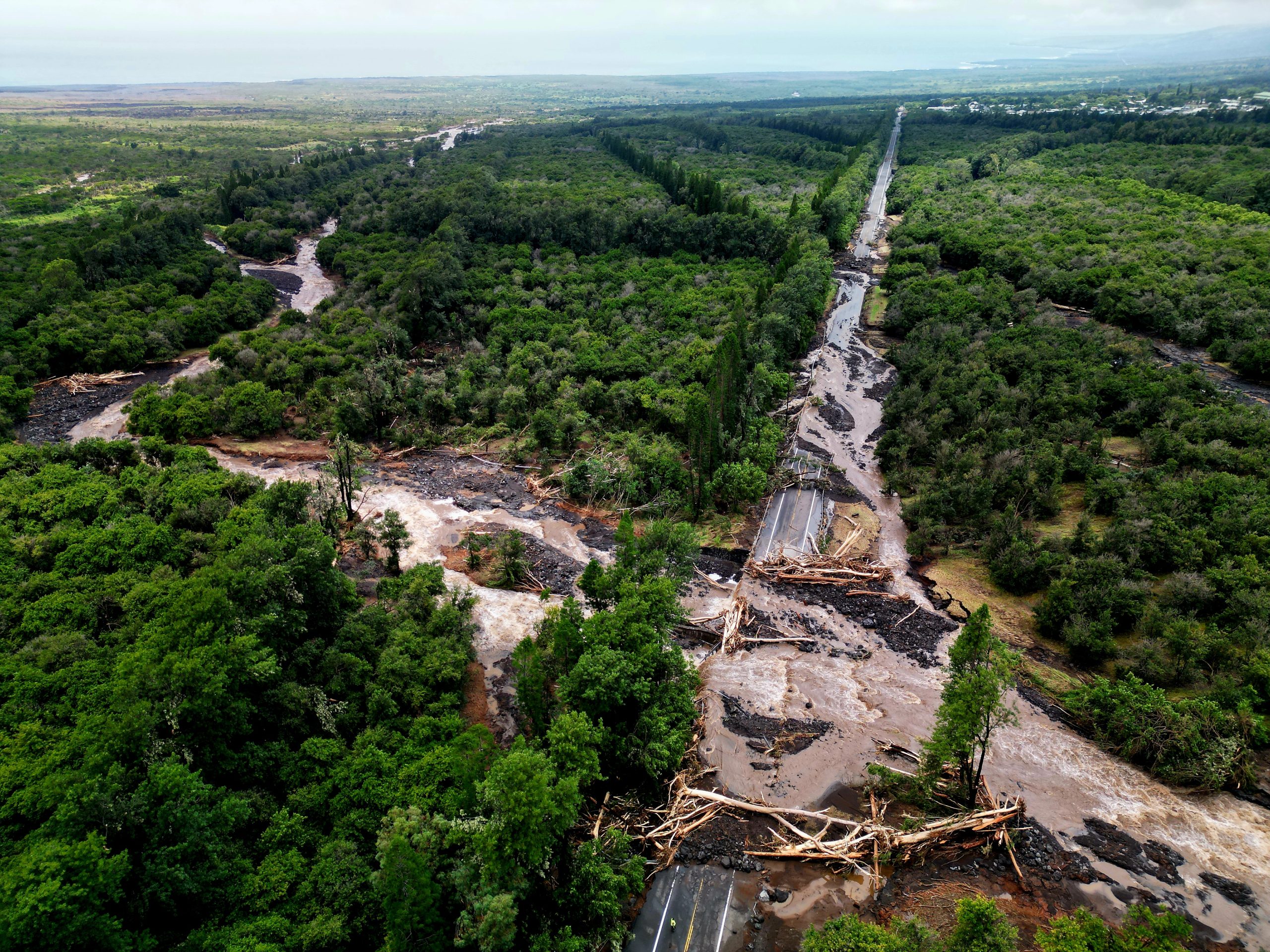
Acting Fire Chief Daniel Volpe called it “definitely the worst flooding damage that I’ve seen out in the Ka’u area.” According to Big Island Now, the storm’s fury extended beyond infrastructure — the Punalu’u Bake Shop in Na’alehu, a beloved local institution and major employer, was severely damaged, with water rushing through its factory and retail store, leaving about 3 feet of mud behind.
“This is a different level of damage. It’s literally catastrophic,” said Zachary Kennedy, the bake shop’s manager.
Search-and-Rescue Operations
Emergency responders initiated search-and-rescue operations in Na’alehu and Wai’ohinu in the early hours of Sunday morning after residents called 911 as their neighborhoods flooded. One woman was swept away when her home was knocked off its foundation by raging floodwaters in Wai’ohinu. She was found Sunday morning about 100 yards from her home and transported to a hospital with moderate injuries.
“The vehicle had pushed up against her with the storm surge or with the surge of the water,” Volpe said, describing how the resident was pinned before being carried away by the rushing waters.
A Hawai’i County paramedic and EMT were also rescued from the roof of their ambulance by the Hawai’i National Guard after floodwaters pushed the vehicle against a guardrail while they were responding to a call. The two-man crew climbed to the roof of the ambulance, where they were lifted into a high-water vehicle. Neither was injured.
“There’s nothing more terrifying than to find out that one of your own is in danger,” Volpe said. “Vehicles can be replaced. The people are what we’re most concerned about.” The rescue was documented by Big Island Now, which reported that the National Guard high-water vehicle team from Task Force Hawai’i had been deployed to support the county during the storm.
So far, no storm-related fatalities have been reported. A man died in a head-on collision in Ocean View on Saturday morning, but officials said there is no indication the accident resulted from storm conditions.
Widespread Power Outages and Damage
The storm’s impact extended far beyond the Ka’u District. More than half of Hawaiian Electric’s customers on Hawai’i Island lost power, and approximately 179,000 customers across Hawaii remained without electricity as of Sunday evening, according to Hawaii News Now. Some customers in the hardest-hit rural areas were asked to prepare for extended outages that could last weeks or even months.
Parts of Laupahoehoe on the Hamakua Coast received more than three and a half feet of rain, while wind gusts exceeded 70 mph in South Point and 80 mph in Kohala. Peak rainfall measurements reached 15 to 17 inches across windward Maui and the Big Island, with nearly 900 mm (35 inches) reported at some higher-elevation sites.
At least three hospitals were operating on backup generators, and 19 roofs were lost. The Na’alehu Cemetery was also impacted, with at least one casket unearthed by the floodwaters. Governor Josh Green estimated the storm caused hundreds of millions of dollars in damage statewide, as The Guardian reported.
Statewide Emergency Response
Governor Josh Green signed an emergency proclamation on August 13, activating the Major Disaster Fund and authorizing the activation of the Hawai’i National Guard ahead of the storm’s arrival. “Tropical Storm Lala poses a serious threat to our state, particularly Hawai’i Island — and we are taking action now to ensure resources are available where they are needed,” Green said at the time, according to the Office of the Governor.
All public schools, state courts, and state and county government offices were closed statewide on Monday as cleanup and damage assessment efforts continued, as Hawaii Public Radio reported. The coordinated decision by Green and the mayors of all four counties was made Sunday evening to allow emergency response and restoration efforts to proceed.
Hawai’i Emergency Management Director Randy Collins warned that the danger is not over even though the storm has passed. “Many casualties often happen after the disaster,” Collins told reporters. “As people are cleaning things up, they’re working with heavy equipment, chainsaws, generators. They’re working around downed power lines and so forth. That’s when the casualties come.”
Historical Context and Looking Ahead
Lala intensified from a tropical storm into a Category 1 hurricane with maximum sustained winds of 75 mph early Saturday, making it the first hurricane to threaten the Big Island directly in over a century. The Big Island was last hit directly by a hurricane in 1871, when a Category 3 storm struck the north-east corner. Hawaii was last hit by a major hurricane in 1992, when Hurricane Iniki — a Category 4 storm — caused at least six deaths and billions of dollars in damage on Kauai.
The storm’s arrival comes as a powerful El Nino has formed in the central equatorial Pacific Ocean, with NOAA predicting a 69% chance of a historic event that would exceed the strength of previous El Nino events dating back to 1950. As The Guardian noted, El Nino tends to promote hurricane activity in the Pacific while suppressing it in the Atlantic, and the human-caused climate crisis can amplify these impacts.
Lala continued to weaken as it moved westward away from the state, but the National Hurricane Center warned it could become a hurricane again by Wednesday. Meanwhile, residents of Ka’u are facing a long road to recovery. As Mayor Alameda reflected on the damage, he emphasized the community’s resilience: “These are families that I know, an auntie, an uncle, a nephew. And so it’s close to home for me. I got to tell you folks, Ka’u, you guys are super resilient. Coming out of this, there are going to be a lot of quiet heroes, and I see it already.”
Police Chief Reed Mahuna echoed that sentiment: “We’re going to get through it together. We’re going to care of one another and be patient with one another. And we’re going to see this thing through.”
As damage assessments continue and restoration efforts get underway, officials are urging residents to stay off the roads, avoid downed power lines, and report damage to county authorities to help secure federal assistance. The road to recovery for Hawai’i Island’s southern communities will be long, but the spirit of the Ka’u District remains unbroken.