Hong Kong Firm Unveils 50kg-Lifting Humanoid Robot
Hong Kong-based technology company Jiuguang Technology has officially launched the RayNex G3 (Xiaorui G3), a new generation industrial-grade humanoid robot designed as a “productivity tool” capable of lifting and carrying objects weighing up to 50 kilograms. The launch event, themed “Future·Transformed by Wisdom,” took place on August 17 at the Hong Kong Science Park’s Kao Kung Conference Center, according to Xinhua News.
A Robot Built for Heavy Work
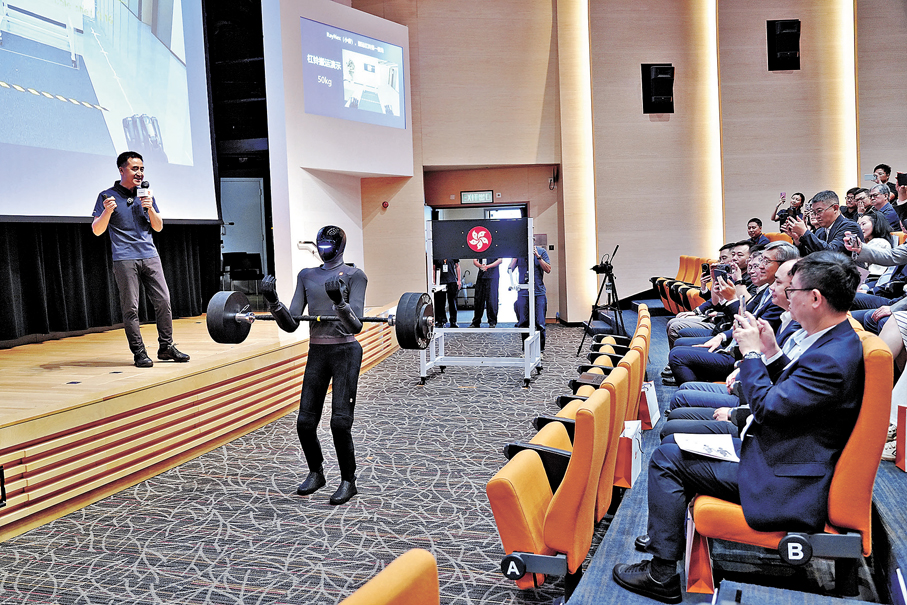
The RayNex G3 stands 173 centimeters tall and weighs less than 60 kilograms, comparable to an adult human. During the live demonstration, the robot responded to voice commands and smoothly completed a 50-kilogram barbell lifting and placement operation, showcasing its capability to handle heavy-load transport, material transfer, and fine manipulation tasks.
Beyond its headline 50kg lifting capacity, the robot can pull objects weighing over 100 kilograms and handle a 30-kilogram regular operational load. It features a 60-kilogram dual-arm holding capacity and a 100-200 kilogram hard pull load capability, as reported by IT之家 (IT Home).
According to Wen Wei Po, the RayNex G3 is described as the world’s first mass-production humanoid robot using a “linear joint + harmonic SEA joint” combined technology route. It is powered by a self-developed RayBrain AI brain, a long-chain end-to-end AI architecture, and a full-body precision force control system.
Positioning as a Productivity Tool
Company founder Xu Zhigen emphasized that the RayNex G3 is positioned differently from other humanoid robots on the market. “Our robot is a productivity tool designed for heavy physical labor in production scenarios, particularly in harsh environments where human workers face significant risks,” Xu said, according to Now News.
Target customers fall into three categories: industrial (To B), consumer (To C), and research/scientific scenarios. Key use cases include nuclear radiation environments where workers currently need to rotate every 15 minutes, high-temperature and high-humidity facilities, infectious disease ward waste collection, and laboratories with toxic or hazardous materials.
The company has also released an “AI Unit” as an open high-performance research platform, supporting users to deploy their own algorithms and training for academic research purposes.
Hong Kong’s Strategic Advantage
Xu Zhigen outlined four reasons for choosing Hong Kong as the company’s base: access to global markets, recruitment of international talent, connection to global capital, and support from the SAR government’s AI policies. “Hong Kong is an international financial center, and in the future it will also become an intelligent technology center,” Xu said, as reported by Xinhua News.
Huang Bingxiu, CEO of the Hong Kong Science and Technology Parks Corporation, welcomed the launch, stating: “Humanoid robots, as important carriers of embodied intelligence, represent a frontier track at the intersection of artificial intelligence and new materials, and are a key direction for cultivating new productive forces and promoting new industrialization.”
Lu Yang, Associate Dean of Engineering at the University of Hong Kong, noted that the new generation humanoid robot “fully demonstrates the solid technical foundation and problem-solving capabilities of Hong Kong’s tech innovation teams.”
Sales, Pricing, and IPO Plans
Products will officially open for sale in September 2026 with globally unified pricing. While the company has not officially disclosed the price, market sources indicate it will exceed $200,000 USD, according to Yahoo Finance Hong Kong.
Xu Zhigen projects product sales of several hundred units this year, with a target annual production capacity of 10,000 units within 2-3 years. The company plans to list on the Hong Kong Stock Exchange by mid-2027, having already met the 18C listing requirements. It is currently in pre-IPO A-round financing, with its largest investor being a foreign institution based in Hong Kong.
A Growing Industry
The launch comes amid rapid expansion of China’s humanoid robot industry. According to Now Finance, Unitree Robotics, a leading Chinese humanoid robot company, is set to list on the Shanghai Stock Exchange’s STAR Market on August 19 as the “first humanoid robot stock.” In the first half of 2026, China accounted for 97% of global humanoid robot shipments.
The second World Humanoid Robot Games are currently being held in August 2026, with 2,056 robots competing in events including long jump, weightlifting, and tug-of-war. Hong Kong has also been actively positioning itself in this sector, with the first Hong Kong Embodied Intelligence Industry Summit held in May 2026, as covered by Yicai.
What to Watch For
As the RayNex G3 enters the market next month, key questions remain about real-world performance in industrial settings, customer adoption rates, and how the company’s technology differentiates from competitors like Unitree and global players such as Tesla and NVIDIA. The company’s planned Hong Kong IPO in 2027 will also be a significant milestone to watch, potentially positioning Jiuguang as a major player in the rapidly evolving humanoid robotics landscape.
Jiuguang Technology was established at the Hong Kong Science Park, focusing on building an embodied intelligence robot ecosystem. Its wholly-owned subsidiary, Jiuguang Intelligence, was established in 2023 and focuses on AI robot research, development, production, sales, and vertical industry applications.