5.6-Magnitude Earthquake Strikes Qinghai’s Haixi Prefecture; No Casualties Reported
A 5.6-magnitude earthquake struck the Haixi Mongolian and Tibetan Autonomous Prefecture in northwest China’s Qinghai Province at 5:36 AM Beijing Time on Wednesday, according to the China Earthquake Networks Center. The epicenter was recorded at 37.81 degrees north latitude and 95.63 degrees east longitude, at a focal depth of 10 kilometers. Strong shaking was felt in the Dachaidan area, with tremors also reported in Delingha, Golmud, and surrounding regions.
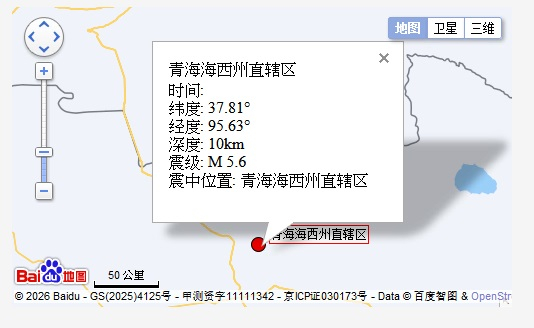
Sparse Population Near Epicenter
The earthquake struck in a sparsely populated high-altitude region. According to CRI International Online, the average elevation within 5 kilometers of the epicenter is approximately 4,247 meters. The village of Yilige Bu’ergasan lies within 5 kilometers of the epicenter, while no township is located within 20 kilometers. Dachaidan Town sits approximately 50 kilometers away. The epicenter is 24 kilometers from the Dachaidan Administrative Committee, 160 kilometers from Delingha, 168 kilometers from Golmud, and 561 kilometers from the provincial capital Xining.
Emergency Response Mobilized
The Qinghai Provincial Fire Rescue Corps activated emergency response plans immediately after the earthquake, mobilizing 2 medium-sized land search and rescue teams and 5 professional land search teams—totaling 195 personnel, 67 fire trucks, and 6 search dogs, as Xinhua News Agency reported. The Dachaidan brigade dispatched a forward team of 1 vehicle and 5 personnel to the epicenter, along with 3 vehicles carrying 16 people to survey surrounding areas. The Qinghai Provincial Seismological Bureau also deployed 2 vehicles with 8 personnel for emergency response work.
Infrastructure and Damage Assessment
Local authorities in the Dachaidan area immediately organized emergency, public security, fire, and town forces to assess casualties, building damage, and infrastructure conditions. According to China Daily, communications, water supply, and road traffic in the affected area are currently normal. Some residential areas experienced power outages, and the power company is conducting repairs. As of the latest reports, no casualties have been reported.
Part of Ongoing Seismic Sequence
Wednesday’s earthquake is the latest in a series of seismic events that have rattled the Haixi region over the past two months. The China Earthquake Networks Center reported that within 200 kilometers of the epicenter, there have been 116 earthquakes of magnitude 3.0 or above in the past five years. The largest was a 6.3-magnitude earthquake on June 16, 2026, located just 6 kilometers from Wednesday’s epicenter.
That June earthquake caused one death and eight injuries (all minor, all since discharged from hospital) and triggered a Level III emergency response from the China Earthquake Administration. According to Jiemian News, the June 16 event was determined to be a thrust-type rupture located on the Zongwulongshan Fault, approximately 3 kilometers from the epicenter. Experts from the China Earthquake Networks Center indicated that aftershock activity would continue for some time.
The seismic sequence has remained active since then. A 5.2-magnitude earthquake struck on June 23, initially determined to be an aftershock of the June 16 event, followed by another 5.2-magnitude earthquake on July 1. As Beijing News reported, the region sits at the leading edge of the Qinghai-Tibet Plateau’s expansion into the continental interior, in the compressional thrust boundary zone between the Qilian block and the Qaidam block.
What to Watch For
Authorities continue to monitor the situation and assess potential damage in the affected areas. The ongoing seismic activity in the Haixi region underscores the persistent geological instability of the Qinghai-Tibet Plateau’s northeastern margin. With emergency response teams already on the ground and infrastructure largely intact, the immediate focus remains on completing damage assessments and ensuring the safety of residents in the sparsely populated high-altitude region. Further aftershocks remain a possibility as the seismic sequence continues to evolve.