China Orders Nationwide Crackdown on Formaldehyde-Treated Cabbage
China’s State Council Food Safety Office, along with the Ministry of Agriculture and Rural Affairs and the State Administration for Market Regulation, has directed local authorities nationwide to strictly investigate and crack down on the use of formaldehyde on cabbage, following an undercover video that exposed merchants dipping cabbage roots in the toxic chemical before transport. The three departments have ordered immediate special inspections of perishable vegetables including cabbage, with strict penalties for any violations found.
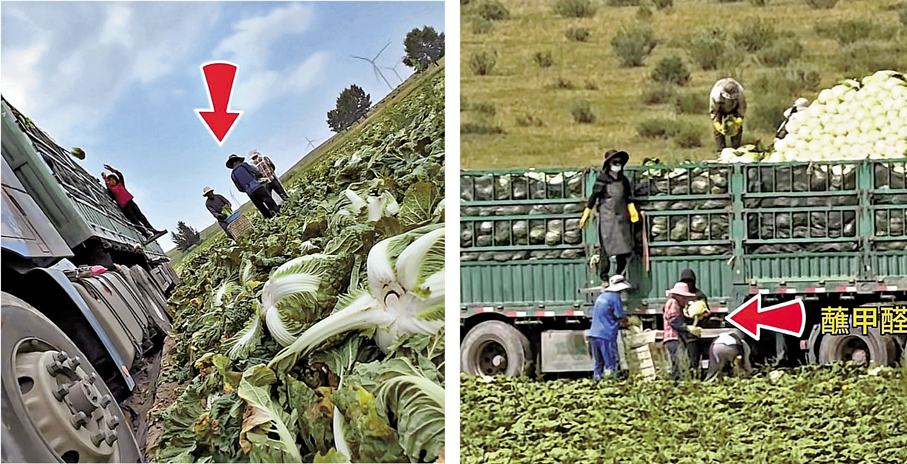
The directive came after blogger Yu Lie Qi Ge released undercover footage on August 22 showing workers at loading sites in Kangbao County, Zhangjiakou City, Hebei Province, dipping cabbage roots into formaldehyde solution before loading trucks for long-distance transport. The same day, the Kangbao County government confirmed the video’s content was true, stating it was an illegal act by purchasing merchants seeking to preserve vegetables during transport. Public security authorities took compulsory measures against the personnel and vehicles involved.
A Recurring Scourge
This is not the first time formaldehyde cabbage has surfaced in China. In 2012, cabbage merchants in Qingzhou, Shandong Province were exposed using formaldehyde solution for preservation, with two people administratively detained. That same year, a similar incident in Dingzhou, Hebei resulted in criminal detention. In 2014, the first criminal case involving formaldehyde cabbage was adjudicated in Laixi, Shandong, where a woman who instructed her mother-in-law to spray formaldehyde on cabbage was sentenced to 18 months in prison with a fine of 15,000 yuan.
Despite these precedents, the practice has persisted. The People’s Daily published a sharp commentary on August 22 declaring that “handling formaldehyde cabbage must be swift and strict,” noting that purchasing merchants “only calculated immediate economic benefits, completely ignoring consumers’ life and health, crossing legal red lines and breaking through moral bottom lines.”
The Economics Behind the Crime
The root cause lies in a simple cost calculation. From Kangbao to Suqian, Jiangsu — roughly 1,000 kilometers — a refrigerated truck costs about 4,500 yuan, while a regular open-top truck costs only 2,000 to 2,500 yuan, a savings of about 2,000 yuan per trip. A barrel of industrial formaldehyde costs just tens of yuan and can treat 30,000 jin (15,000 kg) of cabbage.
As an investigative report by Phoenix Finance’s Storm Eye detailed, local farmer Li Ming, a former vegetable loading worker, calculated: “Two thousand yuan difference per truck. What about a hundred trucks? How much profit is that? It’s really money that caused this disaster.”
Cheng Yujie, a PhD from Northwest A&F University, told Yangzi Evening News that compliant preservation operations are cumbersome, cold-chain transport costs are higher, and the results are not as immediately effective as banned preservatives, causing some purchasing merchants to take risks to reduce costs and product losses.
Collateral Damage on Compliant Farmers
The fallout has hit legitimate farmers and cooperatives hard. A large vegetable cooperative in Kangbao County saw daily shipments plummet from 1,500 packages to fewer than 300, with orders from Wenzhou and Guangzhou supermarkets cancelled outright. Cooperative head Mr. Xing told reporters that his operation uses proper cold-chain storage and has never used formaldehyde, but “the market doesn’t want our goods. They don’t accept verbal assurances, only written proof.”
Village Party Secretary Old Yuan, speaking on behalf of more than 100,000 vegetable farmers in Kangbao who rely on cabbage for their annual income, warned: “We cannot let a few unscrupulous merchants destroy the livelihoods of the entire county’s people.” The Kangbao County Agriculture and Rural Affairs Bureau has announced it will conduct sampling tests on cold-storage cabbage and issue no-formaldehyde-residue certificates for confirmed clean batches.
In Fuyang, Anhui Province, regulatory authorities tested the affected batch of cabbage and found formaldehyde levels exceeding standards, with the highest reading reaching 21.412 mg/kg. The cabbage was sealed and confiscated. Beijing’s Xinfadi Agricultural Products Wholesale Market launched emergency full-chain traceability checks, confirming the affected cabbage did not enter the market.
Legal and Regulatory Implications
Formaldehyde is classified as a Class 1 carcinogen by the World Health Organization’s International Agency for Research on Cancer. Chinese law explicitly prohibits its use in food preservation. The Food Safety Law and Agricultural Product Quality Safety Law mandate that preservatives used in packaging, preservation, storage, and transport of agricultural products must comply with national food safety standards.
Lawyer Wang Yuchen of Beijing Jinsu Law Firm explained that “as long as the act of mixing toxic or harmful non-food raw materials into food for sale is committed, it may constitute a crime, without requiring actual harmful consequences.” Whether the perpetrators actually caused consumer poisoning does not affect the establishment of criminal illegality, only potentially affecting sentencing.
First Financial commentary argued that factors such as cabbage preservation, appearance, seasonal production, and cold-chain transport costs “cannot serve as excuses for the existence of formaldehyde cabbage,” emphasizing that the “Four Stricts” — strictest standards, strictest supervision, strictest punishment, and strictest accountability — must be upheld.
What’s Next
Kangbao County has announced a 3,000 yuan reward for verified reports of illegal use of formaldehyde or other toxic chemicals on vegetables. Local authorities have set up checkpoints on roads leaving the county, sealing and sampling cabbage for testing before it can be transported out.
The central government’s directive orders nationwide special inspections of perishable vegetables, signaling that this incident will be treated as a systemic issue rather than an isolated case. As the Yicai commentary noted, the March 2025 issuance of the Opinions on Further Strengthening Whole-Chain Food Safety Supervision by the CPC Central Committee and State Council, along with the 15th Five-Year Plan’s call for whole-chain food and drug supervision mechanisms, reflects a broader push toward comprehensive oversight from farm to table.
The key question now is whether this crackdown will break the cycle that has persisted for over a decade. As one analysis on Guancha.cn observed, the practice has survived 14 years of exposure and punishment because enforcement remains uneven, formaldehyde is not part of routine mandatory testing for produce shipments, and the economics of low-cost cabbage transport continue to incentivize shortcuts. The nationwide inspection ordered this week will test whether China’s food safety enforcement has finally caught up with the problem.