China’s Robotics Industry Accelerates Globally
China’s robotics industry is accelerating at an unprecedented pace, with the 2026 World Robot Conference (WRC) in Beijing drawing record crowds and showcasing the country’s growing dominance in the global robotics supply chain. The five-day event, held August 19-23 at the Beijing Economic-Technological Development Area, attracted 557,000 on-site visitors—a 106% increase from the previous year—and featured 373 enterprises displaying over 3,000 innovative products, according to Xinhua News.
A Sector in Overdrive
The conference, themed “Human-Machine Symbiosis, Production-Demand Integration,” featured 7 main forums and 71 parallel events with over 1,000 domestic and international experts participating. International engagement was robust: 30 international institutions supported the event, 40 overseas enterprises exhibited, and more than 10,000 foreign visitors attended. Teams from 26 countries—11,418 teams with 17,802 contestants—competed in the associated robotics competitions.
Behind the spectacle lies a sector in rapid expansion. According to data from China’s Ministry of Industry and Information Technology (MIIT), robotics industry enterprises above designated size achieved operating revenue exceeding 300 billion yuan (RMB) in 2025, with an average annual growth rate of over 20% in the past five years. In the first half of 2026, revenue reached 165.5 billion yuan, a year-on-year increase of 24.5%.
“In recent years, China’s robotics industry has achieved a great leap from small to large and weak to strong, becoming the world’s largest industrial robot market for many consecutive years, with the humanoid robot industry at the global leading level overall,” said Xu Xiaolan, chairperson of the Chinese Institute of Electronics (CIE), as reported by Xinhua News.
From Demos to Real-World Work
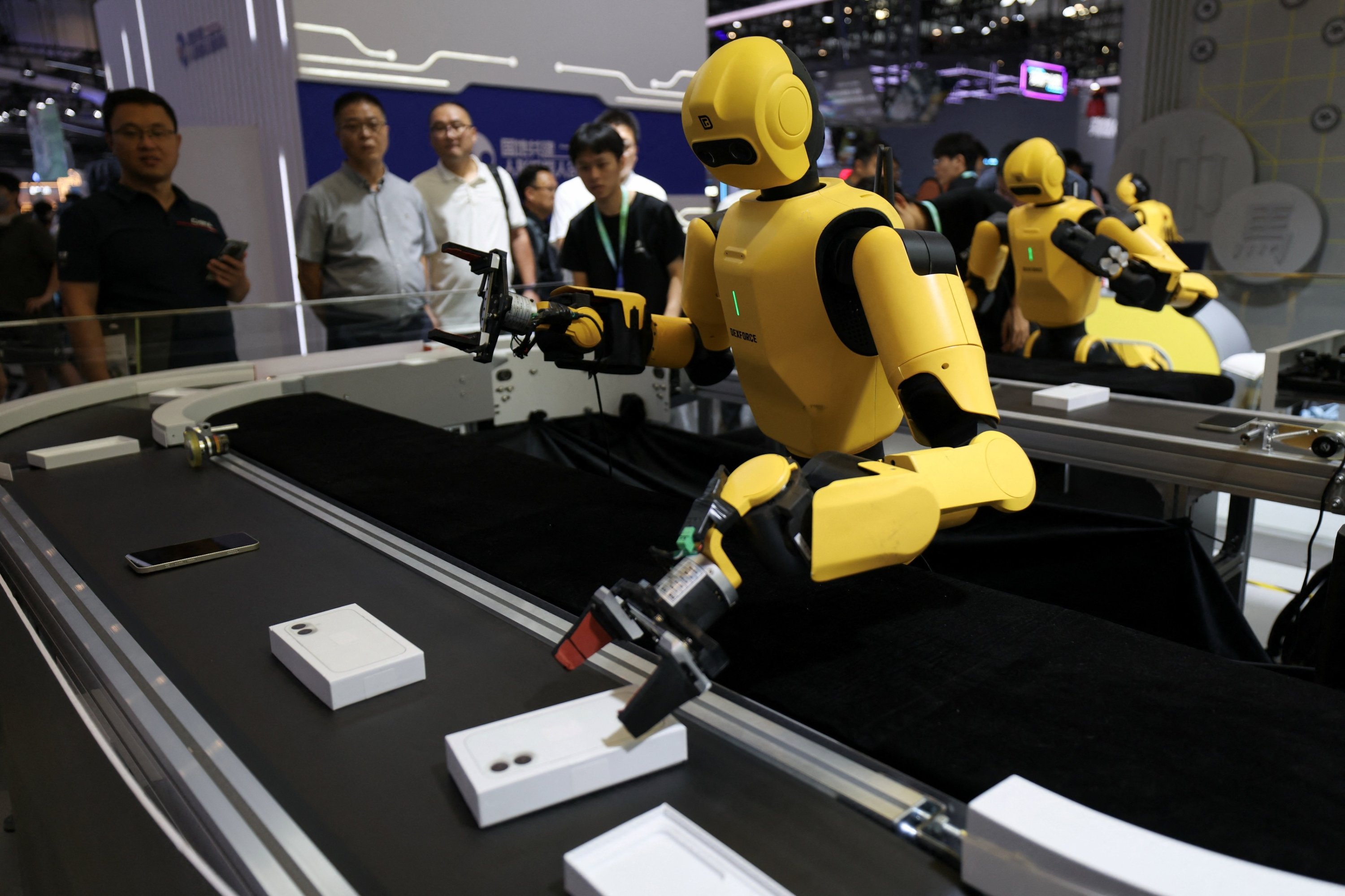
The conference showcased a decisive shift from flashy demonstrations to practical, real-world applications. Intelligent robots have moved from talent shows to genuine operations like parcel sorting, cooking noodles, and product packaging, noted Zhang Feng, Party Committee Secretary of CIE and chairperson of the China Humanoid Robot and Embodied Intelligence Hundred People’s Association, according to the Chinese Institute of Electronics.
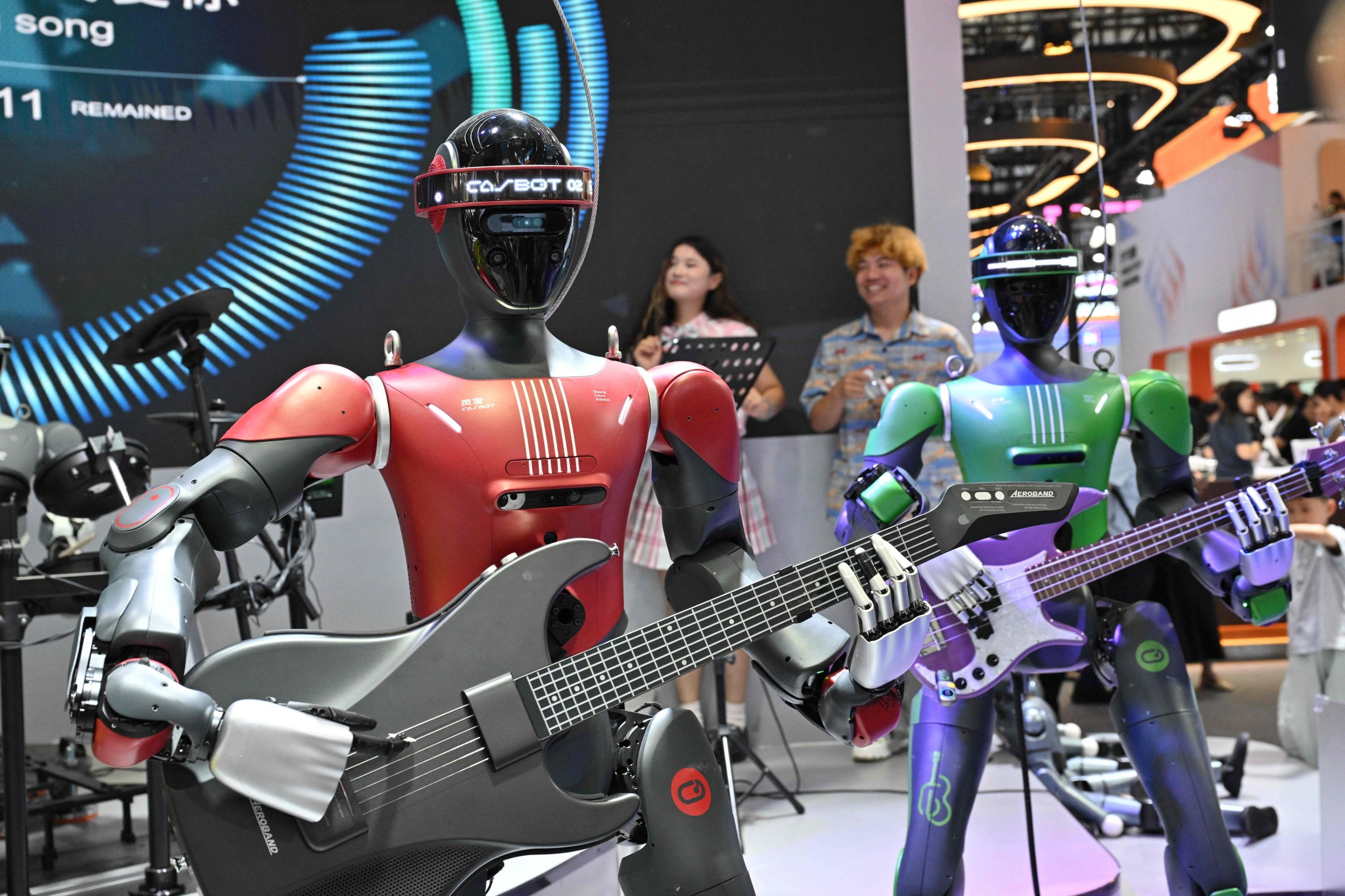
Chinese companies displayed robots performing increasingly complex tasks. Suzhou-based Youliqi Robot Technology showcased robots that make pizza, brew tea, create ink paintings, and even form bands. “Compared to previous static robots that completed single commands, the robots we are exhibiting this time are smarter and can complete more complex and refined tasks,” said Lu Xizhe, PR representative for the company, as quoted by Xinhua News.
Beijing-based Galbot demonstrated its heavy-duty robot Galbot S1, which operates 7x24 in CATL production lines, while Zhishen Technology’s co-founder Liu Yulong reported mass-producing and delivering over 10,000 embodied intelligence robots in the first half of the year, deployed in emergency firefighting, industrial inspection, security patrol, and education fields.
Global Collaboration Takes Center Stage
The conference also served as a platform for international cooperation. The “Global Robot Application Exploration Plan,” jointly launched by the World Robot Cooperation Organization (WRCO) and the Chinese Institute of Electronics on August 20, will select 1,000 application scenarios annually from global submissions for free robot trials and secondary development, according to the Chinese Institute of Electronics. The initiative aims to accelerate technology transfer from research to industrial value while building an open, win-win global robotics innovation ecosystem.
South Korea’s Dynamic Solution, a first-time participant specializing in brain-computer interface and wearable robots, expressed interest in partnering with Chinese companies to tap the expanding Chinese market. Japanese-invested SMC (China) has been collaborating with Chinese robot firms on pneumatic components for industrial automation. International visitors from around the world flocked to the event, with organizers reporting that 30 international institutions supported the conference and 40 overseas enterprises exhibited, as detailed in Daily Sabah’s coverage of the event’s global reach.
A Market Under Global Scrutiny
China’s robotics ascendancy has not gone unnoticed. The country now accounts for roughly 85% of the global humanoid robot market, and in the first half of 2026, Chinese humanoid robot shipments exceeded 40,000 units—97% of the global total. In 2025, Chinese robot makers shipped 25 times more units than their U.S. rivals, with Unitree and AGIBOT each shipping more than 5,000 humanoid robots compared to a few hundred or less for American counterparts like Tesla and Figure AI, according to Fortune.
The sector’s momentum was underscored by Unitree Technology’s landmark IPO on Shanghai’s STAR Market on August 19, raising $900 million at a $9 billion valuation. The stock soared 460% on its first day, reaching a $66 billion valuation before retreating about 19% on the second day. However, Unitree CEO Wang Xingxing cautioned that the industry’s breakthrough—or “ChatGPT moment”—could take “2 to 3 years at the fastest, and 5 or even 10 years at the slowest,” as Fortune reported.
The rapid growth has also triggered regulatory pushback. In late July, the U.S. Federal Communications Commission announced a ban on imports of new foreign-made humanoid robots and power inverters, citing national security risks in a move widely seen as targeting China. Chinese Foreign Ministry spokesperson Mao Ning responded: “Protectionism does not make the U.S. more competitive, and it will only hurt the interests of U.S. companies and consumers,” as reported by Fortune.
What’s Next
Looking ahead, China’s robotics ambitions show no signs of slowing. Beijing E-Town unveiled the “Beijing Robot Domain” plan, aiming to develop 100 practical robot products, deploy robots in 1,000 niche applications, achieve mass production of 100,000 sets of embodied intelligence robots, and build production capacity for 1 million sets of key core components, according to Beijing Daily.
Industry analysts project continued growth. Morgan Stanley forecasts China’s humanoid robot market could reach $15 billion by 2030, while GGII data projects it could exceed $20 billion by the same year. The MIIT has also launched a Humanoid Robot Real-Scene Training Special Action, refining over 100 high-value application scenarios to move robots from “can demonstrate” to “can work and be useful.”
The 2027 World Robot Conference is already scheduled to open on August 18, 2027, with the 2027 Yizhuang Humanoid Robot Half Marathon set for April 18, 2027. As the industry continues its rapid evolution, the question is no longer whether China’s robotics sector will shape the global market—but how the rest of the world will respond to its accelerating rise.