Barbary Macaque Baby Born at Planckendael Helps Troop Heal
ZOO Planckendael in Belgium has welcomed a new Barbary macaque baby, a birth that zoo officials say carries profound significance for a troop still recovering from trauma. The infant, born this week to mother Jella, is the third baby born into the group since the animals were rescued from an illegal breeding center in Poland in 2017.
The newborn, which has a black coat with a pink snout and pink hands and feet, is already visible to visitors, though Jella keeps her baby close to her belly. “Jella is doing fantastically,” keeper Brent told HLN. “She holds her young very firmly. Every now and then we get a glimpse of that pink snout. It’s beautiful to see how naturally she takes on her mother role.”

A Birth That Means More Than Most
The arrival carries special weight because of the troop’s painful history. The original group of seven macaques was rescued from an illegal breeding center in Poland in 2017, where babies were taken from their mothers and sold on the black market. After rehabilitation, the animals arrived at Planckendael in 2019, where they now live in a Moroccan-style enclosure.
“The original group comes from an illegal breeding center in Poland,” keeper Charlotte Coupaud told VRT NWS. “There, the babies were taken away to be sold on the black market.” She explained that the new births are helping the animals process their past: “The babies mean a lot to them and they also help process trauma. Last year, the monkeys Azul and Adeni were born, and you can tell the group really benefits from this.”
The birth brings the troop to 11 members, and the zoo’s keepers suspect another female, Ilse, may be pregnant as well. “We didn’t expect it this time, because Jella didn’t have a big belly either,” Coupaud said. “There’s another female, Ilse, and she does have a big belly. We’re keeping a close eye on her, and if all goes well, it will soon be a double celebration.”
A Village Raises a Child
Barbary macaques are notable among primates for their social structure, in which males and females alike participate in caring for young. “The saying ‘It takes a village to raise a child’ is literally applied here,” Coupaud told VRT NWS. “The mother provides milk, but everyone else helps care for the young. The older animals often babysit, and all focus is on the new baby.”
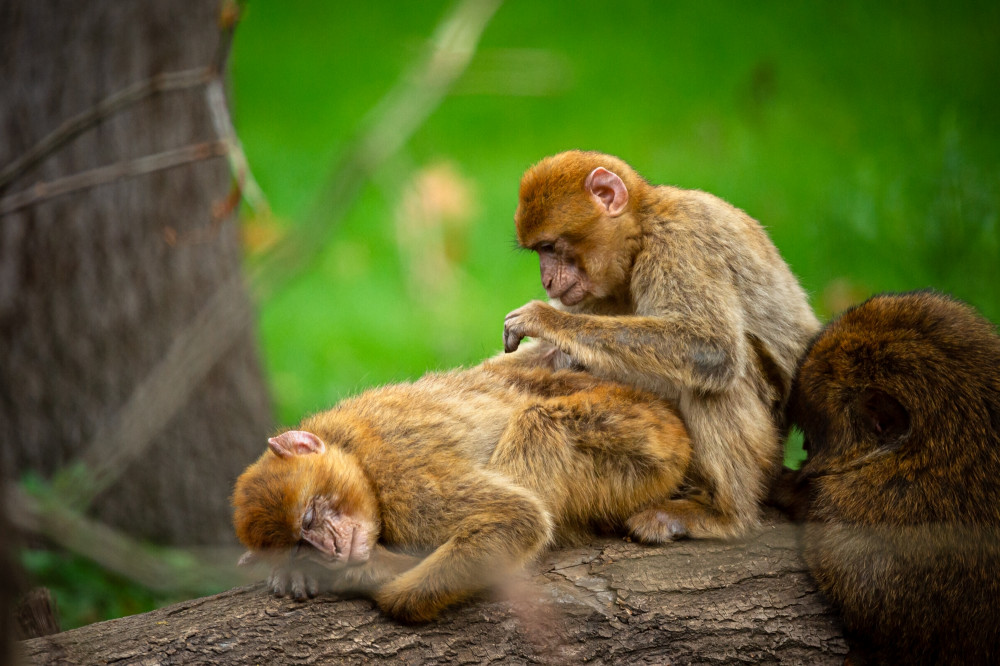
This communal care is central to why the birth is so meaningful for the group’s recovery. The macaques’ behavior has been closely studied since their arrival. In 2020, researchers from the Antwerp Centre for Research and Conservation conducted over 166 hours of behavioral observations, finding that the animals were behaving as they would in the wild—frequent grooming, low aggression, and lots of play—indicating they were thriving despite their traumatic past, as documented by ZOO Science.
An Endangered Species
The Barbary macaque is the only macaque species found outside Asia and the only primate in Europe north of the Mediterranean. With only about 10,000 animals remaining in the wild—a decline of 65 percent over the past three decades—the species faces severe threats from habitat loss, illegal pet trade, and exploitation as tourist attractions.
ZOO Planckendael participates in the European breeding program for the endangered species, making each birth a meaningful contribution to conservation. The zoo also uses the occasion to raise awareness about the illegal wildlife trade. “A vacation photo with a monkey may seem innocent, but it can help sustain illegal animal trade,” the zoo said in a statement. “The message is therefore simple: don’t take a photo with a monkey when traveling.”
Details Still Emerging
The sex of the newborn is not yet known—keepers need to see the baby from the right angle or catch a well-timed urine sample to determine it. Once identified, the zoo will propose three name options and the public will vote via social media, as RTV reported.
Paternity is also pending: three males—Dayo, Aku, and Tuareg—are potential fathers, and DNA analysis will determine which one is the sire. “During ovulation, the monkeys mate with almost everyone, so it’s difficult to tell,” Coupaud noted.
What to Watch For
With Ilse suspected to be pregnant, the Planckendael troop may soon grow further. For a group of animals that endured unimaginable suffering, each new life represents a step forward in their recovery—and a testament to the resilience of a species fighting for survival.