China Achieves First Two-Way Laser Link to the Moon
China has successfully established its first two-way high-speed laser communication link between Earth and the Moon, spanning a distance of more than 400,000 kilometers. The breakthrough, announced by the Technology and Engineering Center for Space Utilization of the Chinese Academy of Sciences, marks a significant milestone in deep-space communication technology and paves the way for China’s ambitious lunar exploration program.
The mission, carried out using a satellite operating in a distant retrograde orbit, achieved communication rates of 1.25 Mbps uplink and 100 Mbps downlink. According to Xinhua News, this represents the transition of China’s space laser communication technology from near-Earth orbit into the cislunar space domain.
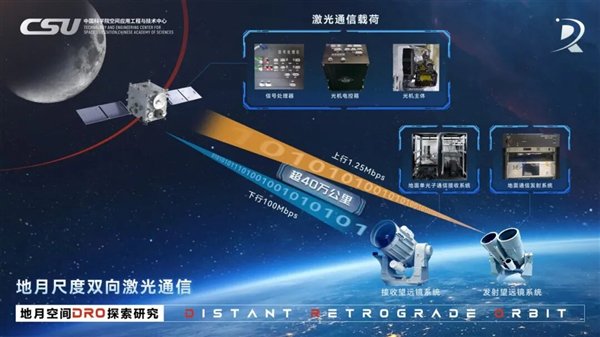
Overcoming Three Major Technical Challenges
Space laser communication offers significant advantages over traditional radio-frequency systems, including higher bandwidth, faster speeds, precise directionality, and enhanced security. However, as Science and Technology Daily reported, deep-space laser communication has long faced three formidable obstacles.
Yang Lei, a researcher at the Technology and Engineering Center for Space Utilization, CAS, described the challenges: “Deep-space laser communication has long faced three major challenges: distances of hundreds of thousands of kilometers, making it extremely difficult to achieve precise beam alignment; signals weakening to near-undetectable levels by the time they reach Earth; and persistently low transmission speeds.”
The first challenge was beam alignment. Communicating between Earth and the Moon is comparable to precisely directing an extremely fine beam of light through a rapidly moving “pinhole” from 400,000 kilometers away. Even a tiny angular deviation at the transmitting end can result in an error of several kilometers near the target. The research team developed a novel approach that accounted for satellite orbit, telescope installation errors, atmospheric refraction, and laser flight time, enabling the orbiting satellite and ground-based telescope to remain continuously aligned while both were in motion.
The second challenge was signal detection. After traveling 400,000 kilometers, the laser signal arriving at Earth is so weak that only a few photons remain. Ground telescopes receive extremely faint signals while moonlight, starlight, and city lights introduce significant interference. The team employed ultra-sensitive single-photon detectors and developed a sophisticated signal recognition algorithm to extract valid signals from massive amounts of noise.
The third challenge was transmission speed. Through technical breakthroughs, the team significantly enhanced data-processing efficiency, achieving the experiment’s 1.25 Mbps uplink and 100 Mbps downlink rates.
A Quantum Leap in Data Transmission
The practical impact of this achievement is substantial. As Yang Lei explained, downloading an 8K high-definition image of the lunar surface via a traditional 5 Mbps microwave link would take approximately 4 to 5 minutes. With 100 Mbps laser communication, the same image can be transmitted in just about 12 seconds.
“The ‘information highway’ between Earth and the Moon has now been opened,” Yang said. “In the future, we will be able to obtain more scientific data of original value.”
The Global Times reported that these technologies will provide new high-speed information transmission capabilities for China’s crewed lunar landings, lunar research station construction, and deep-space exploration missions.
Building on a Foundation of Progress
This achievement builds on a precursor milestone from April 2025, when a research team comprising the Technology and Engineering Center for Space Utilization, Yunnan Observatory, and Shanghai Observatory successfully detected laser echo signals from the DRO-A satellite at approximately 350,000 kilometers. As reported by Science and Technology Daily, that marked China’s first Earth-Moon scale satellite laser ranging capability, validating deep-space laser ranging technology and laying the groundwork for the current laser communication breakthrough.
China’s research on laser communication began relatively late compared to the United States, with the first domestic satellite-Earth laser communication experiment conducted on the Haiyang-2 satellite in 2011. However, development has accelerated rapidly in recent years, with the country now demonstrating capabilities at the Earth-Moon scale.
International Context and Strategic Significance
The achievement places China in a competitive position in the global race for deep-space laser communication capability. NASA has been developing laser communications through its Laser Communications Relay Demonstration (LCRD) program and plans to demonstrate laser communications on the Artemis II crewed lunar mission with a downlink rate of up to 260 Mbps.
China’s successful demonstration of 100 Mbps downlink over the Earth-Moon distance represents a significant technical milestone, particularly given the extreme engineering challenges involved in maintaining a laser link across such vast distances.
The technology is expected to play a crucial role in China’s lunar program, which targets crewed lunar landings by 2030 and the construction of the International Lunar Research Station (ILRS). High-speed, reliable communication will be essential for these missions, enabling real-time data transmission, remote operations, and scientific data collection.
What to Watch For
As China continues to develop its deep-space communication infrastructure, several developments bear watching. The integration of laser communication capabilities into upcoming lunar missions will be a key indicator of the technology’s operational readiness. Additionally, the evolution of data transmission rates and the expansion of the Earth-Moon communication network will determine how much scientific data future missions can return.
The successful demonstration of two-way high-speed laser communication between Earth and the Moon marks a significant step forward in humanity’s ability to communicate across deep space. As China’s lunar program advances toward crewed landings and permanent station construction, this “information highway” will be essential infrastructure for the next era of lunar exploration.