NASA’s Roman Telescope Launches to Explore Hidden Universe
CAPE CANAVERAL, Fla. — NASA’s newest flagship observatory, the Nancy Grace Roman Space Telescope, successfully launched Sunday morning aboard a SpaceX Falcon Heavy rocket, beginning a mission that promises to transform our understanding of dark energy, exoplanets, and the structure of the cosmos.
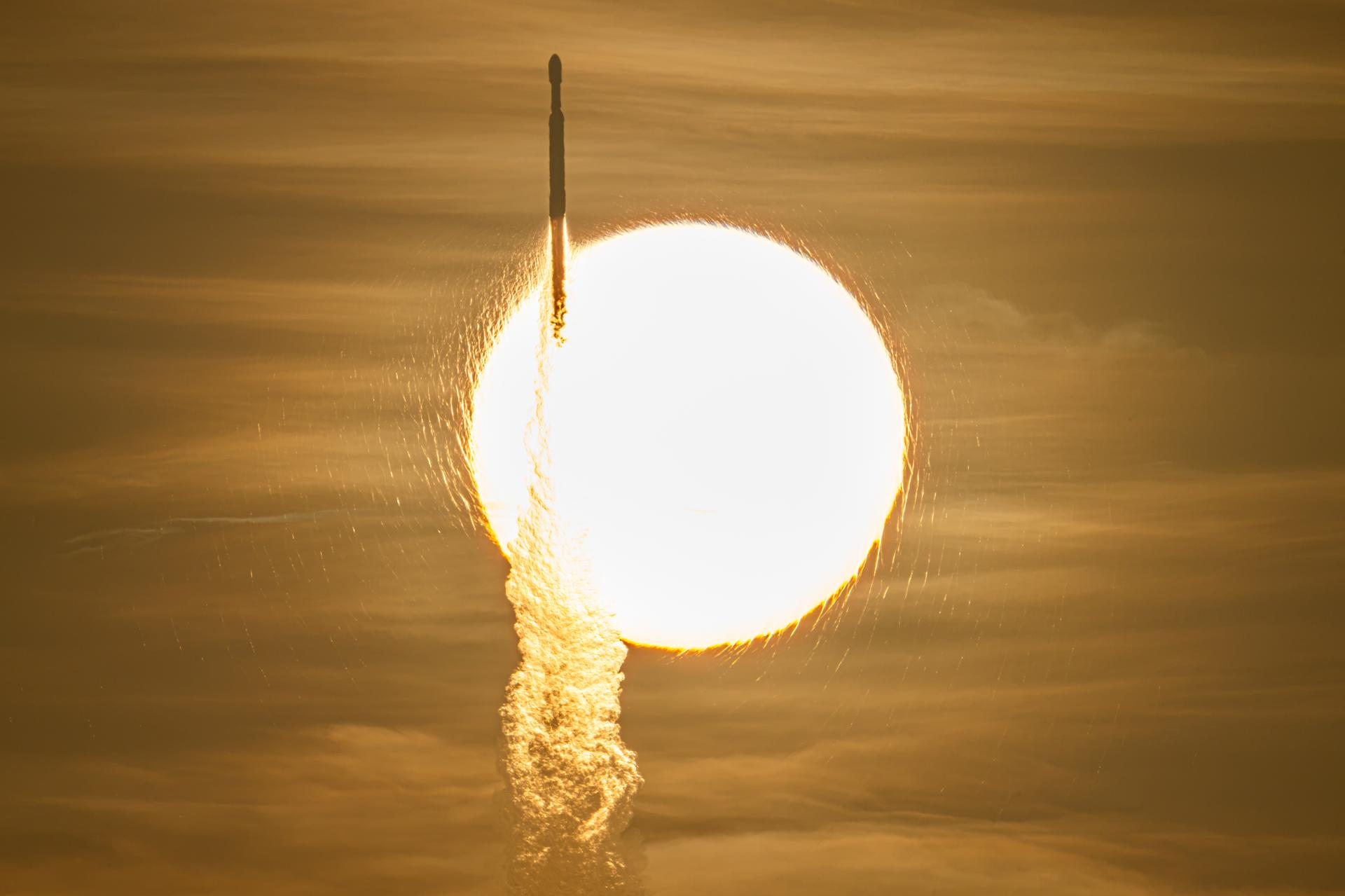
The $4.3 billion telescope lifted off at 7:26 a.m. EDT from Launch Complex 39A at NASA’s Kennedy Space Center in Florida, as AP News reported. The bus-sized observatory separated from the rocket’s upper stage 31 minutes later, drawing applause from ground controllers as it began its three-month journey to Sun-Earth Lagrange Point 2 (L2), approximately 1 million miles from Earth.
A New Era of Cosmic Discovery
Roman’s field of view is more than 100 times wider than that of NASA’s Hubble Space Telescope, giving it unprecedented survey capabilities. Its primary instrument, the Wide Field Instrument, is a 300-megapixel infrared camera that can scan the sky 1,000 times faster than Hubble, according to NASA.
“It’s going to find thousands of supernovae, tens of thousands of planets, billions of galaxies and tens of billions of stars,” said Nicky Fox, NASA’s associate administrator for the Science Mission Directorate, who was in tears watching the launch. “It’s going to be able to do things that we’ve never been able to do before with its massive field of view.”
The telescope also carries the Coronagraph Instrument, an experimental starlight-blocking device that will allow direct imaging of exoplanets. This is the first active coronagraph to be used in space, and it could pave the way for future observatories to search for habitable worlds.
“We are going to make this giant leap forward with the coronagraph technology that is going to allow us to look at these distant worlds and start to really resolve the atmosphere around them to let us know if they could be habitable,” Fox told NPR.
A Namesake Honored
Roman is NASA’s first space telescope named after a woman — Nancy Grace Roman, the agency’s first chief astronomer, who died in 2018 at age 93. Known as the “Mother of Hubble” for her advocacy of space-based observatories, Roman joined NASA in 1959 and championed the idea that telescopes above Earth’s obscuring atmosphere could see farther and better.
Retired NASA scientist Ed Weiler, who coined the “Mother of Hubble” phrase and was hired by Roman in 1978, said the honor is long overdue. “This is very, very fitting. I think Nancy would be very proud that the namesake telescope will tackle some of the biggest, lingering questions about the universe such as dark energy,” Weiler said, as reported by Space.com.
The telescope has an unusual origin: its primary mirror, nearly 8 feet in diameter, was originally designed for a spy satellite. The National Reconnaissance Office donated two leftover mirrors to NASA more than a decade ago, making the mission significantly more affordable.
A Mission That Nearly Wasn’t
Roman’s path to the launch pad was not without obstacles. In April 2025, President Trump’s leaked budget proposal for fiscal year 2026 outlined a 24% overall reduction in NASA funding, with a 50% loss to science programs. The document allocated no funding for telescopes beyond Hubble and JWST, stoking fears that Roman could be canceled.
Jamie Dunn, director of NASA Goddard and former Roman project manager, recalled the uncertainty. “Out of the eight years I worked on Roman, we were zeroed out in the president’s budget in at least half of them,” Dunn told a National Academies committee, as Space.com reported. “Not to be casual about it, but that happens.”
Congress ultimately rejected the steep cuts and restored NASA’s funding. The Roman team accelerated its work, running two shifts daily and weekends, and the mission launched nearly a year ahead of schedule and within budget.
“Sometimes you’ve just got to keep coloring,” Dunn said. “We kept working, and I told the Roman team that the best thing we can do is deliver on our commitments.”
What Roman Will Reveal
Roman’s scientific agenda is ambitious. It will catalog galaxies to help scientists measure how quickly the universe is expanding due to dark energy, the mysterious force believed to drive cosmic acceleration. It will study how gravity subtly bends light across vast distances to map both normal and dark matter. And it is expected to identify more than 100,000 exoplanets through transit detection and about 1,000 more through microlensing.
“Roman’s vast reach will allow us to find the weird, the rare and the unusual,” said Julie McEnery, Roman’s senior project scientist. “We’ll redefine what it means to find a needle in a haystack.”
“The scope is extraordinary,” McEnery added. “We will do a survey of our own Milky Way galaxy and find 20 billion stars. That would make it the largest catalog of astronomical objects that’s ever been produced.”
The telescope will beam back 1.4 terabytes of raw science data each day — the highest data rate of any NASA astrophysics mission. NASA has made the data available to anyone through a cloud-based system called Roman Nexus, allowing scientists and the public alike to search for discoveries.
“Roman’s database at the end of its prime mission after five years is going to be bigger than your standard music streaming platform,” said Jeremy Perkins, NASA integration and test scientist. “It’s all the things that we are not expecting to see. It’s all these one-in-a-million things that we’re going to be able to see with Roman that really excites me.”
Looking Ahead
Roman will take more than three months to reach L2, where it will join the James Webb Space Telescope in a stable orbit beyond the Moon. The telescope is designed to be refueled, potentially extending its life beyond the planned five-year primary mission.
During the post-launch press conference, NASA Administrator Jared Isaacman received a congratulatory call from President Trump, who said, “Boy, it looked beautiful on television. You’re the hottest in space.”
First images from Roman are expected in early 2027. As McEnery put it: “I very much hope, and in fact, expect that the most exciting science of Roman will be a surprise — something we couldn’t predict and that will set the stage for the next, deeper set of questions for future missions to progress.”
With Roman now on its way, the hidden universe may soon reveal its secrets.