NASA’s Roman Telescope Launches to Explore Hidden Universe
CAPE CANAVERAL, Fla. — NASA’s newest flagship observatory, the Nancy Grace Roman Space Telescope, successfully launched Sunday aboard a SpaceX Falcon Heavy rocket, beginning a $4.3 billion mission to explore the hidden universe and unlock secrets of dark matter, dark energy, and planets beyond our solar system.
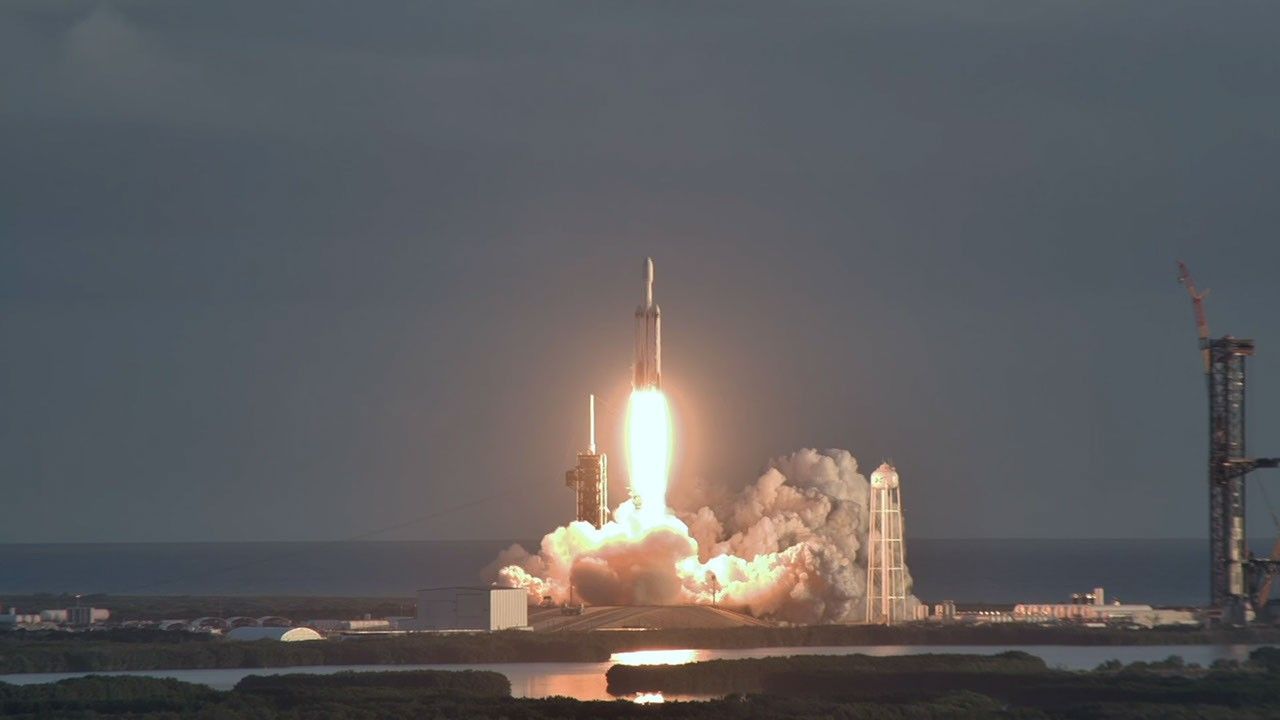
The bus-sized telescope lifted off at 7:26 a.m. EDT from Launch Complex-39A at Kennedy Space Center in Florida, blazing toward an observation point 1 million miles from Earth. The launch marked a triumphant moment for a mission that nearly fell victim to proposed budget cuts, and it came nearly a year ahead of schedule and within budget.
“It’s going to find thousands of supernovae, tens of thousands of planets, billions of galaxies and tens of billions of stars,” said Nicky Fox, NASA’s Science Mission Directorate chief, according to AP News. “It’s going to be able to do things that we’ve never been able to do before with its massive field of view.”
A Wider Window on the Cosmos
Roman’s superpower is its unprecedented field of view — more than 100 times wider than that of the Hubble Space Telescope, which continues to operate after 36 years in orbit. Its 300-megapixel infrared camera matches Hubble’s sensitivity but scans the sky 1,000 times faster, allowing astronomers to survey vast regions of the universe in a fraction of the time.
“A month of Milky Way observations by Roman would take Hubble a century to complete,” senior project scientist Julie McEnery said on the eve of launch, as reported by NPR.
The telescope will catalog an estimated 20 billion stars in the Milky Way and survey more than 2 billion galaxies. Its largest images will span up to a trillion pixels — so massive that “there isn’t a screen on Earth large enough to display all the pixels,” said Dominic Benford, program scientist for the mission, according to Space.com.
Unlocking the Universe’s Dark Secrets
At the heart of Roman’s mission is the quest to understand dark matter and dark energy, which together make up approximately 95% of the universe’s content. Ordinary matter — stars, planets, gas, dust, and everything familiar on Earth — represents just 5%. Dark matter, known only through its gravitational influence, accounts for about 27%, while dark energy, the mysterious force driving cosmic expansion, makes up roughly 68%.
Roman’s catalog of galaxies will help scientists measure how quickly the universe is expanding and investigate the so-called Hubble tension — the discrepancy between different measurements of the universe’s expansion rate. The telescope will also study how gravity subtly bends light across vast distances, helping map both normal and dark matter throughout the cosmos.
Hunting for New Worlds
Beyond dark matter and dark energy, Roman is equipped to revolutionize the search for exoplanets. NASA expects the telescope to discover more than 100,000 new planets using the transit method — detecting dips in starlight as planets pass in front of their host stars — and approximately 1,000 more through microlensing, a technique that detects tiny changes in background starlight caused by a planet’s gravity.
The telescope also carries the first active coronagraph to be used in space, designed to block out starlight and directly image faint planets orbiting distant suns. “We are going to make this giant leap forward with the coronagraph technology that is going to allow us to look at these distant worlds and start to really resolve the atmosphere around them to let us know if they could be habitable,” Fox said, as Al Jazeera reported.
“Why do we care so much about exoplanets?” Fox added. “Because one of our main goals at NASA is answering the question: Are we alone in the universe.”
A Spy Satellite’s Second Life
Roman’s primary mirror has an unusual origin: it was originally designed for a next-generation spy satellite for the National Reconnaissance Office. When that project was canceled, the NRO donated two leftover mirrors to NASA more than a decade ago — a repurposing that saved the agency significant costs and time. The second mirror remains in storage.
The telescope is named after Nancy Grace Roman, NASA’s first chief astronomer, who championed space-based telescopes and earned the nickname “Mother of Hubble.” She died in 2018 at age 93. Roman is NASA’s first space telescope named after a woman.
“This is very, very fitting. I think Nancy would be very proud” that the namesake telescope will tackle some of the biggest, lingering questions about the universe, retired NASA scientist Ed Weiler told The Guardian.
Surviving Political Battles
The mission’s road to the launchpad was not without obstacles. The Trump administration attempted to cancel or drastically reduce funding for the Roman Space Telescope during both his first and second terms. A 2025 White House proposal called for “extinction level cuts” to NASA’s science budget, including axing Roman. Congress rejected those cuts in January 2026, restoring NASA’s funding to $24.4 billion.
The administration is seeking further reductions for fiscal year 2027, proposing a 23% cut to NASA’s overall budget and a 46% reduction for science projects.
A Spectacular Launch
The Falcon Heavy lifted off with the thunder of 21 Merlin 1D engines. About 2.5 minutes into flight, the rocket’s two side boosters separated and executed boostback burns, landing tail-first at Cape Canaveral with sharp sonic booms. The telescope separated from the upper stage approximately 31 minutes after liftoff, and solar panels deployed successfully. NASA Administrator Jared Isaacman confirmed that “all systems are nominal” based on telemetry received at NASA Goddard.
Fox was in tears watching the launch unfold. “It’s such a good day!” she said. President Donald Trump called NASA Administrator Jared Isaacman during a post-launch news conference to offer congratulations, saying, “Boy, it looked beautiful on television. You’re the hottest in space.”
The launch also marked the final flight of SpaceX’s Falcon Heavy rocket, which the company is phasing out in favor of its Starship vehicle.
The Journey Ahead
Roman will take more than three months to reach its destination at Sun-Earth Lagrange Point 2 (L2), approximately 1 million miles from Earth, where it will join the James Webb Space Telescope in a stable gravitational orbit. During the cruise, the telescope will undergo calibration and testing before beginning science operations. First science images are expected in early 2027.
The telescope’s primary mission is planned for five years, with a potential five-year extension. It is designed to be refueled, which could further extend its operational life if a robotic tanker becomes available.
Roman will work alongside Hubble, Webb, the European Space Agency’s Euclid spacecraft, and the Vera C. Rubin Observatory in Chile to provide the most comprehensive view of the universe ever assembled. As NASA’s Fox put it: “It will be as if Hubble and James Webb kind of peered through a keyhole at the universe while Nancy Grace Roman will kick the door down.”
McEnery captured the sense of anticipation: “I very much hope, and in fact, expect that the most exciting science of Roman will be a surprise — something we couldn’t predict and that will set the stage for the next, deeper set of questions for future missions to progress.”
As the telescope begins its journey into the unknown, scientists and space enthusiasts alike await what promises to be a new era in our understanding of the cosmos.