5.1 Magnitude Earthquake Strikes Qinghai’s Haixi Prefecture
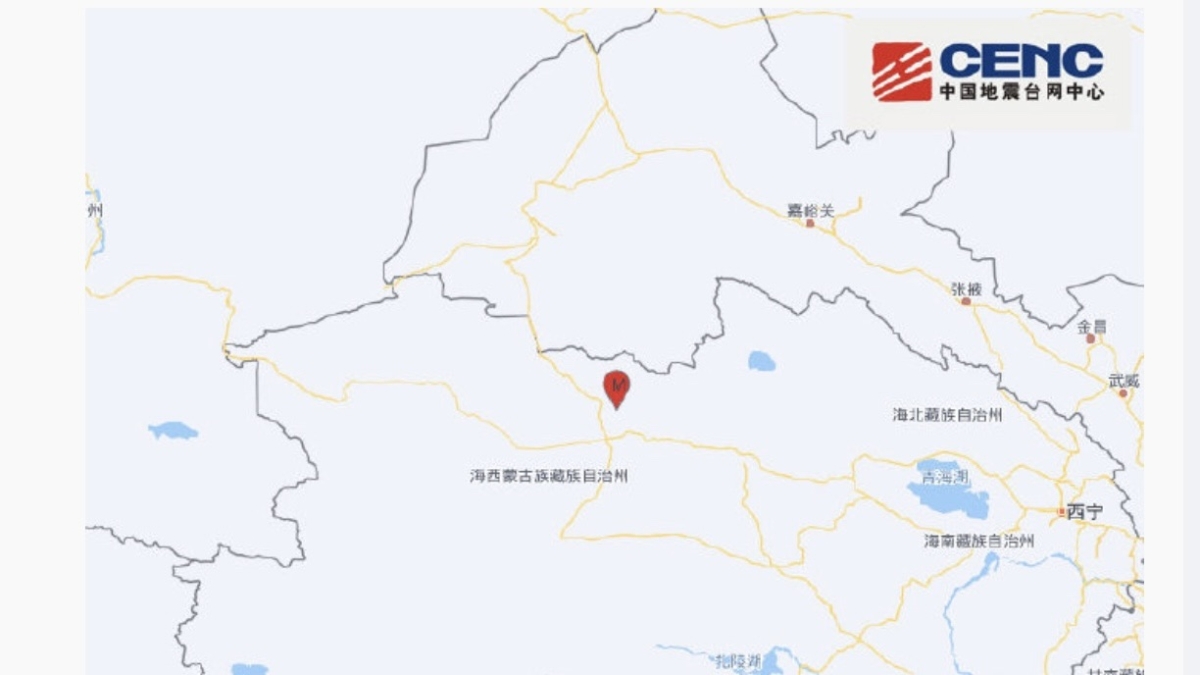
A 5.1 magnitude earthquake struck the Haixi Prefecture directly-administered area of Qinghai Province in northwestern China in the early hours of September 4, according to the China Earthquake Networks Center. The quake struck at 1:04 Beijing Time. The epicenter was located at 37.84°N, 95.59°E, with a focal depth of 10 kilometers. International monitoring agencies, including GFZ and Earthquakelist.org, recorded the event at magnitude 5.2, a slight discrepancy that is normal between different seismic monitoring networks.
The earthquake occurred approximately 20 kilometers from the Dachaidan Administrative Committee seat, about 165 kilometers from Delingha City, and roughly 272 kilometers south of Dunhuang in Gansu Province. The area is sparsely populated, with approximately 5,300 people living within 20 kilometers of the epicenter.
Emergency Response Activated
The China Earthquake Administration quickly activated a Level 4 emergency response following the quake, coordinating the China Earthquake Networks Center and the Qinghai Provincial Earthquake Agency for emergency handling. The Qinghai Provincial Earthquake Agency dispatched a field work team to the affected area to assist local government emergency response efforts, as reported by Yicai.
Local residents in the Dachaidan area reported strong shaking and fear. According to NTD, some described being “scared to tears,” while others noted that “Haixi Prefecture keeps shaking non-stop.” Shaking was also felt in Xi’an, Shaanxi, and Lanzhou, Gansu, hundreds of kilometers from the epicenter.
Part of an Ongoing Seismic Sequence
This earthquake occurred within the ongoing aftershock sequence of the June 16, 2026, M6.3 earthquake that struck the same Dachaidan region of Haixi Prefecture. The June 16 mainshock, located at approximately 37.80°N, 95.56°E, was determined to be a thrust-type rupture on the southern margin of the Qilian Mountain seismic belt, at the compressional thrust boundary between the Qilian block and the Qaidam block, as reported by Xinhua.
The September 4 epicenter lies only 5-7 kilometers from the June 16 mainshock, and given the proximity and ongoing nature of the seismic sequence, experts have indicated this event is very likely part of the same aftershock series. The June 16 earthquake caused one death and eight injuries, all minor, and prompted the closure of five coal mines near the epicenter with 1,004 mine workers safely evacuated, according to Xinhua.
Multiple magnitude 5+ events have occurred in the sequence since June, including a M5.2 on June 23, which was officially classified as an aftershock of the June 16 earthquake, and a M5.2 on July 1. More recently, a M5.5 earthquake struck on August 18-19 and a M4.8 on August 20 in the same area, with no casualties or property damage reported. Xinhua has noted that experts expect aftershock activity to continue for an extended period based on historical earthquake patterns and sequence decay characteristics.
Broader Regional Seismic Activity
Qinghai Province has experienced notably heightened seismic activity throughout 2026. In addition to the June 16 M6.3 earthquake and its numerous aftershocks, the province experienced M5.7 and M5.8 earthquakes in Xinghai County, Hainan Prefecture on July 28, occurring just 18 minutes apart. China News Service reported on the latest event as the region continues to experience significant seismic activity.
Within 200 kilometers of the epicenter area, seven earthquakes of magnitude 6 or greater have occurred since 1900, including a M6.8 in Dulan County in 1962 and a M6.0 in Delingha City in 2022, highlighting the region’s active geological setting at the leading edge of the Tibetan Plateau’s expansion into the continental interior.
Outlook
The activation of a Level 4 emergency response—the lowest level in China’s earthquake response system—reflects the relatively moderate nature of this event compared to the June 16 earthquake, which triggered a Level 3 response. Given the sparse population density and well-established emergency procedures developed over months of repeated seismic activity, the risk of significant casualties or property damage remains relatively low.
Authorities will continue monitoring the seismic sequence closely, with field teams assessing conditions on the ground. As experts have previously noted, aftershocks from the June 16 sequence are expected to persist for some time, and residents in the region should remain prepared for continued seismic activity.