China’s Ding Opens 16th APEC Energy Ministers Meeting
Chinese Vice Premier Ding Xuexiang opened the 16th APEC Energy Ministerial Meeting in Beijing on September 10, delivering an address that positioned China as a stabilizing force in global energy markets and laid out a three-point agenda for Asia-Pacific energy cooperation.
The two-day meeting, which runs through September 11, is a flagship event of China’s 2026 APEC chairmanship. According to Xinhua, approximately 300 participants attended the opening ceremony, including energy ministers or representatives from APEC economies and heads of relevant international organizations.
China’s Energy Positioning
In his keynote, Ding — a member of the Standing Committee of the Political Bureau of the CPC Central Committee — framed China’s energy posture in decidedly global terms, according to the English-language State Council report.
“China will always defend the stability of global energy markets, contribute to the global green and low-carbon transition, and participate in international energy cooperation,” Ding said, adding that Beijing is willing to work with all parties to advance global energy security and sustainable development.
He credited the strategy articulated by President Xi Jinping — known as the “four revolutions, one cooperation” energy security framework — with strengthening China’s supply capacity, deepening its low-carbon transition and rapidly expanding its new energy industries.
A Three-Point Cooperation Agenda
Ding’s proposals centered on the theme of the meeting: “Forging an Inclusive, Innovative, and Synergistic Asia-Pacific Energy Community.” The Chinese Foreign Ministry outlined the three pillars.
First, inclusive sharing. Ding urged implementation of APEC’s energy accessibility initiative, prioritizing “small and beautiful” green energy cooperation projects and promoting distributed energy and charging infrastructure to raise the region’s level of inclusive energy development.
Second, innovation cooperation. He called for joint research and development on emerging technologies such as new-type energy storage and digital grids, alongside the sharing of mature technologies and application scenarios to better empower the region’s energy transition.
Third, synergistic governance. Ding advocated “true multilateralism,” dialogue and consultation, aiming to build a safer, more efficient and sustainable APEC energy governance system while keeping energy industrial and supply chains stable.
Broader APEC Context
The agenda reflects priorities set independently by the APEC Secretariat, which frames the meeting around expanding access to reliable, affordable energy and strengthening links between artificial intelligence and energy systems to build more resilient supply chains.
The gathering builds on APEC’s collective goals to reduce aggregate energy intensity by 45 percent by 2035 and to double the share of modern renewable energy by 2030 across the Asia-Pacific, according to the APEC Secretariat.
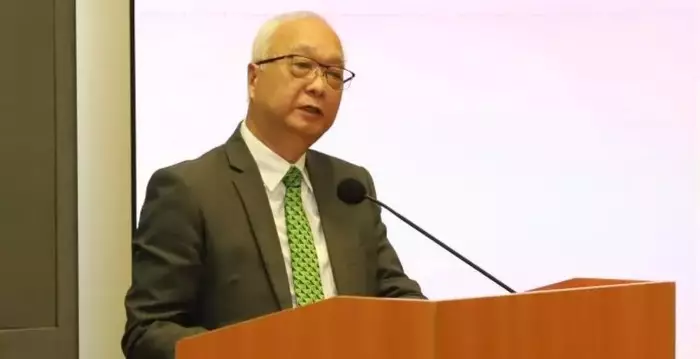
Regional participation extended beyond national delegations. Hong Kong’s Secretary for Environment and Ecology, Tse Chin-wan, traveled to Beijing for the meeting and the accompanying Asia-Pacific Forum on Energy Sustainable Development, where he was set to meet officials from the Ministry of Ecology and Environment, the National Energy Administration and other mainland bodies, Bastille Post reported.
Analysis: Diplomacy Through Energy
The meeting lands at a moment when energy policy has become a central vector of both economic strategy and geopolitical positioning. China’s framing — as a stabilizing force for markets and a contributor to the low-carbon transition — serves several purposes.
It projects continuity in a region acutely sensitive to supply disruptions, reinforces Beijing’s role as a convenor of multilateral energy dialogue under the APEC umbrella, and aligns with China’s domestic priorities, where new energy industries have become a growth engine. The emphasis on AI-energy integration also connects the ministerial to a broader theme of China’s 2026 APEC agenda.
At the same time, the meeting’s consensus-based nature means its practical output will depend on how far the 21 APEC economies can translate shared language into national action. Collective targets such as a 45 percent reduction in energy intensity by 2035 and doubling modern renewables by 2030 are ambitious, and their achievement rests on policy coordination that has historically proven uneven.
What’s Next
The energy ministerial is one of 11 sectoral ministerial meetings under China’s APEC chairmanship. Attention will now turn to the APEC Finance Ministers Meeting in Hong Kong in October 2026 and, most significantly, the 33rd APEC Leaders Meeting in Shenzhen on November 18-19 — where the year’s sectoral agendas, including energy, are expected to be consolidated into leaders-level commitments.
For now, the Beijing meeting signals that China intends to use its host year to frame energy cooperation as a shared regional imperative — a message that will be tested when APEC’s leaders convene in Shenzhen this November.