Charleroi Marks 360 Years of History
Charleroi, the industrial heartland of Belgium’s Wallonia region, is celebrating its 360th anniversary this September, marking more than three and a half centuries since the first stone of its fortress was laid on 3 September 1666. To honour the milestone, the city has published a timeline of its most defining dates and assembled a programme ranging from an archive-based documentary to a rebranded three-day festival.
According to RTBF, the anniversary traces the arc of a settlement that grew “from a small village of nail-makers called Charnoy” into “one of the most economically powerful cities at the start of the last century” - and now confronts a post-industrial present.
A Fortress Born of Spanish Strategy
The city’s origins lie not in commerce or culture but in military necessity. As local history portal Charleroi Découverte recounts, Spanish engineers scouted the Sambre valley from 1660 for a site to defend Brussels against French expansion under Louis XIV. They settled on the modest village of Charnoy, whose rocky spur overlooked the river and was naturally protected on three sides.
The project stalled until the death of King Philip IV of Spain in September 1665 and the accession of his four-year-old son, Charles II. Facing the threat of a new war with France, Governor Francisco de Moura, Marquis of Castel Rodrigo, ordered the fortress built. On 18 July 1666, an engineer named Salomon Van Es was charged with fortifying the post; by 27 August, the name “Charl le Roy” appeared in an official document for the first time, honouring the child king.
The foundation act was recorded in the parish register of Charnoy by the priest Jacques Gilson. The chronogram “FVNDATVR CAROLOREGIVM” embeds the Roman numerals that spell out 1666. The fortress never fully served its purpose: the Spaniards blew it up in May 1667 to keep it from the French, who then took Charleroi and tasked the military engineer Vauban with rebuilding it. The lower town followed in 1675.
From Coal and Steel to Rebirth
Charleroi rode the industrial age to prominence, its rise symbolised by the Brussels-Charleroi canal begun in 1827 and its hosting of the International Exposition in 1911. RTBF’s timeline also marks the closure of the city’s last coal mine in 1984 and the atmosphere surrounding matches during football’s Euro 2000.
That trajectory of boom and decline is the subject of “Charleroi, ton univers impitoyable?” (“Charleroi, your ruthless universe?”), a roughly 90-minute documentary drawn from Sonuma audiovisual archives by the journalists of Wilfried magazine. It was screened at Quai 10, as RTBF reported.
Editor-in-chief François Brabant explained the title’s meaning: “I reassure you right away, Charleroi is not the only city concerned, the only city where the universe is ruthless,” he said, noting the series had already covered Liège and Mouscron. “The idea is to show a story that is at once social, economic, political, a certain art of living too, but with a common thread of a form of harshness.”
The documentary gives voice to that harshness. In archive footage from 1975, steelworker Félix Marlier of a rolling mill in Monceau-sur-Sambre reflects on the industry’s decline: “We’re used to our factory, we’re attached to it… but to save it, I don’t think we’ll manage. You’d have to modernise everything… retrain the whole region, give people other outlets, other trades. But if you don’t create new jobs, where will we go?”
A City Looks Back
The anniversary programme also includes a new book, “Les bourgmestres de Charleroi, Récits de Ville” (“The Mayors of Charleroi, City Tales”), co-authored by historian and former Bois du Cazier director Jean-Louis Delaet and former mayor Jean-Claude Van Cauwenberghe. As RTBF noted, roughly 40 people have held the title of bourgmestre, bailly-mayeur or maire across the city’s various regimes. Delaet recounted the near-miss of Joseph Tirou, who as a young councillor in 1912 sided with socialists on raising teachers’ pay and tendered a resignation that was refused. “We call him the great improver,” Delaet said, crediting Tirou with the town hall and the lower-town works - and the boulevard that bears his name.
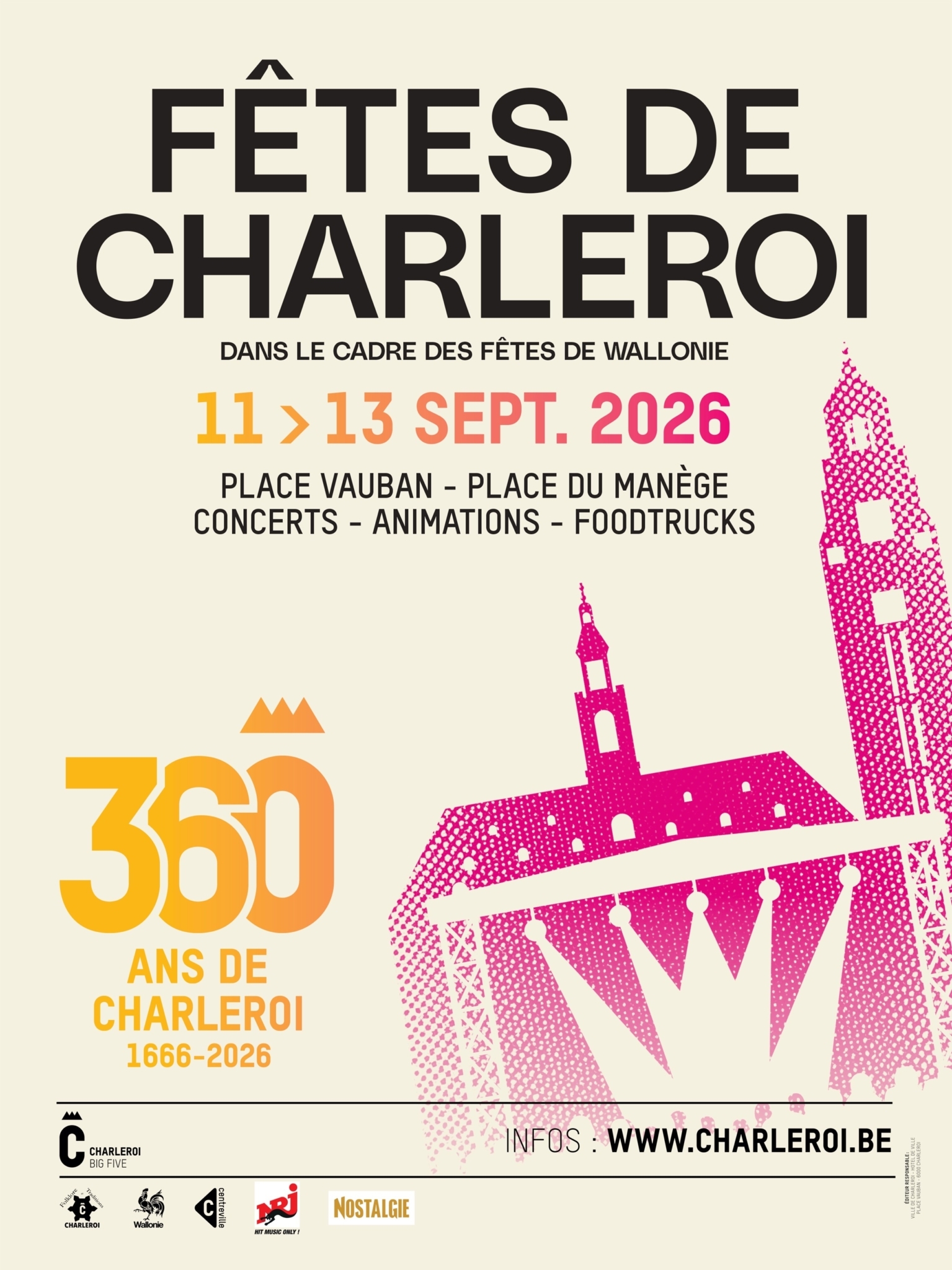
The festivities culminate in the Fêtes de Charleroi from 11 to 13 September, a rebranded version of the traditional Fêtes de Wallonie. The Ville de Charleroi says the programme will bring a Nostalgie concert, a folklore parade featuring Charleroi Métropole and an NRJ concert on Place Vauban expected to draw more than 10,000 people.
“Our ambition is to make Charleroi’s heart beat by offering popular and free events that bring together young people, students, families and all citizens,” Mayor Thomas Dermine said. “They must help strengthen the pride of the Carolos and make Charleroi shine well beyond its borders.”
Why It Matters
The 360th anniversary lands amid a sustained push to recast Charleroi as a transformed post-industrial city - branded “Charleroi Métropole” - that draws visitors through heritage, street art and urban culture. Mayor Dermine’s own contribution to the academic session is billed not as a history but as a “reflection on the future of Charleroi Métropole.”
Brabant suggested the pull of the past is broadly felt. The documentary’s screenings sold out in Liège, Mouscron and Charleroi, a result he read as meaningful. “There are a lot of people who are, in a way, hungry to rediscover their collective history,” he said.
What to Watch Next
Beyond the September weekend, further events between September and December will carry the “360 ans de Charleroi” label, including the commemoration of the Liberation of Charleroi, a sports festival, archive visits, a Halloween event, a photo marathon and the traditional Christmas concert. The coming months will show whether a city shaped by industry and known for its grit can convert a moment of reflection into a durable sense of renewal.