No Single ‘Data Center Effect’ on U.S. Housing, NAR Finds
As the construction of large data centers continues to accelerate across the United States, the National Association of Realtors has published a first-of-its-kind study concluding that the impact of these sprawling computing facilities on the housing market varies so dramatically from place to place that no single rule of thumb applies.
The NAR report, released September 8 and covered extensively by NPR on September 11 and 12, combines county-level data analysis with a survey of more than 2,300 realtors. Its central finding is captured in a phrase NAR officials now use as a mantra: there is no single “data center effect.”
“We talk about data centers as though they are one category, and they are not,” said Nadia Evangelou, the association’s principal economist and director of real estate studies, in an interview with NPR.
A Highly Concentrated Industry
Data centers power everything from AI systems to basic web searches, and the AI boom has supercharged demand for the massive warehouses that house them. But the report found that although the facilities are found across much of the country, they are heavily concentrated in a handful of markets.
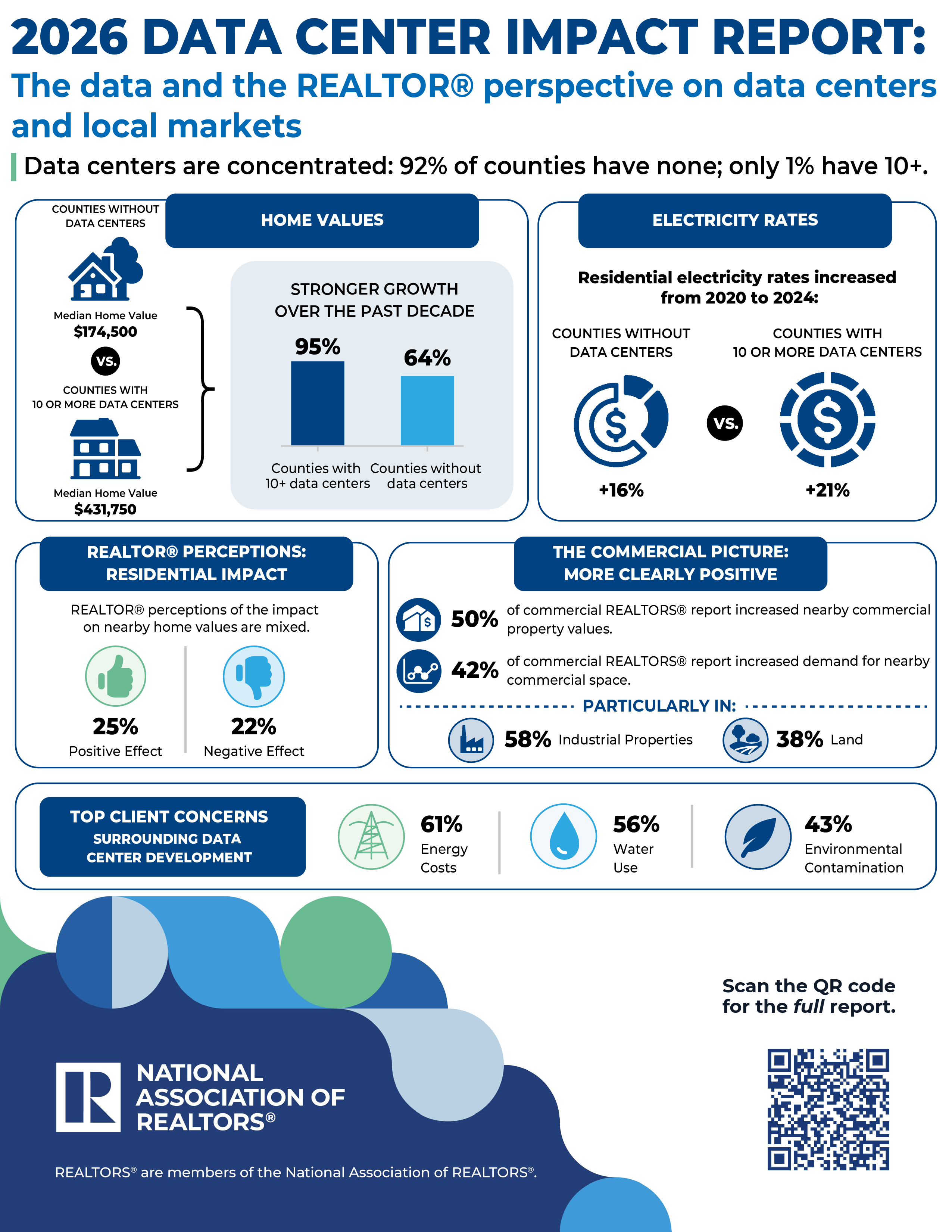
According to the NAR study, 92% of U.S. counties have no mapped data centers, and only 1% have 10 or more. Northern Virginia leads the nation: Loudoun and Prince William counties together account for about 19% of all mapped data centers nationwide. Other major clusters include Silicon Valley (5%), central Ohio including Franklin and Licking counties (5%), the Phoenix area (4%) and central Washington state (4%).
A separate analysis by HousingWire identified 1,474 data centers across 251 U.S. counties. Loudoun County alone leads the nation with 213 facilities, followed by Santa Clara County, California (75) and Maricopa County, Arizona, and Prince William County, Virginia (63 each).
Correlation Is Not Causation
At first glance, the data seems to suggest data centers are a boon for local homeowners. The median home value in counties with 10 or more data centers is $431,750, compared with $174,500 in counties with none. Home values in high-concentration counties grew 95% over the past decade, versus 64% elsewhere. Incomes are higher (about $89,000 versus $64,000), residents are more likely to hold college degrees (41% versus 22%), and employment grew roughly 16% from 2014 to 2024, compared with 2% in counties without data centers.
But the report cautions strongly against reading those numbers as cause and effect. Counties with high data center concentration were already affluent, highly educated technology hubs long before the recent construction surge, meaning the stronger home prices and job growth are not necessarily driven by the facilities themselves.
“We do not see evidence of weaker housing markets in counties with a large data center presence,” said NAR Chief Economist Lawrence Yun. “But these are county-level numbers, and they can’t tell us what happens to an individual home next to a facility. That’s why local knowledge and credible data matter so much right now.”
Perceptions Are Mixed, Concerns Are Real
When NAR surveyed its members, the picture grew murkier still. Thirty-eight percent of respondents reported a data center already in place or in development in their market. Of those, 25% saw a positive effect on nearby home values, while 22% saw a negative one, roughly a third were unsure, and the rest reported no change. On demand for nearby residential properties, perceptions tilted slightly more negative.
Commercial real estate told a more clearly positive story: half of respondents reported increased nearby commercial property values, and 42% reported increased demand for commercial space. Industrial properties drew the most interest near data centers, cited by 58% of respondents, followed by land at 38%.
Clients’ top worries were energy costs (61%) and water use (56%), followed by environmental contamination (43%) and impact to the immediate landscape (32%). Those concerns are backed by data: residential electricity rates rose 21.4% from 2020 to 2024 in counties with 10 or more data centers, compared with 15.7% in counties without. The increase, however, did not consistently rise with the number of facilities.
The Boomtown Problem
For a snapshot of how disruptive the industry can be, the report and NPR point to Abilene, Texas, where construction of the Stargate Project, a $500-billion, roughly 4-million-square-foot facility operated by Oracle for OpenAI, has drawn more than 6,000 workers to a midsized city. The result has been a severe supply crunch.
“Buyers that are currently in the market are well aware of it because they’re having trouble finding housing,” local realtor Steve Stovall told NPR. “The rentals are full. The hotels are full. Many of the rentals have become Airbnbs or short-term rentals and the prices are all just going up.” The median home price in Abilene is now about $342,000, up from roughly $250,000 six years ago.
The strain predates the data center and has been compounded by it. As KTXS reported, Gene Reed, CEO of the Abilene Housing Authority, said the city was already short roughly 5,600 housing units when construction began, and the influx of workers has “magnified that gap,” leaving many low-income families struggling with rising costs. Two more large data centers have already been approved for construction on the outskirts of town, suggesting the pressure will intensify.
Why It Matters
The NAR study arrives at a moment when data centers have become a flashpoint in American politics. Heading into the 2026 midterms, conservatives have raised concerns about property rights, electricity prices and local land-use control, while environmental groups and Democrats have focused on water consumption, pollution and strain on the power grid. Texas Gov. Greg Abbott has paused approvals for new large-scale data center loads connecting to the Texas grid, and protests against AI data center expansion have broken out nationwide.
Against that backdrop, the report’s most practical message may be aimed at realtors themselves. Evangelou advised agents to focus on the specific property and development rather than national or even county-level trends.
“Our research does not support saying that a data center will automatically lower or raise nearby home values,” she said. “Real estate agents should look at the local market and provide clients with credible information about the specific development. Even half a mile away can make a difference.”
What’s Next
NAR does not currently hold an official policy position on data centers, casting the report as an effort to understand a fast-moving issue rather than to advocate. The association said it intends to publish a follow-up report as soon as six months from now.
“Specifically, we want to track where the next data centers will be,” Evangelou said. “I would suspect areas that already have data centers will attract even more, since the infrastructure is already there.”
For now, the clearest takeaway is that the debate over data centers and housing will be settled block by block, not with a single national verdict. As Yun put it, “The number of data centers alone does not tell us what will happen to home values, jobs or utility costs.”