AfD Tops German Poll as CDU/CSU Hits Record Low
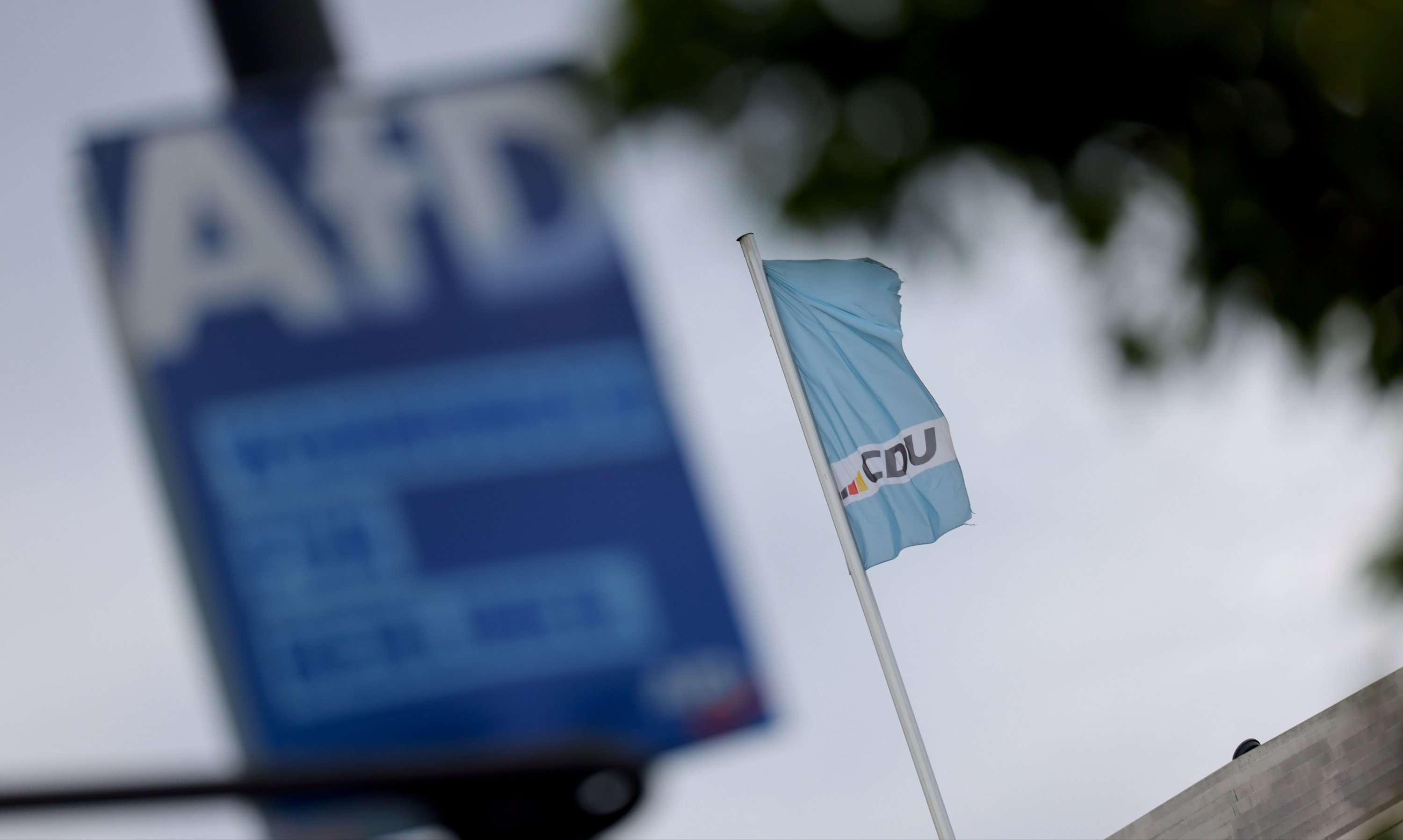
A new YouGov poll has confirmed the far-right Alternative for Germany (AfD) as the country’s strongest political force, with the strongest momentum of any party, while support for Chancellor Friedrich Merz’s governing CDU/CSU union bloc has slumped to a record low of 18 percent. The survey, conducted on YouGov’s own initiative and published on 15 September, comes just over a week after the AfD’s landslide victory in the Saxony-Anhalt state election and deepens a political crisis that has engulfed Merz’s government.
The Numbers
According to the Daily Sabah, which reported the findings via the dpa news agency, the poll was conducted between 11 and 14 September among 1,787 eligible voters in an online survey. The results place the AfD at 29 percent, up one point, while the CDU/CSU fell two points to 18 percent — the worst result for the bloc in this YouGov series.
The Greens rose one point to 16 percent, the Social Democrats (SPD) gained one point to 13 percent, and The Left (Die Linke) fell two points to 10 percent. The Free Democrats (FDP) held steady at 5 percent, the Sahra Wagenknecht Alliance (BSW) rose a point to 4 percent, and other parties collectively stood at 5 percent, according to the dawum.de aggregator, which put the margin of error at roughly plus or minus 1.7 percentage points.
The theoretical seat distribution underscores the scale of the shift: in a 630-seat Bundestag, the AfD would take 201 seats, the CDU/CSU 124, the Greens 111, the SPD 90, and The Left 69. Crucially, the current CDU/CSU-SPD coalition — which together commands only 31 percent of the vote — would no longer hold a parliamentary majority.
A Historic Swing
The dawum.de data places the poll in stark historical perspective against the February 2025 federal election. Since then, the AfD has surged from 20.8 percent to 29 percent — a gain of 8.2 points — while the CDU/CSU has collapsed from 28.5 percent to 18 percent, a loss of 10.5 points. The Greens also advanced, from 11.6 percent to 16 percent, while the SPD slipped from 16.4 percent to 13 percent.
The poll’s publication followed the AfD’s extraordinary showing in Saxony-Anhalt on 6 September, where the party took 43.8 percent of the vote and won 38 of 41 constituencies. The CDU, by contrast, crashed to 17.2 percent and failed to win a single constituency. As DW reported, Merz described that result as the worst election defeat the CDU had suffered in years — or even decades — and said the party had been “shaken to its very foundations.”
The Merz Crisis
The poll arrives at a precarious moment for the chancellor. The 2026 Friedrich Merz political crisis began in July with the surrogacy scandal surrounding CDU/CSU parliamentary leader Jens Spahn, who resigned on 18 July, followed by a chaotic cabinet reshuffle on 29 July. A second phase opened after the Saxony-Anhalt defeat.
On 9 September, the Bundestag witnessed a bitter clash in which Merz accused the AfD of advancing Russian interests and branded its “remigration” policy a synonym for ethnic cleansing. The AfD’s co-leader, Alice Weidel, responded that Merz’s time was up. Merz reportedly postponed a call with US President Donald Trump, who had praised the AfD’s victory.
By 15 September, DW reported that Merz had cancelled a planned trip to the United Nations General Assembly in New York, as senior figures — including Foreign Minister Johann Wadephul and Bavarian premier Markus Soder — publicly closed ranks behind him. Soder warned that “it would be a real problem if Germany were to falter.” A separate INSA poll found that only 14 percent of voters regarded Merz as the right chancellor, while 78 percent did not.
The Eroding Firewall
Perhaps the most consequential finding concerns Germany’s longstanding “firewall” — the policy under which mainstream parties refuse to cooperate with the AfD. According to the Daily Sabah report, 51 percent of respondents now believe other parties should not categorically rule out cooperation with the AfD, up from 44 percent in August. Only 40 percent favor maintaining a categorical exclusion, down from 46 percent the previous month.
That shift has drawn alarm from civil society. Charlotte Knobloch, a 93-year-old Holocaust survivor who has received death threats after calling for the AfD to be banned, told DW that the Saxony-Anhalt result was a sign that democracy was breaking down, adding: “It scares me.” Foreign Minister Wadephul said that “Jews must never again be forced to live in fear in Germany.”
Sahra Wagenknecht, founder of the BSW, declared the cordon sanitaire a failure.
Analysis: A Leadership Test
Analysts caution that a single poll is not an election, but the trajectory is difficult to dismiss. Three scenarios are now openly discussed in Berlin: a chancellor swap (Kanzlertausch), the collapse of the coalition in favor of a Union minority government, or a confidence vote under Article 68 that could trigger a snap election. The next regular Bundestag election is not due until 2029.
The pressure is compounded by economic discontent. Merz promised a Wirtschaftswende — an economic turnaround — but a July 2026 reform package has proven unpopular with parts of the electorate and even within the SPD. Fuel prices remain near record highs, with Super E10 at roughly €2.286 per liter and diesel at €2.412.
Oliver Lembcke, a political analyst quoted by DW, framed the coming weeks as decisive. Merz, he said, is “trying to rally the influential state premiers behind him in particular. If they do not demonstratively express their confidence in him after the elections, his situation will become very difficult.”
What to Watch
The immediate test comes on 20 September, with state elections in Berlin and Mecklenburg-Vorpommern. A strong AfD performance — particularly in Berlin, a traditionally left-leaning city-state — would intensify pressure on Merz and likely accelerate debate over the firewall.
For now, the AfD’s rise and the CDU/CSU’s record-low standing reflect a deeper realignment of German politics, one in which the old certainties of the post-war party system are increasingly in question. Whether Merz can arrest the slide, or whether his party will look elsewhere for leadership, may be decided within weeks.