Utah Leads Nation in Home Insurance Nonrenewals
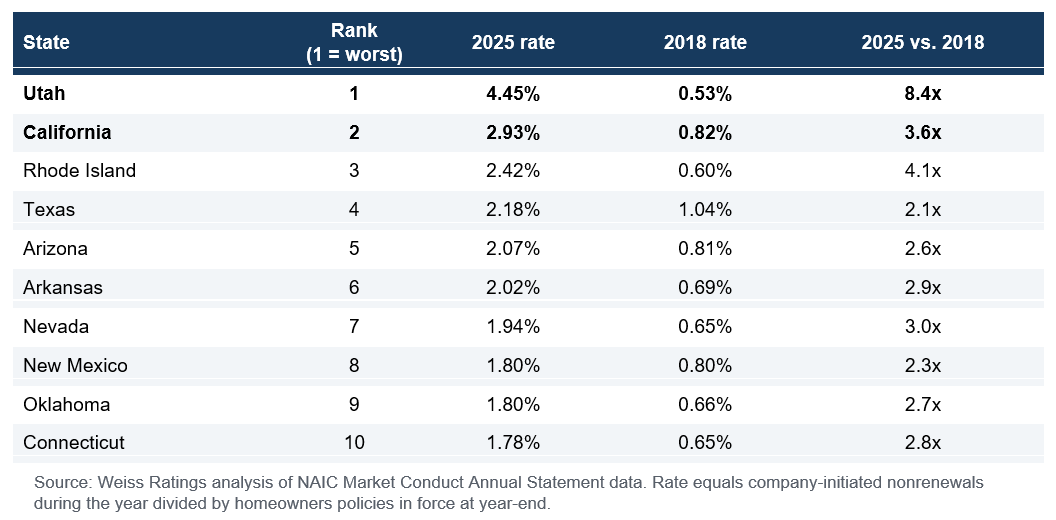
Roughly 4.5% of Utah homeowners’ insurance policies — nearly 1 in 20 — were not renewed by insurers in 2025, the highest nonrenewal rate in the country, according to new data from the National Association of Insurance Commissioners (NAIC). The figure, first reported by KUER 90.1, marks Utah as a major epicenter of the national homeowners insurance crisis and underscores how climate-driven risk is reshaping housing markets across the American West.
Utah’s 2025 rate was 1.5 percentage points higher than California, the number-two state, and well more than double Utah’s own 1.73% nonrenewal rate in 2024. The data comes from NAIC, which represents state insurance regulators.
A Warning Sign From the Mountain West
Utah is not alone. According to the NAIC data, several Western states recorded homeowners insurance nonrenewal rates above 1% — the threshold that former California insurance commissioner Dave Jones says should prompt official concern. Arizona is just over 2%, while Nevada and New Mexico are close to that. Idaho and Colorado both sit around 1.4%.
Utah Republican state Rep. Matt MacPherson called the data “very troubling.”
“The jump in nonrenewals is raising a lot of eyebrows, and it should,” he told the Mountain West News Bureau. He said he is exploring potential legislative responses.
Why Insurers Are Pulling Back
The driving force, experts say, is climate change-fueled disasters. Jones, now director of UC Berkeley’s Climate Risk Initiative, told KNPR that the record-high nonrenewal rate is “very bad news for homeowners in Utah.” He pointed to increasingly powerful storms and the damaging winds and hail they bring, alongside wildfire, as forces destabilizing insurance markets across the West.
Jones’s eight-year tenure as California’s insurance commissioner included the devastating 2018 Camp Fire, which killed dozens and largely destroyed the town of Paradise — an event he has cited as a turning point in how the industry assesses climate disaster risk.
Because insurance is required for mortgage holders, the consequences ripple well beyond individual policies. “The net result is very bad for mortgage availability, the ability of people to get a mortgage, the ability of people to maintain a mortgage, and then overall the home and real estate market,” Jones explained.
The Safety Net That Utah Lacks
Most states provide a last-resort option for homeowners who cannot find private coverage: state-backed “FAIR plans,” or Fair Access to Insurance Requirements pools. As Governing has reported, 34 states have created or are creating such plans to cover wildfire, windstorm and other hazards.
Utah does not have a FAIR plan. Nonrenewed homeowners there may instead be pushed onto surplus line policies, which are not required to follow many of the rules that state-licensed plans must observe. State officials in neighboring Idaho warn consumers that surplus lines can be more expensive, carry limited coverage and higher deductibles, and can drop customers midyear.
“A healthy insurance market does not rely on surplus lines for traditional products, like homeowners’ coverage,” according to a fact sheet from the Idaho Department of Insurance. Speaking at a state legislator-organized forum in January, a representative of that department described surplus line policies as “the Wild West of insurance.”
A Growing Uninsured Population
Some homeowners without mortgages choose to go without coverage altogether after a nonrenewal — a trend Jones said is on the rise. Analysis from Insurify shows that roughly 14% of American homes are uninsured, and data the company provided to the Mountain West News Bureau indicates that 11.3% of Utah homes have no coverage. New Mexico has the nation’s second-highest uninsured-home rate at 23%.
What States Can Do
Jones argues that the crisis demands action on two fronts. “In the long term, we’ve got to reduce fossil fuel emissions, and we need every state to take steps to do that,” he said. “In the short and intermediate term, more investment in mitigation can help.”
He also stressed that insurers must account for homeowners’ mitigation efforts in their risk models. Colorado offers a template: its HB25-1182, enacted in 2025, requires insurers that use wildfire or catastrophe risk models to disclose their scoring methods, notify policyholders of their wildfire risk scores, and provide discounts to homeowners who take steps to reduce loss risk. The law also gives homeowners the right to appeal their risk classification.
“Unless state legislatures intervene,” Jones warned, “it’s only going to get worse.”
What to Watch
Utah’s record nonrenewal rate puts the state at the leading edge of a problem spreading across the Mountain West. The coming months will test whether lawmakers in Utah and elsewhere heed MacPherson’s call for a legislative response — and whether states can build the mitigation incentives, transparency rules and last-resort protections that experts say are necessary to keep homeownership viable as climate risk mounts.
For now, the data offers a stark warning: in Utah, and increasingly across the region, the availability of home insurance — long treated as a given — can no longer be taken for granted.