APEC Adopts First AI-Focused Jobs Statement in Nanjing
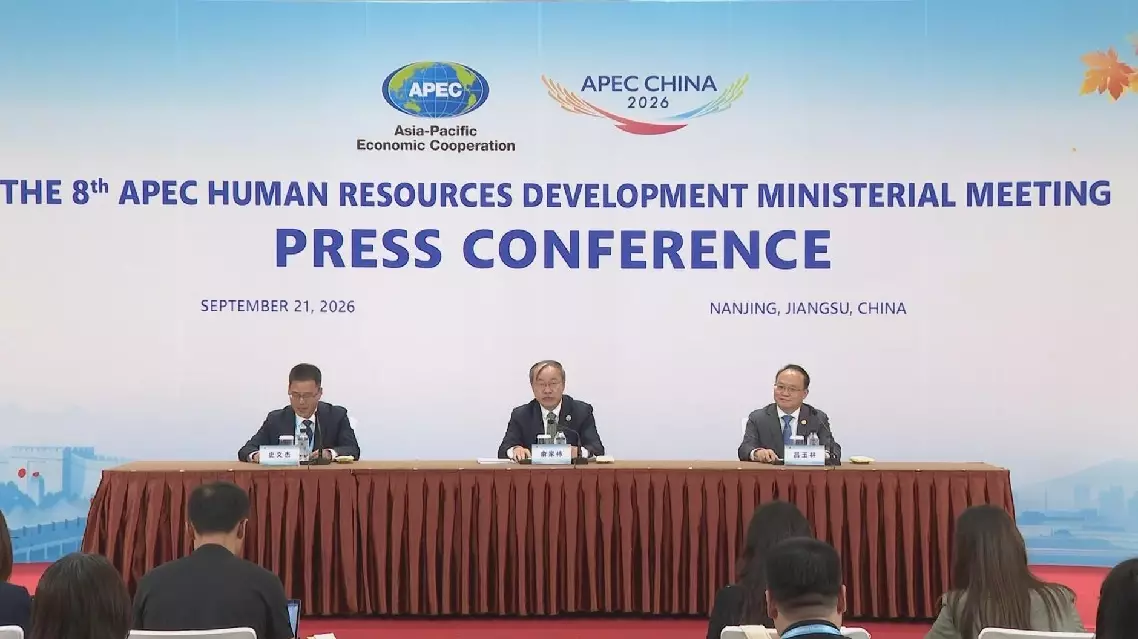
Asia-Pacific economic ministers adopted the first artificial intelligence-focused outcome document in the history of APEC human resources cooperation, wrapping up the 8th APEC Human Resources Development Ministerial Meeting in Nanjing, China, on 21 September 2026. The meeting produced the “Nanjing Statement” and an annexed set of commitments on harnessing AI’s potential for employment across the region, as participating economies confronted the twin pressures of rapid technological change and aging populations.
The ministerial, chaired by Wang Xiaoping, China’s Minister of Human Resources and Social Security, was held under the theme “Modernizing Human Resources Development for A Stronger Asia-Pacific Community.” According to APEC, ministers focused on jobs, skills and social protection “as artificial intelligence (AI) and aging populations reshape labor markets across the Asia-Pacific.”
What the Nanjing Statement Commits To
The Joint Statement of the 8th APEC Human Resources Development Ministerial Meeting, also known as the Nanjing Statement, organizes its commitments around three pillars: promoting high-quality, full and productive employment; investing in people and enhancing vocational skills training; and strengthening and optimizing social security systems. The document reaffirms the APEC Putrajaya Vision 2040 and draws on the APEC 2026 theme, “Building an Asia-Pacific Community to Prosper Together.”
The centerpiece is the Annex on Harnessing Artificial Intelligence’s Potential for Employment in the Asia-Pacific Region, described by APEC as the first outcome document of its kind in the forum’s human resources development cooperation. It sets out eight commitments, including harnessing AI’s potential for job creation, empowering workforce transformation, improving working conditions, promoting lifelong vocational training, expanding AI-enabled human resource services, and protecting the rights of workers.
Ministers agreed that AI should serve people and be “secure, reliable, trusted, and resilient,” and called for its “effective and responsible” use in occupations facing labor shortages and in high-risk environments.
”Investing in People” as a Shared Action
A recurring theme was the framing of skills investment as a high-return strategic priority. Reporting for Kyodo News, the ministerial’s press outreach said the statement “put forward six policy recommendations on employment and called on APEC economies to strengthen lifelong vocational skills training systems, making ‘investing in people’ a shared action across the Asia-Pacific region.”
Speaking at the meeting, State Councilor of China Shen Yiqin warned that technological transformation is “profoundly reshaping modes of production and employment patterns,” according to the Xinhua News Agency. “We should strengthen information sharing and trend analysis, jointly reinforce employment monitoring, continuously improve policies that adapt to AI development and promote entrepreneurship,” she said.
China’s Vice Minister of Human Resources and Social Security, Yu Jiadong, said the meeting agreed that “‘investing in people’ is a strategic investment with high returns,” and that vocational skills training is “an important means of such investment,” as Bastille Post reported.
The Forces Behind the Focus
The agenda was driven by two converging trends. People aged 65 and older make up 15 percent of APEC’s population, and the region’s population is set to shrink by 2035. At the same time, the World Economic Forum projects that 92 million jobs globally will be displaced and 170 million created by 2030.
Addressing the ministers, International Labour Organization Director-General Gilbert Houngbo urged economies to “create more decent jobs, particularly for young people and women, build the skills workers need for digital and green transitions and strengthen social protection systems as a foundation for resilient economies.”
According to the Xinhua Chinese-language report, Chinese officials outlined six areas through which AI can empower human resources development — from using AI to replace dangerous positions and reduce workloads, to applying it in job matching, career guidance and social security administration. “We encourage the use of AI to better identify training needs and employment preferences of all workers including people with disabilities,” the Annex states.
What to Watch Next
The ministerial is one of several sectoral gatherings under the 2026 APEC “China Year.” APEC confirmed that China is hosting the forum for the third time, after Shanghai in 2001 and Beijing in 2014, with the theme “Building an Asia-Pacific Community to Prosper Together.”
The two outcome documents now serve as a template for how regional economies intend to manage AI’s labor-market disruption. The test will come in implementation: whether the commitments on reskilling, social protection and “human-centric” AI translate into domestic policy. The 33rd APEC Economic Leaders’ Meeting in Shenzhen on 18–19 November 2026, preceded by the CEO Summit, will be the next major checkpoint — and a venue where leaders may be pressed to show that the Nanjing commitments are more than aspirational.