Belgian King and Queen in Historic Central Asia State Visit
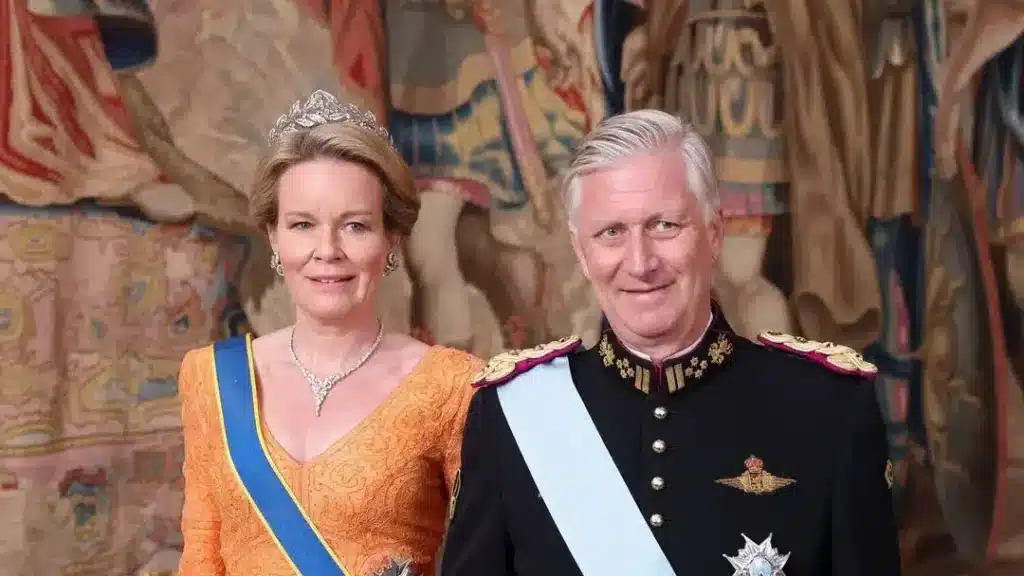
King Philippe and Queen Mathilde of Belgium were officially received by President Kassym-Jomart Tokayev at the presidential palace in Astana on Monday morning, opening the first-ever Belgian state visit to Kazakhstan and, more broadly, the first by a reigning Belgian monarch to Central Asia. The four-day visit, running 11-14 October, is aimed at deepening diplomatic, economic, technological and scientific ties between Belgium and the resource-rich Central Asian nation, according to VRT NWS.
The welcome ceremony began at 11:00 local time (08:00 Belgian time), with national anthems and helicopters flying the Belgian and Kazakh flags over the palace. The royal couple was joined by a Belgian political delegation including Federal Minister Jean-Luc Crucke, Brussels Minister-President Boris Dilliès, Flemish Minister Cieltje Van Achter and Walloon Minister Anne-Catherine Dalcq. Kazakhstan was represented by Deputy Prime Minister Zhaslan Madiyev, Deputy Chair of Parliament Dinara Zakieva and Ambassador to Belgium Roman Vassilenko.
A Delegation Built for Business and Science
The state visit is a heavyweight affair. According to the Belgian FPS Foreign Affairs, the royal couple is accompanied by a 110-person delegation that includes 25 CEOs and 10 university rectors. A 2026-2029 Roadmap between the two foreign ministries is set to be signed, alongside a range of academic and economic agreements, with a joint statement expected at the end of the visit.
The trip also carries personal significance for King Philippe. According to Kursiv.media, he previously travelled to Kazakhstan three times as Crown Prince — in 2002 and 2009 for the launches of Belgian astronaut Frank De Winne’s missions from the Baikonur cosmodrome, and in 2010 to lead an economic mission. This is his first visit to the country, and to Central Asia, as Head of State.
Trade Tripled in Under a Decade
The economic rationale for the visit is clear. Bilateral trade between Belgium and Kazakhstan has more than tripled in less than a decade, rising from €220 million in 2016 to €765 million in 2025, the Belgian foreign ministry said. Belgium is now Kazakhstan’s sixth-largest source of foreign direct investment, with more than 100 Belgian companies active in the country across chemicals, biopharma, energy, logistics and agri-food.
“More than 110 companies with Belgian capital are operating successfully in Kazakhstan, reflecting our shared commitment to strengthening mutually beneficial cooperation,” President Tokayev said, according to the BeNeLux Chamber of Commerce in Kazakhstan, which estimates Belgian investment in Kazakhstan at roughly $15 billion over 20 years.
The fourth edition of the Kazakh-Belgian Business Council, launched in 2023, is being held during the visit and will focus on logistics and agriculture. “It will provide an opportunity to highlight success stories and explore new forms of cooperation in logistics and agriculture, two areas in which Belgium and Kazakhstan already enjoy close collaboration,” the Belgian foreign ministry said.
Critical Minerals, Transport and AI
Beyond trade, the two sides are positioning the visit around strategic sectors. Kazakhstan holds 21 of the 34 raw materials the European Union classifies as critical, while Belgium brings expertise in processing and recycling. Europe is actively seeking to diversify critical raw-material supplies, a goal embedded in the 2022 EU-Kazakhstan partnership on sustainable raw materials, batteries and renewable hydrogen.
The Astana Times reports that cooperation is also deepening in transport logistics, with the Trans-Caspian International Transport Route — the so-called Middle Corridor — seen as a priority. Alisher Abdreshev of the Kazakhstan Institute for Strategic Studies told the outlet that Kazakh ports on the Caspian could benefit from Belgian logistics expertise.
“The Port of Antwerp-Bruges, one of Europe’s largest logistics hubs, could play a key role in these efforts,” Abdreshev said. “Its expertise in digitalizing port operations, multimodal transport and cargo management could help modernize Kazakhstan’s ports of Aktau and Kuryk.”
Technology is another pillar. Kazakhstan has declared 2026 its “Year of Artificial Intelligence” and created the Alem.AI centre in Astana, which the royal couple is scheduled to visit ahead of a dialogue between Kazakh and Belgian authorities and university rectors. Health cooperation is also on the agenda, including a visit to the National Centre for Children’s Rehabilitation and existing nuclear medicine partnerships with the Institute of Nuclear Physics in Almaty.
Why It Matters
Analysts frame the visit as part of a broader European push into Central Asia. “Amid continued tensions between Russia and the West, the restructuring of global supply chains and growing competition for strategic resources, Europe is showing increasing interest in Central Asia,” Abdreshev said. “What is particularly important is that Kazakhstan is increasingly approaching its relations with Europe through the lens of its own economic interests.”
The visit marks a milestone near the 35th anniversary of Belgian-Kazakh diplomatic relations, established in 1992, and the 20th anniversary of Belgium’s embassy in Astana.
The programme continues through Wednesday, moving from Astana to Almaty and including cultural events such as a James Ensor exhibition and a contemporary dance performance. The signing of the 2026-2029 Roadmap and the various commercial agreements will be the benchmarks by which the trip’s concrete results are judged — the clearest signal of whether this historic first visit translates into long-term economic partnership.