Poppy Decries Vandalism of Its Cars During Brussels Riots
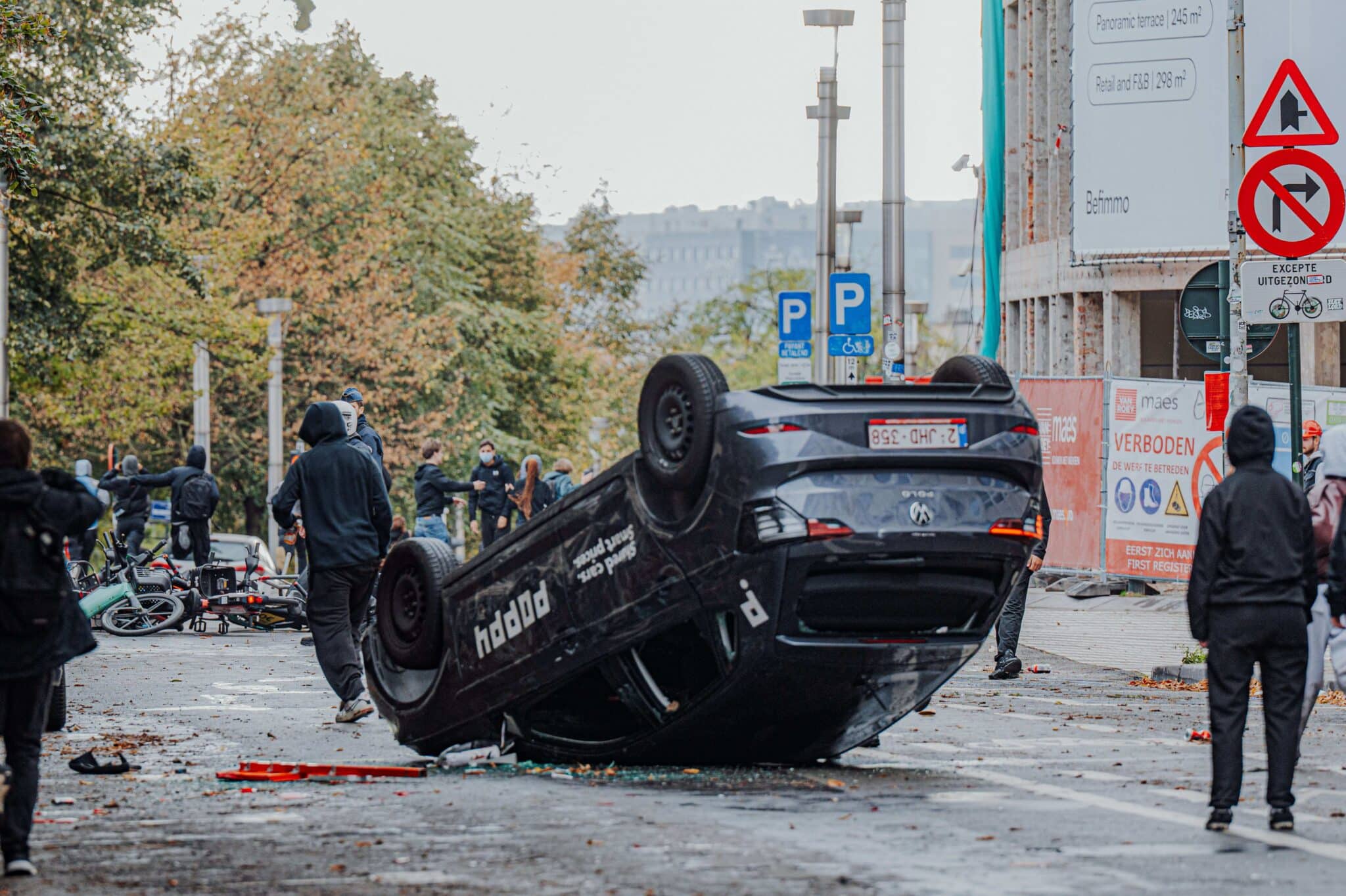
Car-sharing company Poppy says nine of its vehicles were vandalized in Brussels in a single week — two of them set on fire — as waves of urban unrest swept the Belgian capital. The firm, a subsidiary of the automotive group D’Ieteren, says the attacks are both economically painful and unjust, because it considers itself “a completely inappropriate target.”
The damage is the latest blow to a shared-mobility sector whose cars must sit openly on public streets to function, leaving them exposed to the very disorder that is convulsing Belgian cities.
Context: A Capital on Edge
The unrest follows a national union demonstration on 9 October, when between 30,000 and 50,000 people marched against the federal government’s budget measures under the slogan “Keep your hands out of our pockets!” The march from Brussels-Central to Brussels-Midi was disrupted by masked rioters, according to La Libre Belgique, which reported that street furniture was destroyed, bicycles and bins burned, and a city bus ransacked. Police reported about 20 arrests and deployed water cannon and tear gas.
Further violence erupted around 17 October. It was during this second wave that another Poppy vehicle was found overturned in Brussels.
Best Day, Worst Day
For Poppy, the timing could scarcely have been harsher. According to the outlet 21news, the company recorded an all-time record number of trips on 9 October — boosted by the paralysis of the metro in Brussels and Antwerp — even as eight of its cars were damaged that same day, two of them incinerated.
“Friday was our best day. And our worst,” Grégory de Walque, Poppy’s commercial director, wrote on LinkedIn. He said the cost of the damage in a single afternoon exceeded the entire revenue of that record day.
The Insurance Gap
Central to Poppy’s complaint is its claim that the destroyed vehicles are not insured against this kind of loss. “We are not insured. Not for this,” de Walque said, arguing that each destroyed car is a direct, uninsured hit to the company.
The company’s argument lands in the middle of a broader national debate over who pays for riot damage. As RTBF reported, business premises damaged in riots are generally covered by the owner’s fire insurance — provided the causal link can be proven — but coverage for vehicles is more limited, with only a full omnium policy compensating for damage.
Poppy also rejects the idea that a large company can simply absorb the loss. De Walque revealed that the firm has had only one profitable year since its creation. Each car taken off the road removes transport capacity and diverts funds that would otherwise go to fleet renewal, service improvements or price moderation.
A Public Good, Not a Symbol
De Walque pushed back against the notion that a shared car “belongs to no one.” A Poppy vehicle, he argued, is used hundreds of times a year and amounts to a collective good. He cited a Bruxelles Mobilité study finding that each Poppy car replaces an average of 11.5 private vehicles among its regular users.
He likened the situation to a jeweler discovering his shop ransacked — with one key difference: Poppy’s “shop” is roughly 2,500 cars parked on public streets, exposed day and night.
A Structural Vulnerability
The episode lays bare a paradox at the heart of shared mobility: unlike a shop that locks its doors at night, a free-floating fleet must remain publicly accessible around the clock to be useful — and is therefore permanently exposed to vandalism. The disruption that drives demand for alternative transport is the same disruption that puts the vehicles at risk.
De Walque said his teams would get the cars back into circulation “strike or no strike,” but he issued a request to Brussels authorities: help the company protect the vehicles it makes available to the public.
“Brussels needs shared cars more than ever,” he said.
What’s Next
It remains to be seen whether Poppy can secure insurance or state compensation for riot-related losses, and whether Brussels will act on its call to better protect shared-mobility assets during unrest. The wider question — who bears the cost of civil unrest — is one that Belgian and French insurers and governments are increasingly being forced to answer.